The 5-Step ROI Formula: Measuring Your Sydney Office Cleaning Contract Against Performance KPIs
Most Sydney businesses sign an office cleaning contract, pay the monthly invoice, and assume something useful is happening. They check whether the bins were emptied and whether the bathroom looks clean. That is the extent of the performance review.
That approach does not measure whether the contract is working. It measures whether it happened.
There is a significant difference between the two. A cleaning contract that fails to deliver can still cost a Sydney office 15% or more of its monthly revenue through sick days, reduced productivity, and the gradual degradation of assets.
Key Takeaways
-
Measure contract success by performance standards, not just completed tasks.
-
Record sick days, staff satisfaction, and audit scores before a contract begins.
-
Define clear success metrics, audit schedules, and consequences for poor performance.
-
Proper hygiene reduces sick days and boosts cognitive focus, creating direct financial returns.
-
Deep cleaning extends the lifespan of expensive carpets, flooring, and HVAC systems.
-
Use a 30-minute pass/fail checklist every quarter to monitor ongoing provider performance.
Why Most Sydney CBD Cleaning Contracts Fail to Deliver ROI
Before applying the five-step formula, it helps to understand why the average cleaning contract underperforms. The problem is structural, not accidental.
Most cleaning contracts are written around inputs, not outcomes. The contract specifies how many times per week cleaning will occur, which areas will be covered, and what tasks are included. It does not specify which standard those areas will meet, how that standard will be measured, or what happens if it is not met.
The Cost of Getting This Wrong
World Commerce and Contracting found that poor contract management costs organisations an average of 9% of total contract value annually.
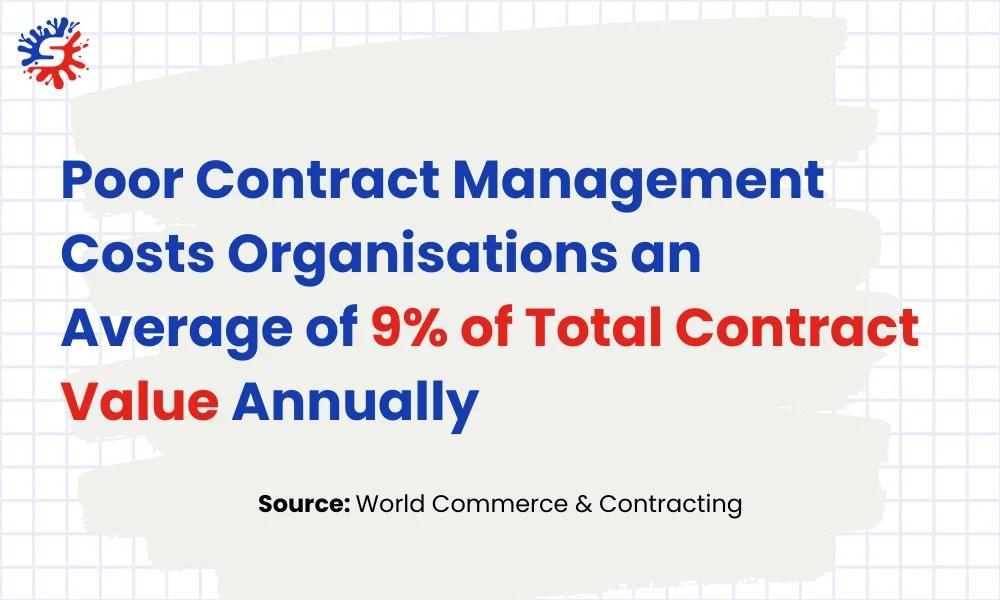
For a Sydney CBD office spending $3,000 per month on cleaning, that is around $3,200 per year in value that disappears through untracked underperformance. And that figure only captures direct contract value loss. It excludes the downstream costs of sick days, productivity reduction, and asset degradation that a properly measured contract would prevent.
The 5-Step ROI Formula: How it Works
The formula works by identifying all measurable values your cleaning contract is supposed to deliver, establishing a baseline before the contract starts, tracking performance against that baseline over time, and comparing the total value delivered to the contract cost.
It is not complicated maths. It is a disciplined measurement applied to areas that most businesses have never quantified before.
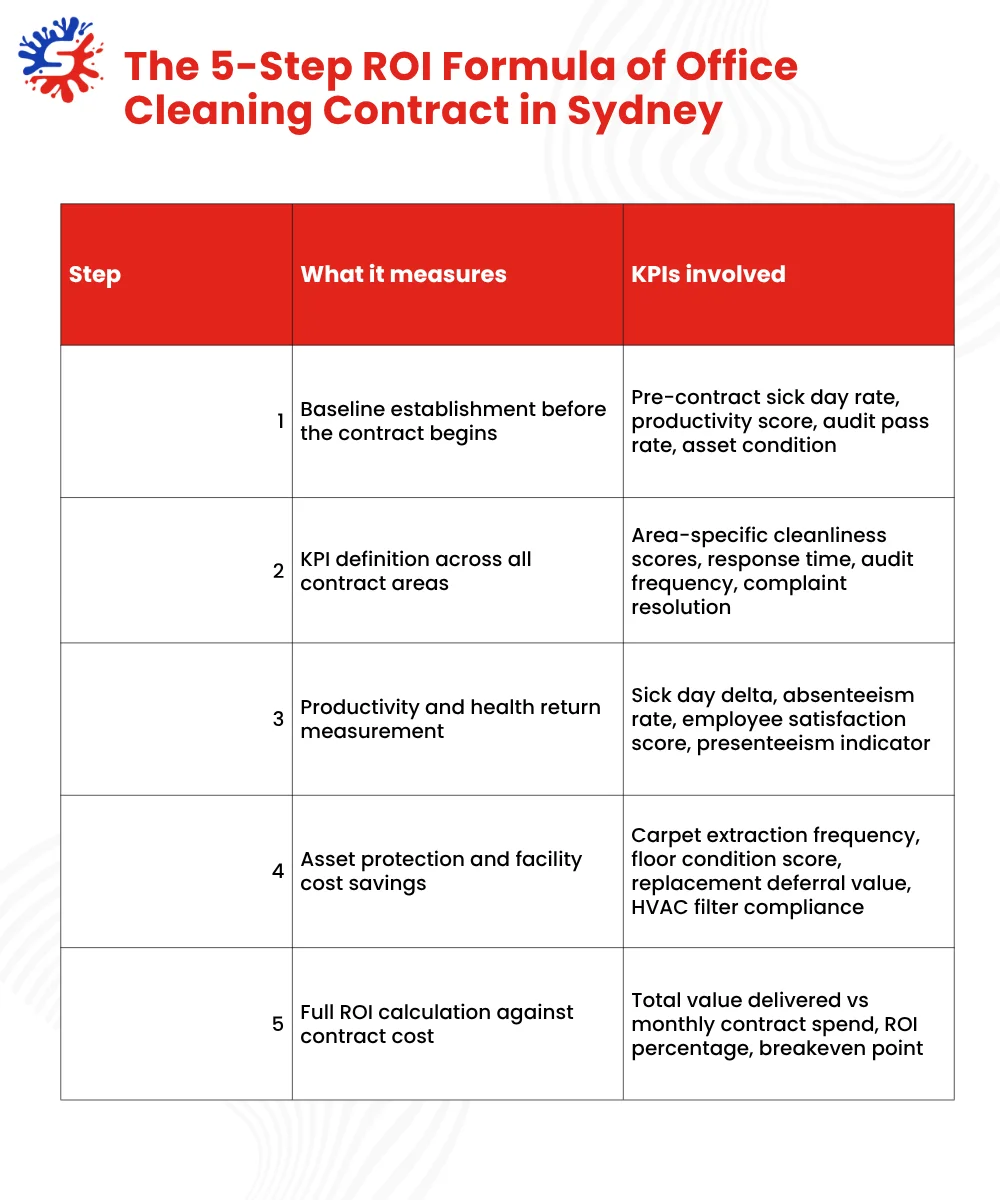
Step 1: Establish Your Baseline Before Measuring Anything
ROI measurement without a baseline is just a guess. Before any cleaning contract starts or is renewed, you need a snapshot of the current state of the three areas the contract is supposed to affect.
Most Sydney businesses skip this step entirely. They switch providers or renew a contract and have no way of knowing whether performance has improved, because they never recorded what performance looked like before.
The Three Baseline Metrics
Getting your baseline requires a single week of data collection across three areas. You do not need a consultant for this. You need a spreadsheet.
-
Sick day rate per employee. Count the total sick days taken by your team in the three months before the contract starts. Divide by the number of employees. This is your baseline absenteeism rate. For most Sydney offices, this will fall between 10 days per employee per year before any hygiene improvement program is in place. Track it quarterly after the contract starts and compare.
-
Self-reported productivity score. Send a one-question anonymous survey to your team: 'On a scale of 1 to 10, how much does your physical work environment affect your ability to concentrate and work effectively?' Average the responses. This is your baseline environment satisfaction score. It takes five minutes and gives you the measurement point you need for Step 3.
-
Cleaning audit pass rate. Walk through your office with a simple checklist covering the ten highest-risk surfaces and areas: bathroom fixtures, kitchen appliances and drains, meeting room surfaces, carpet condition, entry area, bins, high-touch points, and air quality. Rate each area as pass or fail. Your percentage of passes is your baseline audit score. A typical Sydney CBD office that has not been on a KPI-based contract will score between 50% and 70% on this checklist on the first pass.
The Baseline Documents You Need
Before the contract starts, record the following in writing and keep it on file:
-
Average monthly sick days across all staff for the preceding three months
-
Your office environment satisfaction score from the anonymous survey
-
Your cleaning audit pass rate from the walk-through checklist
-
A photographic record of the ten highest-risk areas, dated and signed
-
The current condition of your carpet, floors, and any high-use furniture
If your current provider has been in place for more than six months and you do not have these records, run the baseline now. The data is still useful for measuring forward improvement. The detailed guidance in our commercial cleaning services audit framework covers the exact checklist format used for this baseline walk-through.
Step 2: Define and Attach KPIs to Every Area of the Contract
Once you have your baseline, the next step is converting your cleaning contract from a task list into a performance document. This means attaching a measurable KPI to every area covered by the contract.
KPIs should follow the SMART framework: Specific, Measurable, Achievable, Relevant, and Time-bound. A KPI that says 'bathrooms will be clean' is not a KPI. A KPI that states 'bathroom audit score will achieve 90% or above on the standard checklist at every fortnightly inspection' is valid.
The Five Core KPI Categories for a Sydney Office Cleaning Contract
|
KPI category |
What to measure |
Target benchmark |
How to measure it |
|
Area cleanliness score |
Pass rate across bathroom, kitchen, meeting rooms, floors, entry |
90% or above on fortnightly inspection |
Walk-through checklist, scored pass or fail per item |
|
Response time to complaints |
Time between complaint lodged and rectification confirmed |
Same business day or within 48 hours |
Complaint log with timestamps |
|
High-touch surface compliance |
Disinfection of keyboards, phones, door handles, tap handles |
100% of nominated surfaces completed per scheduled visit |
Photographic sign-off or ATP swab results |
|
Deep clean schedule adherence |
Completion of quarterly carpet extraction, monthly drain treatment, HVAC filter checks |
Zero missed scheduled deep cleans per quarter |
Service completion certificates with dates |
|
Staff satisfaction score |
Employee rating of office cleanliness and environment quality |
Above 7 out of 10 on quarterly survey |
Anonymous quarterly survey, single question |
How to Write KPIs Into Your Contract
The KPI language in your contract should be in the service level agreement section, not the task description section. Each KPI clause needs four elements:
-
What does success look like? For example: 'All bathroom surfaces will achieve a pass rating on the standard inspection checklist.'
-
How often will performance be measured? For example: 'Inspections will be conducted fortnightly, alternating between client-led and provider-led.'
-
What happens when the KPI is not met? For example: 'Any area scoring below 80% must be re-serviced within 24 business hours at no additional cost.'
-
What is the contractual outcome of repeated failure? For example: 'Three consecutive inspection failures in any single KPI category will trigger a contract review at the client's discretion, with the right to terminate with 14 days written notice.'
Step 3: Measure the Productivity and Health Return
Step 3 is where the ROI formula begins generating numbers to compare against your monthly contract spend. The productivity and health return is the most significant single source of ROI for cleaning in most Sydney CBD offices.
There are three components: the sick day delta, the productivity gain, and the employee satisfaction movement. Each one is measurable and each one translates directly to dollars.
Component A: The Sick Day Calculation
Workplaces with routine professional cleaning and sanitisation protocols saw a reduction in sick days. To calculate the sick day return for your office, use this formula:
Sick Day ROI Calculation
Monthly sick day saving ($) = (Baseline sick days per month) x (Reduction % from cleaning, use 20-30%) x (Average daily loaded labour cost per employee)
Component B: The Productivity Gain Calculation
Employees working in clean, well-maintained offices are more productive. Research from Princeton University found that dirty or cluttered environments reduce cognitive focus.
Productivity Gain ROI Calculation
Monthly productivity gain ($) = (Total monthly payroll) x (Conservative productivity improvement %, use 3-5%)
Component C: Employee Satisfaction and Retention
Turnover at a Sydney business costs between 30% and 150% of the departing employee's annual salary in recruitment, onboarding, and lost output. When improved cleanliness measurably lifts satisfaction scores, it directly contributes to retention, and the financial value of preventing a departure is significant.
Track your office environment satisfaction score quarterly using the single-question survey from Step 1. A three-point improvement in the score over six months is a meaningful outcome that you can reasonably attribute in part to the cleaning contract.
Step 4: Measure the Asset Protection and Facility Cost Savings
This is the least discussed component of cleaning ROI, but for Sydney offices with significant flooring, furniture, and equipment assets, it is often the most financially material.
Professional cleaning does not just maintain hygiene. It protects the physical assets of your tenancy and defers replacement costs that would otherwise arrive years earlier than necessary.
Carpet: The Biggest Asset Protection Opportunity in Most Offices
Office carpet in a commercial tenancy can represent tens of thousands of dollars in asset value. Routine vacuuming removes surface debris but does not address the abrasive grit particles that work their way into the carpet pile with every footfall.
Those particles act like sandpaper against the carpet fibre with each step, degrading the weave from within. Professional hot water extraction removes those particles and directly extends carpet lifespan.
Hard Floors, Surfaces, and Shared Equipment
Timber, vinyl, and tile surfaces in commercial offices face the same grit problem as carpet, with the added complication of moisture damage. Regular professional cleaning with appropriate products for each surface type directly extends the maintenance cycle between full refinishing events.
Office kitchen appliances, such as coffee machines, dishwashers, and refrigerators, all have manufacturer-recommended cleaning cycles. Appliances that are not cleaned to those cycles fail earlier and require replacement or repair. The cost of an unexpectedly failed commercial kitchen appliance in a Sydney CBD office can range from a few hundred to several thousand dollars.
HVAC Filters and Air System Performance
A clean HVAC system uses energy more efficiently than a contaminated one. Poorly maintained or clogged HVAC filters can increase energy consumption by up to 15%, creating a measurable electricity cost on top of the equipment replacement risk. This energy saving alone can partially offset the cost of the professional cleaning program.
Step 5: Calculate the Full ROI and Compare Against Contract Cost
Steps 1 through 4 have given you the inputs for the final calculation. Step 5 is where you bring those numbers together and produce a single ROI figure that tells you whether your cleaning contract is delivering value or costing you money in disguise.
The Full ROI Formula
ROI (%) = ((Sick day saving + Productivity gain + Asset protection saving) - Monthly contract cost) / Monthly contract cost x 100
A result above 0% means the contract is paying for itself. A result above 100% means it is returning more than double its cost.
The case for the measurable financial returns that professional cleaning delivers for Sydney businesses is fully developed in our detailed commercial cleaning returns analysis.
Sydney CBD Benchmarks for Interpreting Your Result
|
ROI result |
What it means |
What to do |
|
Below 0% |
Contract cost exceeds measurable value delivered |
Immediate contract review. Either renegotiate terms with KPI clauses or switch providers |
|
0 to 100% |
Contract is marginally positive but underperforming |
Review KPI compliance, introduce audit schedule, set improvement targets for next quarter |
|
100 to 300% |
Contract is delivering solid value |
Maintain current structure. Look to improve through higher-frequency deep cleans or expanded scope |
|
Above 300% |
Contract is performing at high level, consistent with well-structured KPI-based programs |
Document and lock in contract terms. Use this data in renewal negotiations |
What to Do When Your Contract Fails the Formula
Most Sydney businesses that run this formula for the first time will find their contract in the 0% to 100% range, or below zero. That is not a reflection of whether cleaning is worthwhile. It reflects whether the current contract has been structured to deliver results.
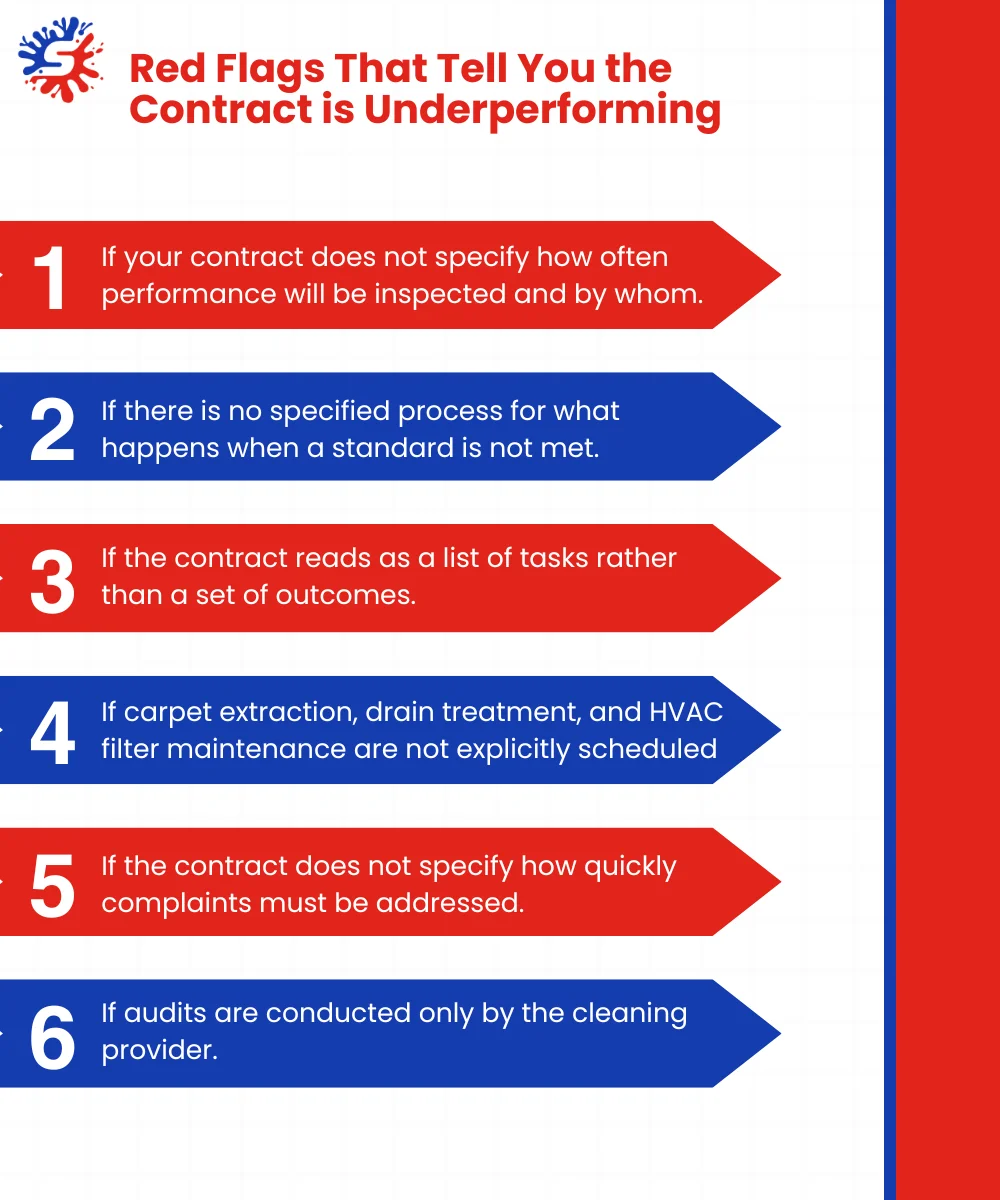
Red Flags That Tell You the Contract is Underperforming
These are the signs that your contract has structural problems before you even run the formula:
How to Renegotiate a Failing Contract
The most effective approach to renegotiating a failing cleaning contract is to present the baseline and KPI data you have collected and use it as the basis for a structured conversation with the provider.
Most providers, when presented with documented evidence of underperformance against agreed standards, will accept a contract amendment rather than risk losing the account. The amendment should add KPI language, an audit schedule, a rectification process, and a consequence clause.
If the provider is unwilling to accept performance accountability into the contract, that unwillingness is itself informative. A provider that cannot commit to measurable standards is telling you something about what they expect to deliver.
The step-by-step guide to what commercial cleaning best practices look like in practice gives you the specific standards to reference when writing KPI language into your contract amendment.
Running the Quarterly Performance Audit
The formula works when it is applied consistently over time. A single measurement tells you where you are. Quarterly measurements tell you whether you are improving, staying the same, or declining.
The quarterly audit is a 30-minute process that produces the data you need for Steps 3, 4, and 5 of the formula.
The Quarterly Audit Checklist
Run this audit at the same time each quarter, ideally at the beginning of a week, before the cleaning team's scheduled visit. This gives you a reading of the space's carryover condition after its most recent clean.
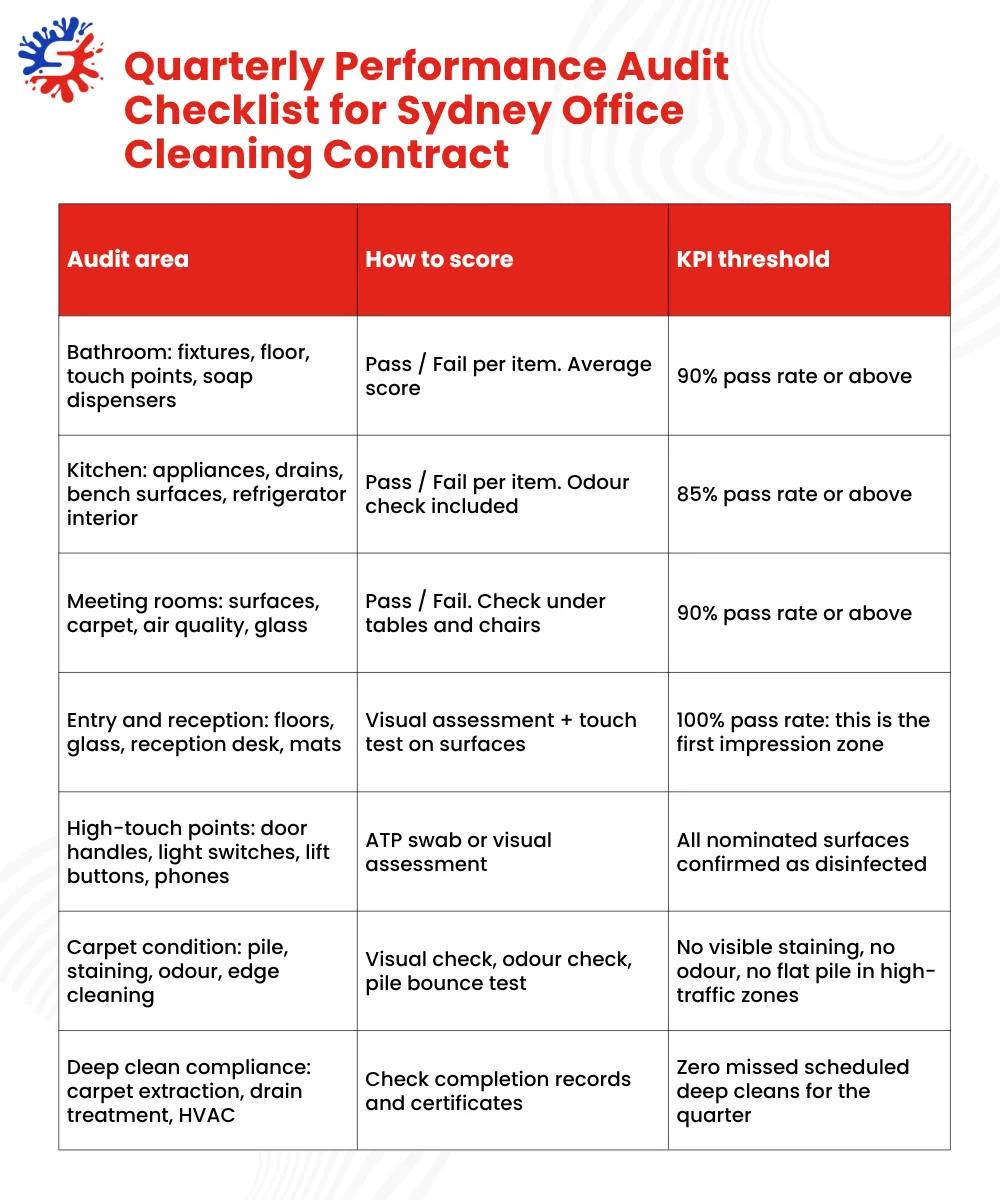
After each quarterly audit, update your ROI spreadsheet with the new figures. A provider whose audit scores are improving quarter-on-quarter is delivering increasing value. A provider whose scores are static or declining is telling you that the contract structure needs revision.
What a High-Performing Contract Actually Looks Like
Having the formula is only half the work. The other half is having a provider who is willing to be measured by it.
What a High-Performing Provider Does Differently
-
They propose KPIs before you ask for them. Providers confident in their performance welcome measurement, because measurement protects them from unfair complaints and demonstrates the value they deliver.
-
They supply completion records proactively. Every deep clean, every scheduled service, every high-touch disinfection cycle comes with a date-stamped record you can verify.
-
They conduct their own quality audits and share the results. Internal audit scores that are shared with the client, including when they reveal issues, demonstrate operational integrity.
-
They participate in joint inspections. A provider who will walk the space with you quarterly and review the audit checklist together is treating the relationship as a partnership, not a service transaction.
-
They flag issues before you do. When a deep clean reveals a drain problem, an HVAC filter that is worse than expected, or carpet that needs attention sooner than scheduled, they tell you and propose a solution.
Sydney CBD Cleaning Contract Rates and What to Expect
Professional commercial cleaning services in Sydney typically range from $45 to $65 per hour, depending on the building type, scope, and service inclusions, such as green-cleaning compliance and infection-control protocols.
For a medium Sydney office of 300 to 500 square metres with five-day service, daily maintenance cleaning, fortnightly deep cleans of bathrooms and kitchen, and quarterly carpet extraction, a well-structured contract will typically sit between $1,500 and $2,500 per month. Against the ROI formula in Step 5, that cost is recoverable through productivity and sick day savings alone in most offices.
The providers charging at the lower end of that range and declining to include KPI clauses are pricing their commodity. The providers at the higher end who accept performance accountability are pricing their accountability. In the long run, the accountable provider is almost always a better value because you can measure it.
Conclusion
Most Sydney CBD businesses pay for office cleaning and assume it is working. The five-step formula in this blog turns that assumption into a measurement.
If you want to understand whether your current contract is delivering against this framework, contact Spark Clean Australia for a performance review of your existing setup. We will assess your current provider's standards against the KPI framework in this guide, identify where value is being lost, and put a proposal together that includes full performance accountability and a quarterly audit schedule from day one.
You can also explore our professional office cleaning services for Sydney, which operate on outcome-based contracts with scheduled audits, completion records, and KPI reporting built in as standard.
Frequently Asked Questions
Find quick answers to booking, payments, pet-friendly policies, deep cleaning, and more. Our team is dedicated to making the process effortless and transparent. If you have additional questions, we're here to help ensure a seamless experience.
Get In Touch