10-Point Hygiene Blueprint for Sydney Pub Managers
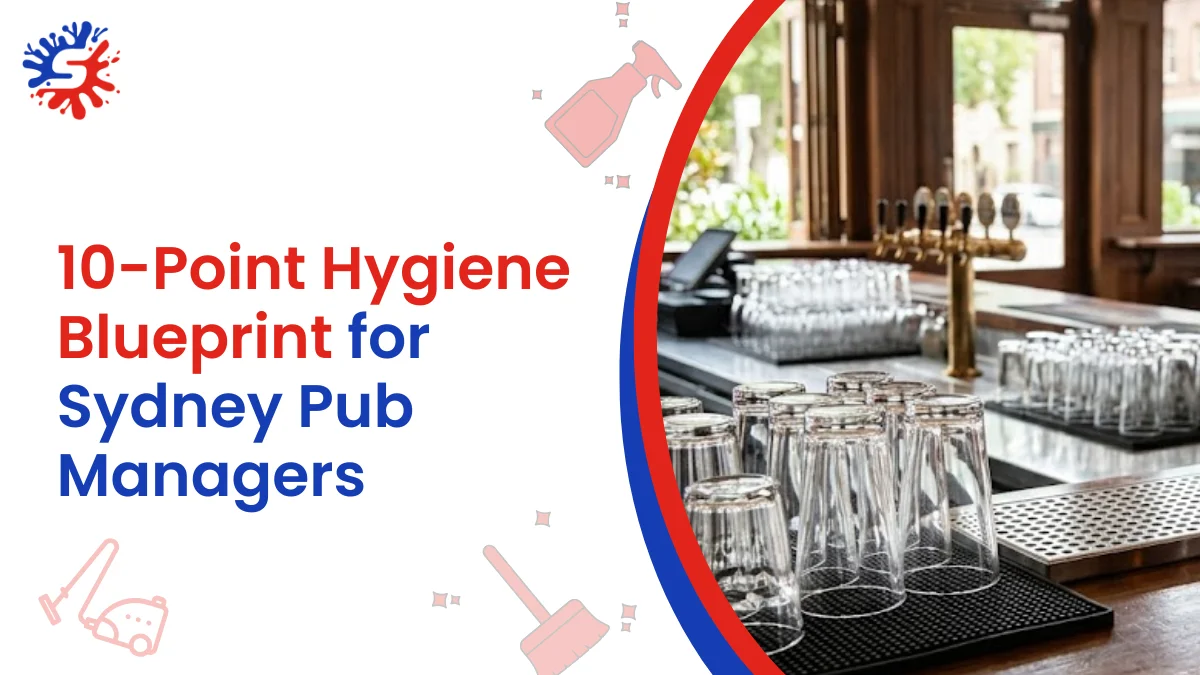
An environmental health officer can requests access to the kitchen, checks the beer cellar, tests the bathroom, swabs the surfaces, and produces a finding that is publicly searchable on the NSW Scores on Doors register within days. For any Sydney pub, that outcome can be 5 stars or a penalty notice, and the difference is almost entirely determined by what was done between inspections, not during them.
The blueprint below covers the ten specific areas where Sydney pubs are most vulnerable to enforcement action and most likely to fail when a customer or staff member triggers a complaint inspection. Each point is built around the hygiene standard an auditor expects to find, the data on what actually happens when it is missed, and the practical action that keeps the venue on the right side of that line.
Key Takeaways
- True audit-readiness requires maintaining standards capable of passing a surprise inspection during any trading hour, as the outcome is determined by day-to-day hygiene, not last-minute performance.
- Audit failures often stem from hidden risks such as beer line biofilm, where bacterial levels can reach 6.6 log10 CFU/cm² in older tubing.
- An audit-ready pack must include consistent temperature logs, grease trap dockets, and AS 1851-compliant kitchen exhaust certificates.
- Simple wiping is insufficient, as bar menus alone can harbor 185,000 bacteria per cm².
- Unserviced kitchen exhaust systems, which can reach 1,000°C during a grease fire, pose risks to both compliance and safety.
- 95% of customers avoid dirty venues; maintaining a 5-star rating acts as a critical, long-term marketing asset.
The 10-Point Blueprint
Each point in this blueprint corresponds to a specific inspection focus area, a documented hygiene risk, and an action that keeps it audit-ready. They are sequenced from the bar floor to the back of house and into the venue's compliance documentation.
1. Beer Tap Lines and Draft System Hygiene
Every pint poured from an unclean draft line is poured through a biological system. Biofilm, the layered community of bacteria, wild yeast, mould, and mineral deposits that builds up inside beer tubing, is the primary reason draught beer develops off-flavours and the primary reason a beer line system fails a hygiene audit.
What makes it dangerous as an inspection risk is that biofilm is invisible from outside the line. The tap can look perfectly clean and be carrying a contamination load that would not survive five seconds of scrutiny from an environmental health officer.
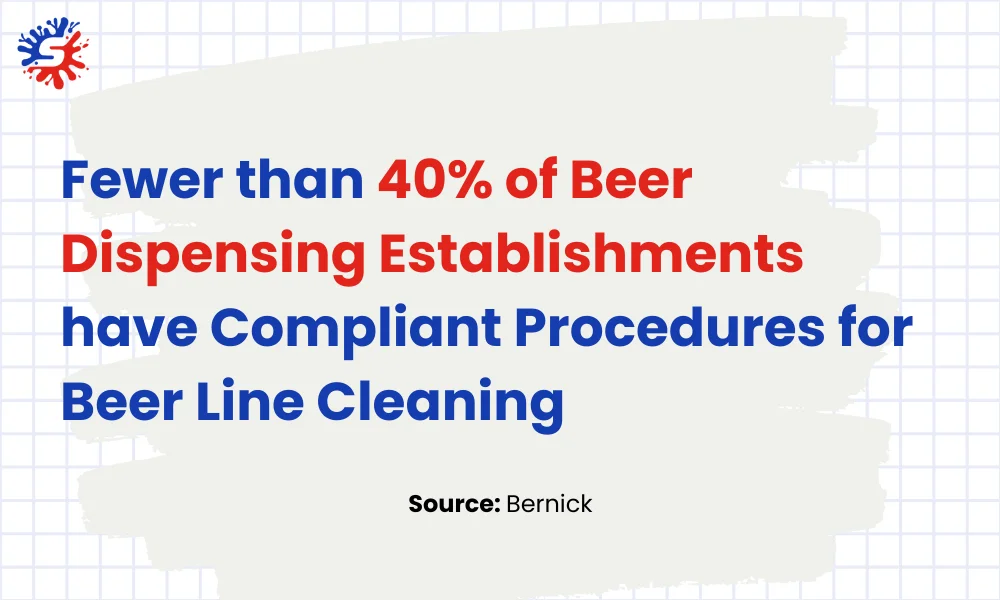
Fewer than 40% of beer dispensing establishments have compliant standard operating procedures for beer line cleaning. Testing have found that many draft systems routinely test positive for bacteria and yeast despite 'regular' cleaning.
A peer-reviewed study found that bacterial log densities in simulated five-year-old draft beer tubing reached 6.6 log10 CFU/cm2, compared to 5.6 log10 in new tubing. Biofilm accumulation compounds with line age and cleaning inconsistency.
We recommend cleaning draught lines at minimum every two weeks, with weekly cleaning for high-volume venues. The standard method requires an alkaline detergent flush to break down proteins, yeast, and mould, followed by an acid clean quarterly to address mineral deposits that alkaline solutions cannot remove.
What the audit checks:
-
Written beer line cleaning schedule with completion dates
-
Log of cleaning agent used, contact time, and staff member responsible
-
Tap faucets free of visible residue, biofilm, or deposits on the outer surface
-
Lines flushed to clear chemical residue before service resumes
The contamination that builds in draft systems is closely connected to what our detailed breakdown of pub hygiene and customer retention identifies as one of the highest-impact and least-addressed hygiene failures in bar operations.
2. Ice Machine Decontamination
Ice is a food ingredient and directly goes into every drink served. It sits in contact with beverages that customers consume. And it is cleaned with less frequency and rigour than almost any other food contact surface in a typical Sydney pub.
Highest enteric bacteria of any ice production environment tested. Bar and pub ice samples contained 14 bacterial strains from 11 species across 8 genera, some of which are recognised agents of human infection, higher than both home and industrial ice production settings.
Ice machine bins collect condensation, residual water, and ambient bacteria over time. The scoop handle is touched by multiple staff members across every service. The bin interior is rarely opened for inspection between routine service days. When an environmental health officer swabs a bin interior, they are testing for exactly this accumulation.
What proper ice machine hygiene requires:
-
Empty and clean the bin interior at least monthly, including paddles, storage walls, and the water distribution system
-
Sanitise the ice scoop holder and scoop handle at every service, not weekly
-
Check for and remove any pink or black discolouration inside the bin, which indicates bacterial or mould growth
-
Keep the ice machine door closed between uses and never use the bin as temporary cold storage for other items
-
Record all cleaning dates, the product used, and the staff member responsible
3. Kitchen Exhaust and Grease System Compliance
The kitchen exhaust system is a legal compliance area, not just a hygiene one. In NSW, AS 1851 is the mandatory Australian Standard governing the routine maintenance of kitchen exhaust and fire protection systems.
For commercial kitchens in pubs and bar venues, failure to comply with AS 1851 exposes the venue to insurance voidance, Annual Fire Safety Statement non-compliance, and direct enforcement from Fire and Rescue NSW.
Every commercial building in NSW must submit an Annual Fire Safety Statement (AFSS) to the local council and Fire and Rescue NSW, certifying that fire protection systems including kitchen exhaust have been maintained to the relevant Australian Standards. The exhaust cleaning documentation is part of that certification.
The ductwork, fan housing, and roof discharge point must be assessed separately and cleaned based on grease accumulation rate.
-
Canopy and baffle filters: Monthly clean and degreasing
-
Plenum chamber and vertical duct: Quarterly inspection and clean at minimum
-
Exhaust fan housing and blades: Degreased at every duct clean
-
Documentation: Compliance certificate issued after each clean, retained for AFSS submission
4. Bathroom Deep Sanitisation
For every audit, the bathroom is a separate inspection zone. It is not assessed as part of the general venue cleanliness check. It has its own criteria, its own standard, and its own failure pathway. It is also the room that does the most damage to customer retention when it is substandard.
95% of customers say they will avoid a venue in the future after finding a dirty restroom. For auditors, restroom condition is one of the strongest proxies for overall venue hygiene standards.
What an environmental health officer checks in a pub bathroom goes well beyond whether the floor looks clean. The inspection covers:
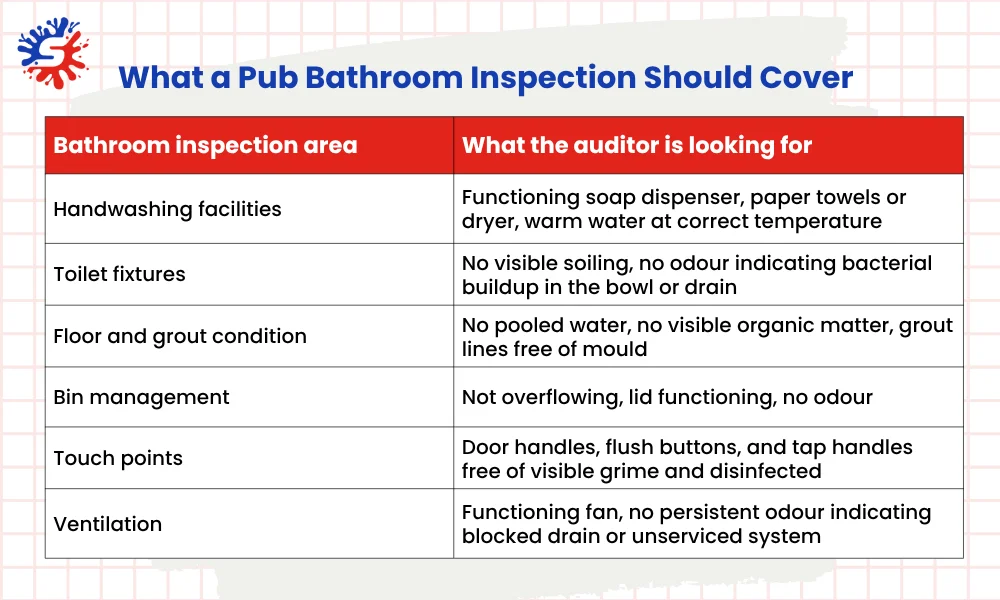
The depth of what bathroom hygiene data shows about bacterial accumulation on fixtures makes clear that a visual check during service is not sufficient. A deep clean to audit standard requires a scheduled service, not a mid-shift wipe-down.
5. Bar Surface and High-Touch Disinfection
The bar surface is the most frequently touched non-food contact surface in any pub. Hundreds of hands touch it across a service, drinks are set on it, cards are tapped on it, and staff wipe it repeatedly with cloths that accumulate bacteria rather than remove it.
185,000 bacteria per cm2 is the level found on restaurant and bar menus in. Bar menus, reusable cocktail lists, and table menus pass through hundreds of hands daily and are rarely sanitised between uses.
A bar surface disinfection protocol that will withstand audit scrutiny covers more than just the visible horizontal surface. It includes:
-
Bar top: Disinfected with an approved sanitiser at correct contact time, not wiped with a service cloth that has been used for the previous hour
-
Speed rails and drip trays: Emptied, cleaned, and sanitised at every service close, not just when visibly dirty
-
Reusable menus and bar lists: Sanitised between customers or replaced with single-use alternatives
-
Payment terminals and card machines: Disinfected daily as part of the cleaning schedule, not ad hoc
-
Bar cloths: Changed and laundered at minimum once per service, not reused across the full shift
The broader problem of what surface wiping versus proper commercial sanitisation actually achieves is at the centre of most bar hygiene audit failures.
6. Food Temperature Control and Cold Storage Verification
Temperature control is one of the most heavily weighted inspection categories. An inspecting officer will test refrigeration units, check probe thermometer records, and verify that the temperature log for the previous seven days is available and accurate. A single gap in that log is a recordable violation.
12.9% of food premises inspections in 2024-25 resulted in at least one formal enforcement action including penalty notices, prosecutions, and suspension orders in Greater Sydney. Temperature control and food storage violations feature consistently among the most commonly cited breaches.
For a pub with a kitchen bistro or bar snack offering, the temperature requirements under the Food Standards Code are specific and non-negotiable:
-
Cold holding temperature: Potentially hazardous food must be kept at 5°C or below
-
Hot holding temperature: Food held for service must be maintained at 60°C or above
-
Cooling: Cooked food must be cooled from 60°C to 21°C within two hours and to 5°C within a further four hours
-
Temperature logs: Daily records of refrigeration unit temperatures must be kept and available for inspection
-
Probe thermometer calibration: The probe used to verify food temperature must be sanitised between uses and calibrated on a recorded schedule
The hygiene standards at the kitchen level that protect against both audit failure and foodborne illness risk form the foundation of everything above the service counter.
7. Floor Drain and Grease Trap Maintenance
Floor drains in commercial kitchens and bar areas are the most consistently neglected surface in any food premises audit. They accumulate organic matter, food residue, grease, and moisture continuously across every service. They are the primary breeding point for drain flies, cockroaches, and the foul odour that travels from the kitchen into the customer-facing areas of the venue.
1,000°C is the temperature that duct fires can reach within minutes when grease accumulates in the drain and extraction pathways. Floor drains that overflow with grease-laden water create both a hygiene violation and a fire pathway adjacent to cooking equipment.
A grease trap that is not serviced on schedule breaches council trade waste agreements and creates an odour and contamination risk that spreads through the drain network. In Sydney, most council areas require grease traps to be serviced by a licensed trade waste contractor at a frequency determined by the trap's capacity and the venue's volume.
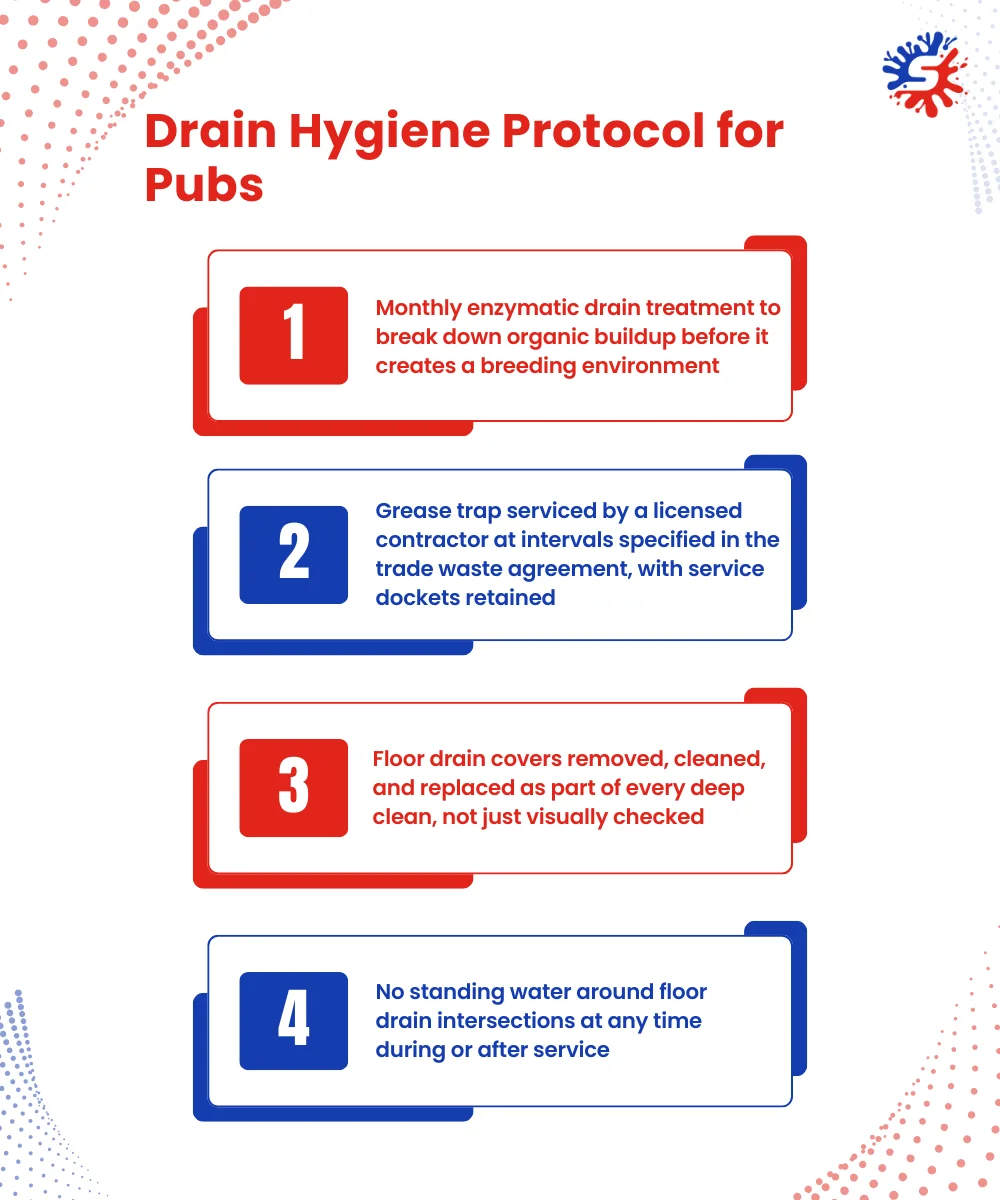
The drain hygiene protocol that holds up to inspection:
8. Pest Prevention Through Waste and Organic Matter Control
Pest findings are one of the most severe outcomes an inspection can produce. A single live cockroach, fresh rodent droppings, or visible fly activity in a food preparation area is sufficient to trigger an immediate enforcement action in NSW under the Food Act 2003. There is no remediation process that undoes a pest sighting during an active inspection.
Pest prevention in an audit-ready pub is not the responsibility of the pest control contractor alone. It is a cleaning and hygiene management outcome. Pests require three things to establish: food, moisture, and shelter. A pub that removes all three through rigorous cleaning practices removes the conditions for infestation.
The cleaning actions that directly reduce pest risk:
-
All food waste removed from the kitchen before close, not stored in internal bins overnight
-
External bins kept lidded and positioned away from kitchen entries
-
Drain covers in place and floor intersections clear of organic accumulation
-
Under-equipment areas deep-cleaned quarterly; grease and food residue beneath fryers, ovens, and refrigeration units are the primary cockroach harborage point in any commercial kitchen
-
Wall and floor sealing gaps identified and reported for repair; rodents can enter through gaps of 6mm or larger
-
Pest control contractor visit records retained and available for inspection.
9. Glasswashing and Beverage Equipment Verification
Glassware in a busy pub operates in a continuous cycle: used, washed, dried, and returned to service. At peak service volumes, that cycle shortens to minutes. When the glass-washing machine is not serviced properly, the glasses returned to service carry bacterial contamination that customers drink directly from.
119 bacterial species and 18 fungal species were identified as contaminants in retail draft beer systems across four tested beer types in a peer-reviewed PMC study. Contamination includes the glassware-to-line pathway, where a poorly washed glass introduces contamination back into the draught system.
An environmental health officer checking glasswashing equipment will look for:
-
Wash water temperature at or above 55°C and rinse water at or above 77°C, or chemical sanitisation at manufacturer-specified concentration
-
Visible cleanliness of the interior chamber, spray arms, and filter trays
-
Absence of lipstick residue, protein haze, or physical debris on washed glasses
-
Glass storage away from splash zones and at a position that allows air drying rather than towel drying, which introduces cross-contamination
-
Documented service record for the glass wash machine, showing maintenance and temperature verification
Glasses returned to service without reaching the correct sanitisation temperature, retaining bacteria from the previous user. At scale, across a Friday night service of several hundred covers, the contamination exposure is material. This is part of the broader pattern that commercial cleaning best practices for hospitality venues in Sydney address through systematic equipment verification.
10. Scores on Doors Readiness and Compliance Documentation
Every other point in this blueprint prepares the venue for what an auditor finds during an inspection. This point is about ensuring that when they find it, you can prove it was deliberate rather than accidental.
Sydney food businesses appear on the NSW Food Authority's active penalty notice. The register is publicly searchable by business name. Currently, there are 776 registered penalty notices.
The NSW Scores on Doors program rates food premises at 3, 4, or 5 stars based on unannounced inspections by council environmental health officers. A 5-star rating is displayed at the venue and can be searched by any patron before they visit. A low rating, or appearance on the name-and-shame register, is public, permanent for up to two years, and immediately accessible to every prospective customer who checks.
The Audit-Ready Documentation Pack
Don't just prepare for planned audits. Maintain your documentation and standards so they can pass an unannounced inspection at any time. The documentation pack that an audit-ready Sydney pub keeps current at all times:
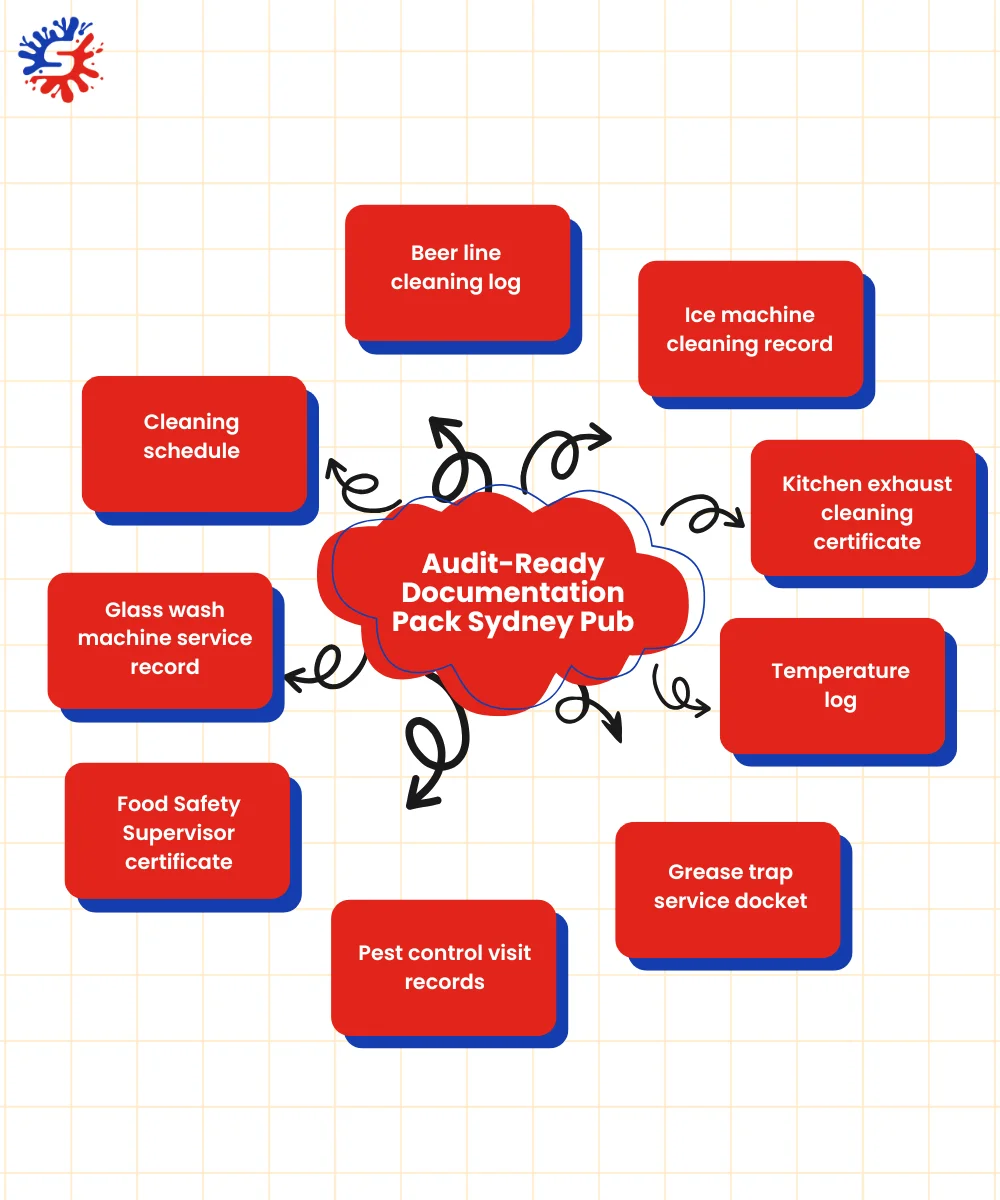
None of these documents is difficult to maintain. All of them are easy to miss when the priority is getting through the service. The venues that consistently achieve 5-star ratings under Scores on Doors are not doing something dramatically different during service.
What Audit Readiness Looks Like Week to Week
The 10-point blueprint is a week-to-week rhythm that keeps each area at a standard that would pass inspection on any day of the trading week.
|
Frequency |
Task |
Who is responsible |
Record kept |
|
After every service |
Bar cloth change, drip tray empty and clean, drain covers clear |
Bar manager on duty |
Service close checklist |
|
Daily |
Refrigeration temperature log, ice scoop sanitisation, bathroom check and restock |
Designated duty manager |
Temperature log, bathroom check log |
|
Weekly |
Beer line clean and flush, glass wash machine inspection, floor drain enzymatic treatment |
Cellar or bar supervisor |
Beer line cleaning log |
|
Monthly |
Ice machine internal decontamination, grease trap check, pest inspection, deep bathroom sanitisation |
Professional cleaning provider |
Service completion records |
|
Quarterly |
Kitchen exhaust duct clean and compliance certificate, carpet extraction in venue areas, deep clean of under-equipment zones |
Licensed contractor and cleaning provider |
AS 1851 certificate, completion log |
|
Annually |
Annual Fire Safety Statement preparation, full documentation audit, Food Safety Supervisor certificate review |
Manager or compliance officer |
AFSS submission, full documentation pack review |
Conclusion
A Sydney pub that consistently maintains our 10-point standard does not view an inspection as a risk. The documentation is current, the areas are at standard, and the officer's findings reflect what has been done, not what was scrambled together the week before.
A 5-star Scores on Doors rating is a public trust signal that a venue earned through documented, consistent hygiene management. It is also one of the most cost-effective marketing assets a Sydney CBD pub can have, visible to every customer who looks before they walk in.
Book a free consultation program for your pub or bar with Spark Clean Australia. We cover all ten points in this blueprint on scheduled cycles, deliver completion records as standard, and build our program around your service hours so the cleaning happens when the venue is closed, not while customers are in it.
Frequently Asked Questions
Find quick answers to booking, payments, pet-friendly policies, deep cleaning, and more. Our team is dedicated to making the process effortless and transparent. If you have additional questions, we're here to help ensure a seamless experience.
Get In Touch