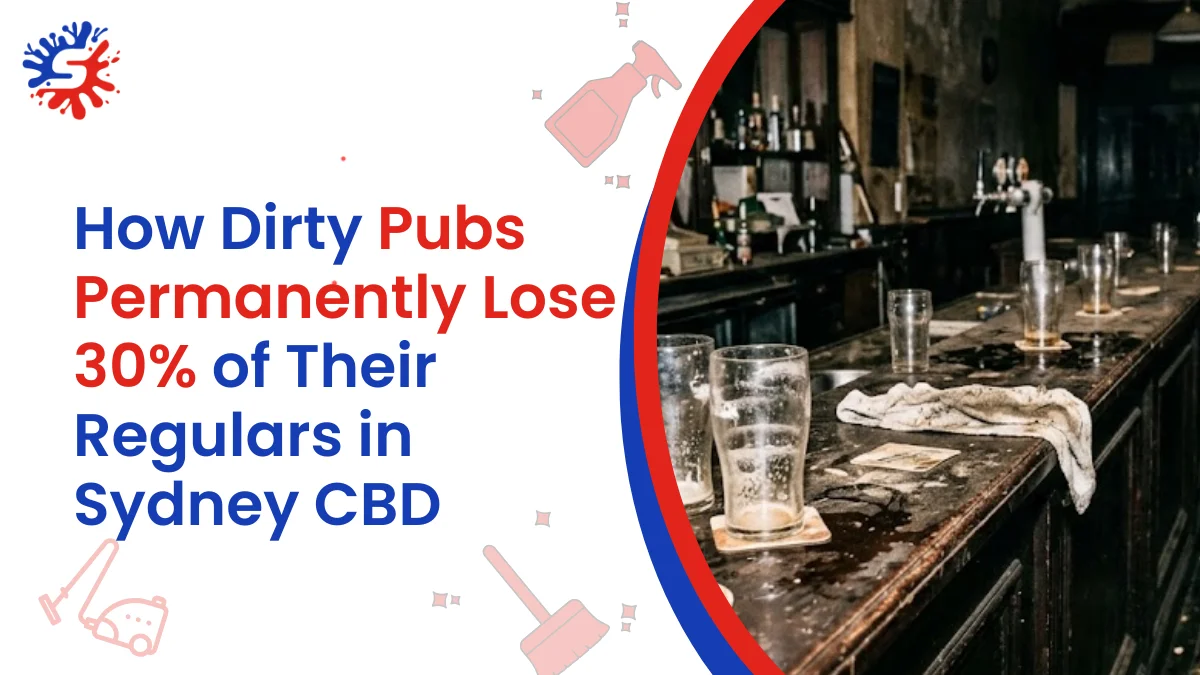
How Dirty Pubs Permanently Lose 30% of Their Regulars in Sydney CBD
There is a type of customer loss that does not announce itself.
No argument at the bar, no complaint left at the counter. One Friday, they are there, in their usual spot, ordering the same thing they always order. Next Friday, they are not. The Friday after that, still gone. And they never come back.
This is not the dramatic version of losing a regular. There is no confrontation, no feedback, no chance to fix anything. They just stop showing up, and the pub carries on without ever knowing why.
Key Takeaways
-
Cleanliness is the top reason customers do not return to a hospitality venue, ranking above slow service, menu quality, and price
-
73% of visitors say they will avoid a venue in the future after encountering a dirty restroom
-
Unhappy customers rarely complain to the business; most tell between 9 and 15 other people instead
-
Beer tap lines, ice machines, and bar wiping cloths are among the most contaminated surfaces in any pub
-
A one-star improvement in cleanliness ratings can lift overall review scores by a full star and support more than an 11% price increase
-
NSW's Scores on Doors program makes hygiene inspection results publicly visible, including for pub bistros and bar kitchens
The Bathroom They Walked Into and Never Forgot
Most pub owners think about the bar when they think about hygiene. The glass, the tap, the bench. But the room that does the most damage to customer retention is the dirty bathroom.
What a Dirty Restroom Actually Tells a Customer
When a patron walks into a pub bathroom and finds what they find in too many Sydney CBD venues on a busy Friday night, they do not think "this bathroom needs attention." They think: "What is the kitchen like?"
The bathroom is the part of the venue that is hardest to maintain during peak service. If it is neglected, the areas customers cannot see are almost certainly in worse shape.
Here is what the research actually says about what happens next:
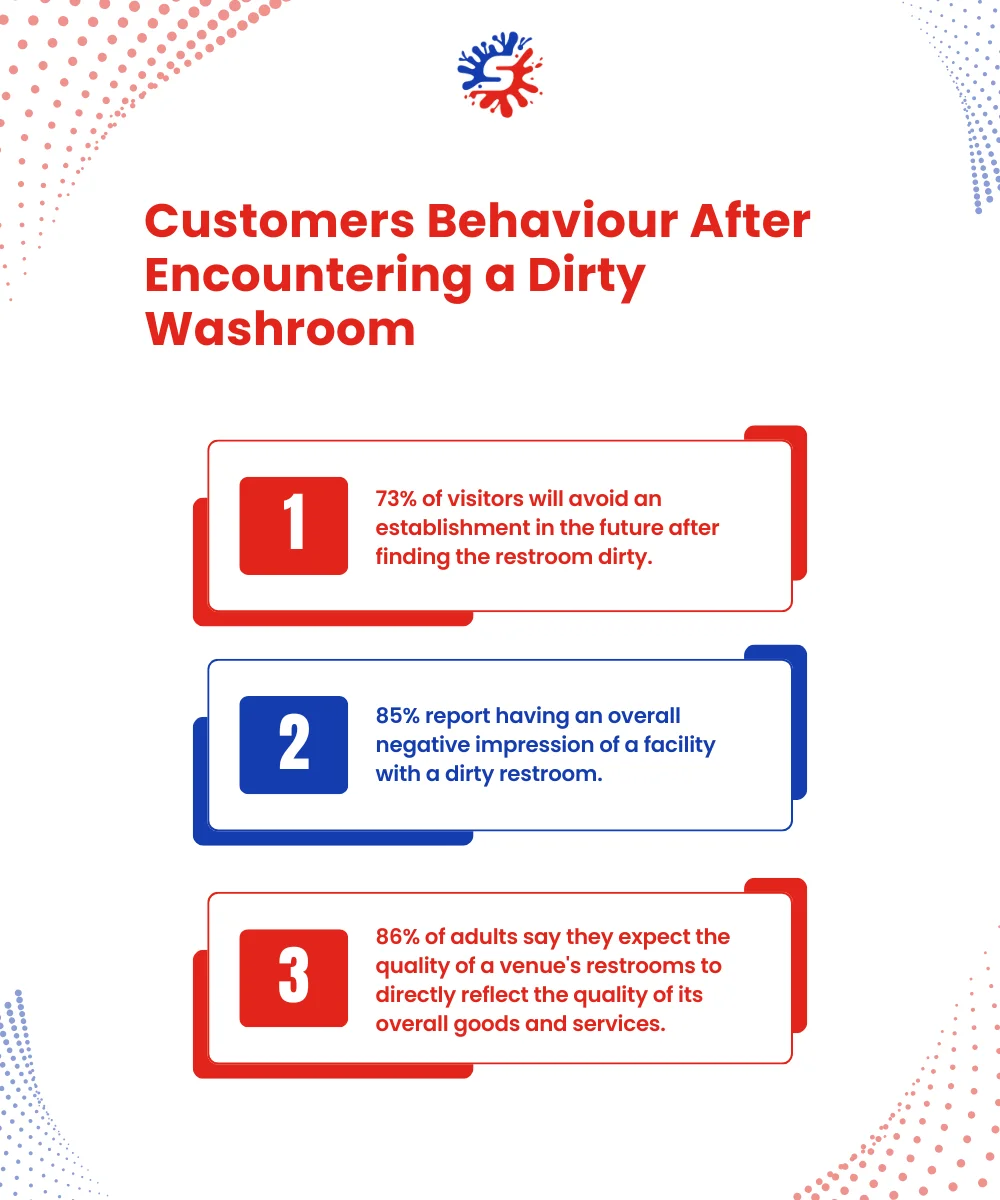
For a Sydney CBD pub, those numbers represent a near-total loss of a customer from a single experience. In a high-traffic pub bathroom, hundreds of users over a Friday night with no mid-service deep clean means the problem scales fast.
Why the Problem Outlives the Visit
The second issue with a dirty pub bathroom is that it does not stay in the room. It goes home with the customer, and then it goes online.
A TotalFoodSurvey found that 89% of people would not visit a venue because of negative reviews that specifically mention its restrooms. Not their own experience. Someone else's review, read on a phone screen while deciding between two pubs on the same block.
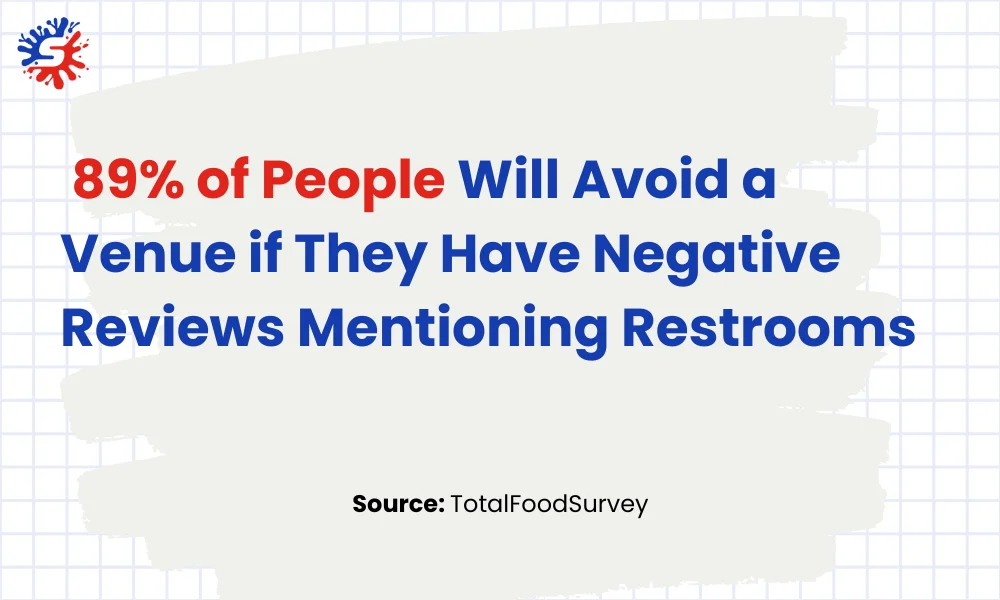
That last point is worth sitting with, missing soap. Something that takes thirty seconds to fix. It is enough to turn away nearly half the people who read about it.
The moment a customer photographs an overflowing bin or a broken tap and posts it on Google, the venue is not just losing one customer. It is losing every person who reads that review before deciding where to go this weekend.
What Your Bar Surfaces are Actually Serving People
Beyond the bathroom, there is a quieter contamination problem affecting the surfaces customers interact with directly, and that staff touch hundreds of times a night. The issue is not what is visible. It is what is invisible, and what it is doing to the drinks being poured.
Beer Lines and Taps: The Problem Nobody Sees
Bacteria, yeast, and mould accumulate in lines that are not regularly flushed and cleaned, forming biofilms that alter the taste of every pint poured and introduce microbial contamination. Overly foamy beer, flat pints, and a slightly off flavour are often a line problem.
A study published in PMC examined microbial communities in retail draft beer systems across four beer types and found:
-
119 bacterial species were identified as contaminants across the draft systems
-
18 fungal species live alongside those bacteria
Contamination was found to change between sampling periods from the same taps, meaning the microbial population is dynamic, not static
Ice Machines: The Highest-Risk Surface in the Bar
Ice goes into every cocktail, every soft drink, every glass of water, and every beer served in a frosted glass. In a venue that has not cleaned its ice machine in weeks, those drinks are being served with a bacterial load that no customer is aware of, and no amount of premium spirits changes.
A PubMed study tested ice produced in bars and pubs. Ice samples from bars and pubs had the highest levels of enteric bacteria of all three environments tested. Fourteen bacterial strains from eleven species across eight genera were identified in pub and bar ice alone, some of which are recognised agents of human infection.
Bar Cloths: Spreading More Than They Clean
The instinct to wipe down the bar between customers is the right one. The execution is almost always wrong. A study published on ResearchGate measured microbial contamination on restaurant and bar surfaces and on the equipment used to clean them. The finding that matters most for any pub operator:
-
Coliform bacteria were found in 89.2% of dishcloths and 70% of tabletops.
-
Isolated from 54.1% of dishcloths and 20% of swabbed tabletops.
-
Bars exhibited significantly higher levels of both HPC (Heterotrophic Plate Count) and coliforms than restaurants.
-
Compared to home studies, restaurant/bar dishcloths had 25-fold higher HPC levels but 60 to 120-fold lower coliform counts.
This is exactly what the difference between looking clean and actually being sanitised means in a real hospitality environment, and it is one of the most common gaps in any pub's cleaning
The Calculation Customers Make Before You Know They Have Made It
The biology of a pub's surfaces is invisible to most customers. What is not invisible is everything they can see within the first sixty seconds of walking in. And in the Sydney CBD, that visual assessment is fast and permanent.
First Impressions Form Before a Drink Is Ordered
Behavioural research on environmental first impressions is consistent. People process quality cues within seconds, before any interaction takes place. A sticky entry mat, a smeared front window, a bar top with dried rings from the night before, and a floor that has not been properly mopped reveal the pub's carelessness.
The floor, the bar top, and the entry area are the venue's silent sales team. They communicate before the first staff member says hello. If you are thinking about this from a business premises perspective more broadly, the principle that a clean display pulls people in applies with equal force to a pub entrance and a Sydney CBD retail shopfront.
Some additional context on how quickly these impressions form:
-
Consumers identify floors as the first thing they look at when judging a venue's cleanliness
-
Bathrooms and kitchens follow
-
Reception or bar areas and general surfaces come next
-
The judgment is typically formed before they have sat down or ordered anything
Clean Pubs Charge More and Earn More
The financial relationship between cleanliness and revenue is documented and quantifiable.
|
Improvements |
Data Point |
Source |
|
Lifts overall review score |
One-star cleanliness improvement raises overall rating by up to one full star |
|
|
Supports higher pricing |
A one-star rating boost allows an 11.2% price increase with no loss of footfall |
|
|
Increases revenue directly |
One-star increase on review platforms corresponds to 5% to 9% revenue increase |
Cleanliness creates the conditions for charging more for the same drinks in the same room. That is a return on a cleaning investment that most pub operators have never put into those terms.
You can read the detailed breakdown of how every dollar spent on professional cleaning yields a higher return for Sydney businesses in our dedicated analysis.
Why the Walk-Out Stays Quiet and How Far the Story Travels
The most dangerous thing about a customer who has had a bad hygiene experience at your pub is not that they leave. It is that they leave without saying anything, and then they keep talking about it.
The Unhappy Customer Who Says Nothing
Research puts a precise number on one of hospitality's most misunderstood patterns: Only 1 in 26 dissatisfied customers will actually tell a business about a bad experience. The other 25 simply leave, no complaint, no feedback, no opportunity for the venue to know that something went wrong.
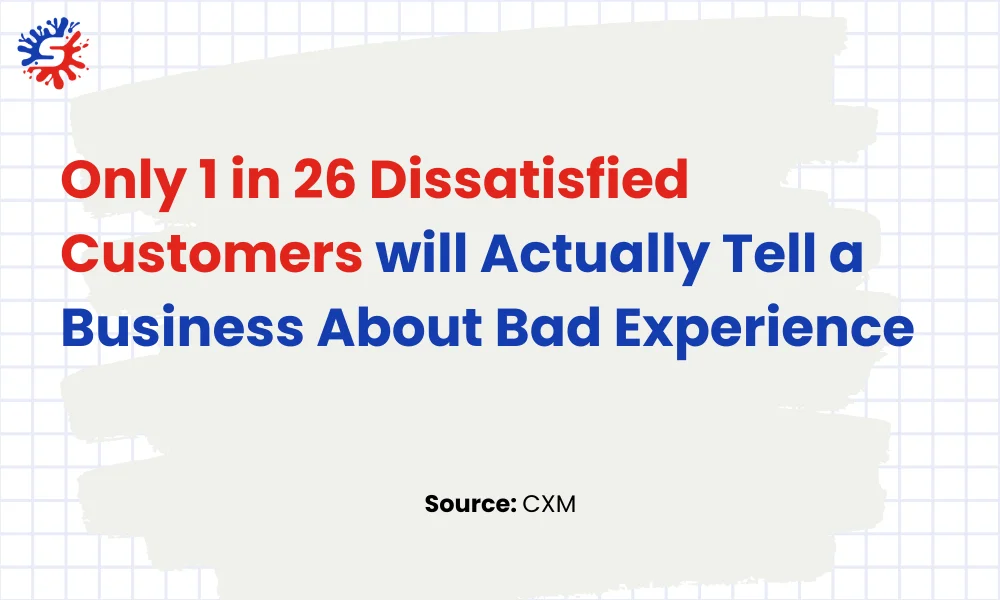
This is the trap that a busy Friday night creates. Four hundred people through the door. Fifteen of them had a bad experience with the bathroom, a cloudy glass, or beer that tasted off. One of those fifteen says something to a staff member. The other fourteen are already gone, already decided, and already beginning to influence the decisions of people around them.
A 30-second audit of your commercial cleaning standards is often the clearest way to identify the gap between what management thinks is happening on the floor and what customers are actually experiencing.
The Word of Mouth Working Against You Tonight
The silent customer is not a passive problem. Research on how unhappy hospitality customers behave shows a consistent pattern:
-
96% of unhappy customers do not report their experience to the business directly
-
Those same customers tell between 9 and 15 people about their experience
-
13% of unhappy tell more than 20 people
-
A satisfied customer, by comparison, tells between 3 and 5 people
In the Sydney CBD, one person's account of a dirty bathroom or off-tasting beer can redirect the whole group. They are not describing a hypothetical risk but a recent experience, which carries a level of credibility no marketing spend can match.
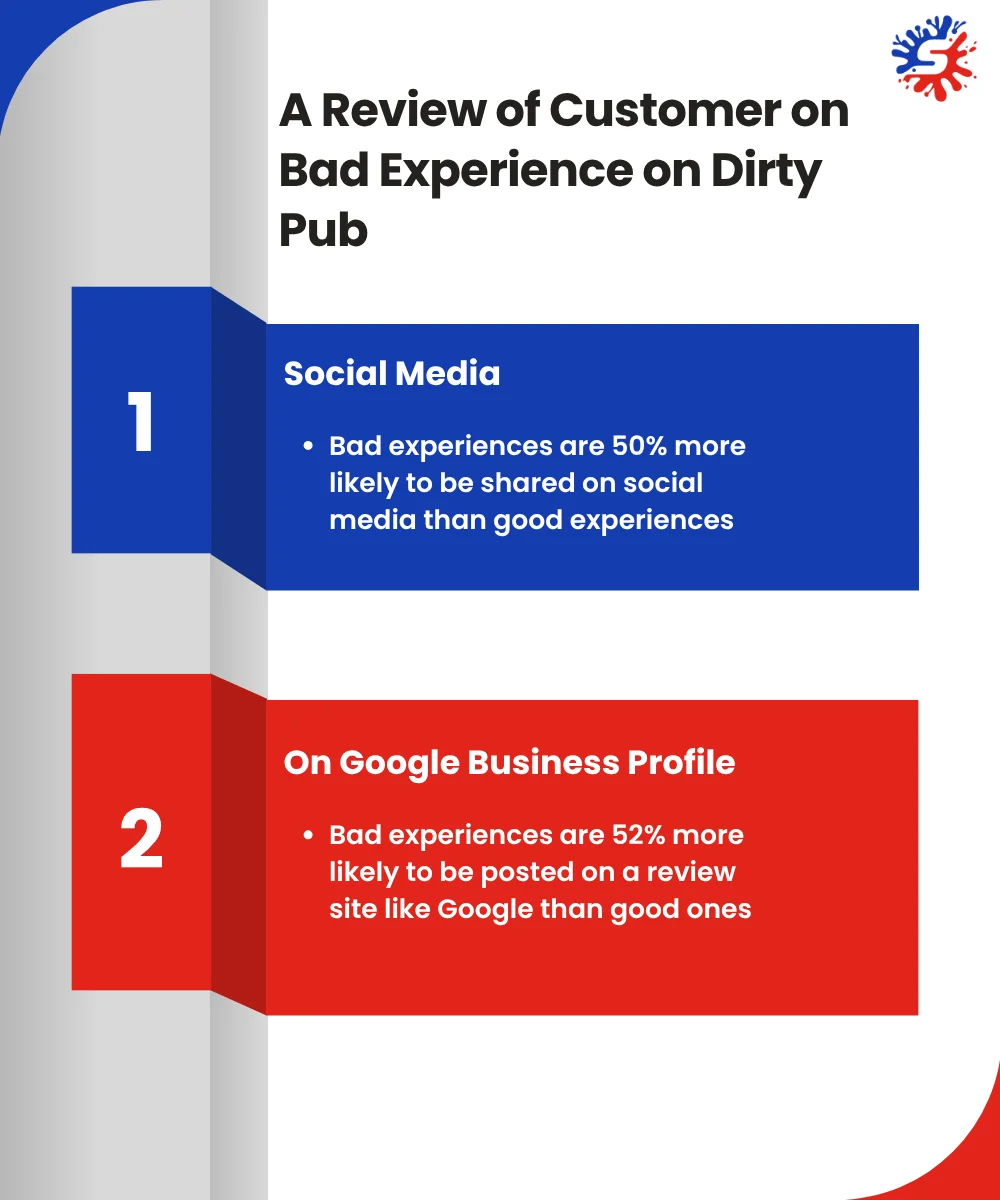
The review dimension makes this worse:
What NSW's Public Hygiene System Means for Your Pub's Visibility
There is one more layer to this that is specific to New South Wales, and that many pub operators treat as a regulatory formality rather than what it actually is: a public-facing trust signal that potential customers are already reading.
Scores on Doors: Your Hygiene Rating Is Already Public
The NSW Food Authority runs the Scores on Doors program, which publishes the results of hygiene and food safety inspections of food premises across the state, including pub bistros and bar kitchens. Inspections are conducted by council environmental health officers and are unannounced.
Venues are rated on the following scale:
-
5 Stars (Excellent): The highest level of compliance with food safety standards
-
4 Stars (Very Good): Strong practices, some minor areas to address
-
3 Stars (Good): Adequate compliance, improvement areas identified
A 5-star rating displayed in the front window is a verifiable, third-party endorsement of your venue's standards. A missing rating, or a low one, is also visible to anyone who searches before deciding where to go.
What Non-Compliance Actually Costs
The NSW Food Authority also publishes a public name-and-shame register of businesses. The establishments have breached food safety laws, either through penalty notices or prosecutions. Entries remain on the register for one to two years.
That record is public, searchable, and tied to the venue's name. A patron who searches a pub before booking it for a work function will find it. The financial and reputational exposure of non-compliance far exceeds the cost of the cleaning routine that prevents it.
The Honest Question Worth Asking About Your Current Setup
Most pub owners reading this are not running venues that are obviously dirty. The venues are busy, the floor looks reasonable by the end of service, and nobody has formally complained about anything.
But looking reasonable and being clean in the ways that drive loyalty and pass unannounced inspections are two different things.
Consider what is actually happening in a typical Sydney CBD pub across a week:
-
Beer lines that have not been flushed since the last keg change.
-
An ice machine that has not been opened and cleaned in over a month.
-
Bar cloths are being used across a full Friday night service without being changed or sanitised.
-
Bathroom soap dispensers that went empty at 9 pm and were not refilled before closing.
-
Menus wiped with the same cloth used on the bar can carry up to 185,000 bacteria per cm².
None of these failures shows up in a single bad review on its own. They accumulate slowly, invisibly, in the experience of customers who feel something is off but cannot name it. And then those customers quietly stop coming.
The kitchen and food-preparation hygiene data tell the same story from the back-of-house perspective, and the same principle applies throughout.
What a Professional Pub Clean Actually Covers
A professional cleaning program for a hospitality venue goes well beyond what in-service staff can manage during a shift. Here is where the difference actually sits:
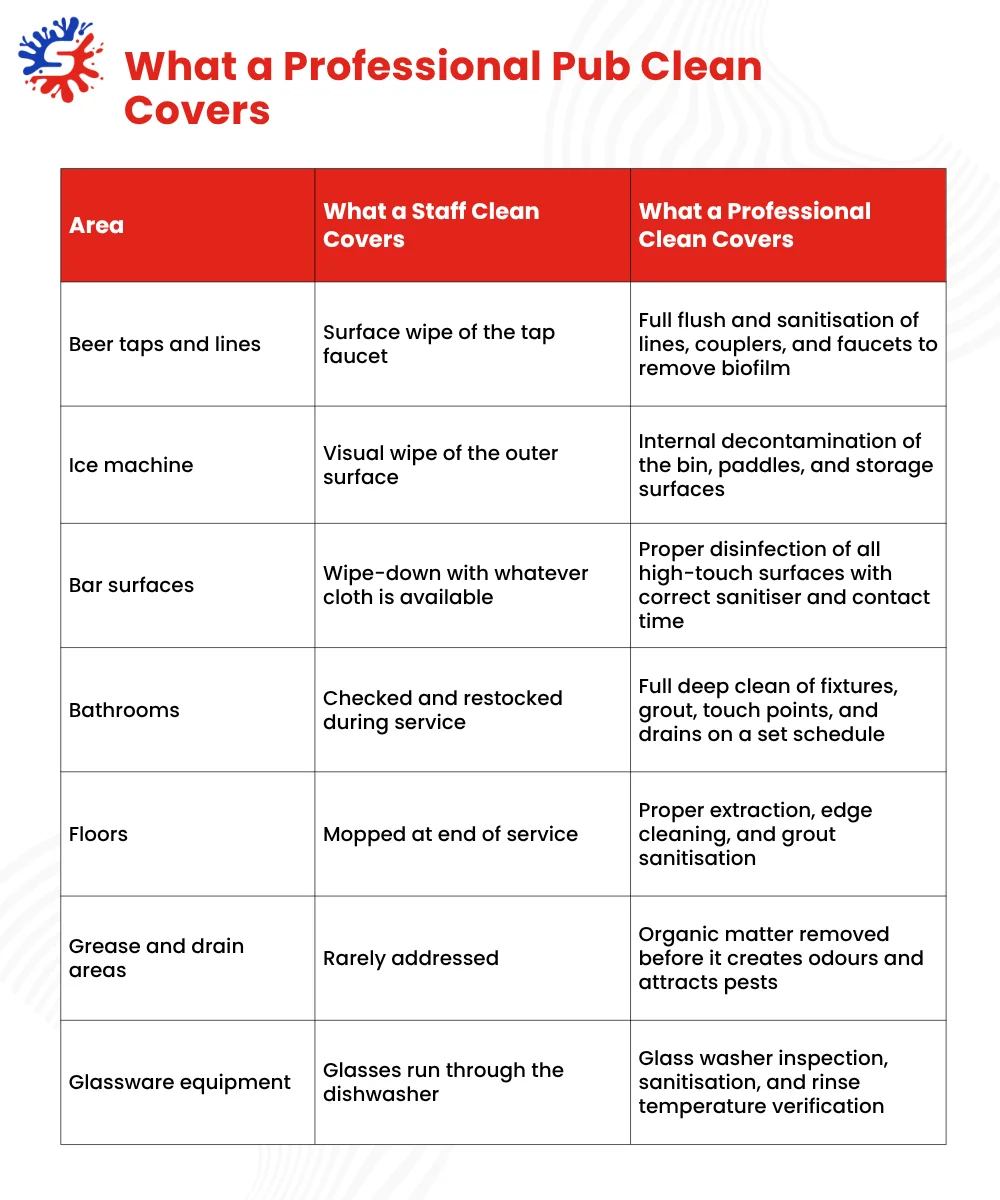
The workplace hygiene data makes a point that is just as applicable here: the surfaces that see the most contact are almost always the least cleaned.
Conclusion
Regular customers leave without saying anything, then tell their peers. They post on Google at 11 pm on a Saturday when the memory is still fresh. And the pub owner reads the roster on Tuesday and does not understand why the last four Thursdays have been quieter than expected.
This is a fixable problem. It is not fixed by staff effort during service because service is not when deep contamination is addressed. It is fixed by a professional cleaning routine that covers the right areas, on the right schedule, with the right equipment.
If you want to understand what that looks like for your venue, contact Spark Clean Australia for a consultation. We will assess your current setup, identify the high-risk areas in your existing routine, and build a program around your service hours.
Frequently Asked Questions
Find quick answers to booking, payments, pet-friendly policies, deep cleaning, and more. Our team is dedicated to making the process effortless and transparent. If you have additional questions, we're here to help ensure a seamless experience.
Get In Touch