Sydney Pub Owners with Struggling Reviews are Ignoring Professional Cleaning
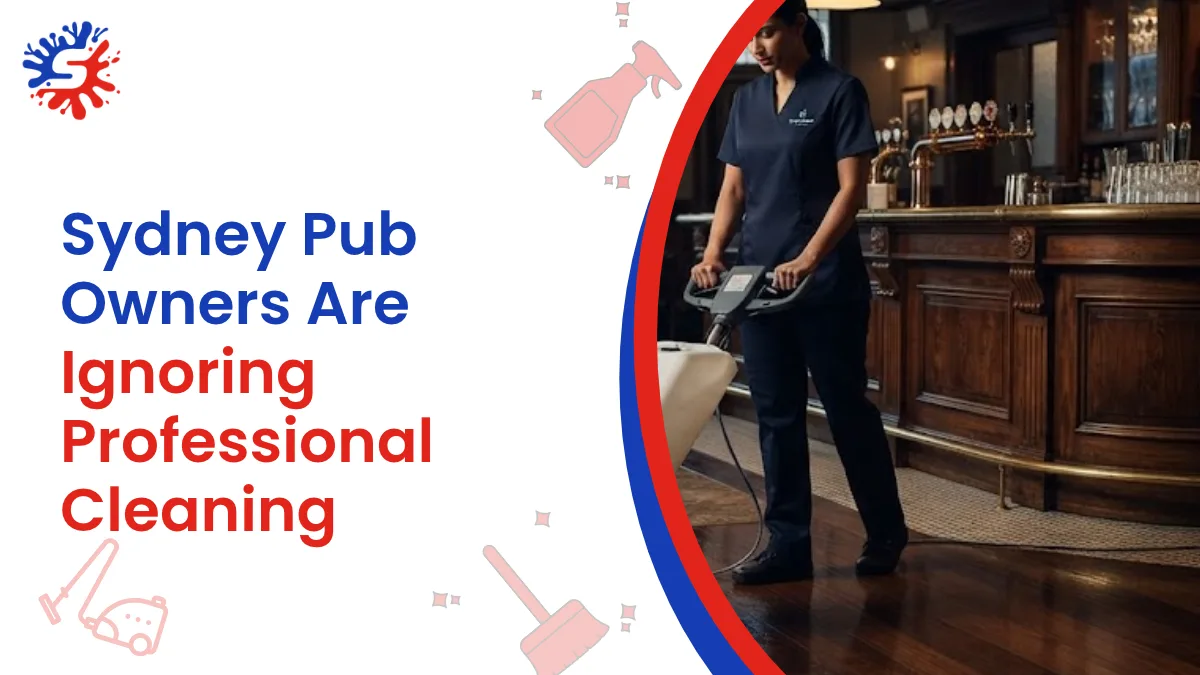
Walk into any local pub in Sydney, and you will see millions of dollars invested. Yet if you pull out your phone and sort reviews by "Lowest Rating," a painfully familiar pattern emerges. Patrons are not just complaining about slow service or overpriced drinks. They are calling out sticky carpets, sour-smelling bar mats, greasy dining tables, and neglected restrooms.
97% of consumers read online reviews for local businesses before deciding where to spend their money, and 31% of customers will only visit a business rated 4.5 stars or higher.
Even more concerning for hospitality operators is how quickly old goodwill expires: 74% of consumers care only about reviews written within the last three months, while 32% specifically look for feedback posted within the past two weeks.

Key Takeaways
- With 97% of consumers reading local reviews and 31% refusing to visit venues rated below 4.5 stars, recurring complaints about sticky floors or smelly toilets directly cut your bistro and bar revenue each week.
- Hospitality research proves 85% of guests rank cleanliness as a primary driver of satisfaction, and venues that fail on hygiene suffer a 45% drop in repeat customers.
- Foodborne illness costs Australia $3 billion annually, and poor kitchen or ice-machine sanitation can land your pub on the NSW Food Authority’s public Name and Shame register for two years.
- Partnering with a professional Sydney cleaning service for daily touchpoint disinfection, steam carpet extraction, and photo-verified audits eliminates sensory complaints and helps convert walk-in patrons into five-star reviewers.
- Addressing past cleanliness complaints by publicly sharing the professional cleaning upgrades you have made persuades consumers who read owner responses to give your pub a second chance.
How Dirty Venues Drive Down Sydney Pub Ratings and Revenue
A single bad review mentioning grime or foul odours does far more damage than a complaint about a busy Friday night wait time. Patrons forgive a busy kitchen, but they rarely forgive a dirty venue. Before looking at where pubs fail, we need to understand how modern diners and drinkers judge hospitality spaces and how their online feedback impacts revenue.
The Link Between Visible Cleanliness and Star Ratings
Hospitality research shows that cleanliness is the foundation of guest trust. A customer satisfaction analysis found that 85% of guests consider cleanliness a primary factor shaping their overall experience, outranking service quality (78%), value for money (72%), and location (65%).
Furthermore, 70% of customers note that visible health and safety measures, including thorough cleaning protocols, directly impact their comfort and trust in a venue. When venues fall short in these core areas, the study noted a 45% decline in repeat visit intentions.
What People Notice Within the First Five Minutes
When a customer walks through your pub doors, they form an impression long before they order their first drink. Hospitality auditors and review analysts consistently see the same sensory triggers showing up in one- and two-star reviews across Sydney:
-
Fatigue vs. First Impressions: Staff who work inside a pub for eight hours become nose-blind to stale beer yeast, damp wool carpets, and sour mop water. A customer walking in from the fresh air smells it within three seconds.
-
Discomfort on Furniture: When a customer pulls out a timber dining chair or rests their elbows on a leaner table and feels a tacky, sticky film left by sugary drink spills and dirty bar cloths, they immediately question the kitchen's hygiene.
-
Residue: Lipstick marks on wine glasses, cloudy beer schooners from poorly maintained glasswashers, and food debris wedged between fork tines are instant review killers.
-
Glass Surfaces and Windows: Smudged glass doors, cobwebs around outdoor heaters, and cigarette ash or grease stains on footpath dining pavers signal to passersby that management does not care about details. Keeping up with streak-free window cleaning practices is one of the easiest ways to improve street appeal before a guest even steps inside.
-
Restroom Neglect During Peak Hours: Overflowing sanitary bins, wet floors, empty soap dispensers, and uric acid smells in the bathrooms convince diners that back-of-house hygiene is equally poor.
The Financial Cost of Losing Half a Star in Sydney's Pub Scene
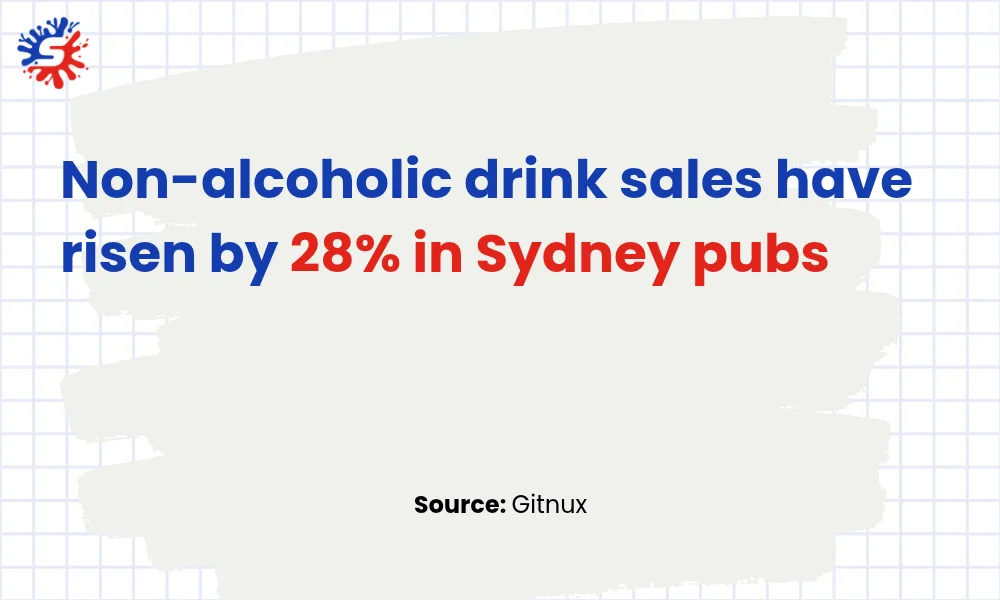
Sydney’s hospitality market is booming, but cost pressures leave pubs with no margin for self-inflicted reputation damage. Hotel and hospitality transaction volumes reached a record $2.7 billion in 2025. Meanwhile, Sydney hospitality industry statistics show an average casual dining meal spend of $45 per head (climbing to $180 for premium dining checks), while non-alcoholic drink sales have risen by 28% as pubs attract wider family and daytime crowds.
When your pub’s Google rating drops from 4.4 stars to 3.8 stars due to recurring cleanliness complaints, you lose business. 68% of consumers read at least four or more reviews before they trust a local business. Look at how cleanliness-driven review drops directly impact a typical medium-sized Sydney pub across different revenue streams:
|
Pub Revenue Stream |
Hygiene Failure Cited in Reviews |
Customer Behaviour Impact |
Estimated Monthly Revenue Risk |
|
Bistro & Family Dining |
Sticky tables, dirty highchairs, food scraps under booths |
Families and group bookings choose competing local clubs or bistros |
$8,000 – $15,000 in lost covers |
|
Main Bar & Beer Garden |
Sour smell near taps, fruit flies, stained outdoor pavers |
After-work drinkers leave after one round instead of staying for dinner |
$5,000 – $10,000 in bar tab drop |
|
Function & Event Spaces |
Musty carpet odours, dusty vents, sub-par restroom state |
Corporate organisers and birthday groups cancel or look elsewhere |
$6,000 – $20,000 in lost bookings |
|
Pub Accommodation |
Hair in bathroom grouting, stained upholstery, dusty blinds |
Negative TripAdvisor scores lower booking conversion rates |
$4,000 – $12,000 in room vacancies |
The Hygiene Blind Spots Destroying Your Pub's Reputation
Most pub owners do not intentionally run a dirty venue. The problem is that daily wipe-downs only address surface-level clutter while ignoring deep biological grime.
Front-of-House Carpets, Upholstery, and Beer-Soaked Floors
Sydney pubs take an extraordinary physical beating every week. Between Thursday night, Friday after-work drinks, and Saturday, thousands of patrons track street dirt, rain, and grease across your flooring while spilling beer, wine, and soft drinks.
When beer and sugary mixers soak into woven pub carpets or porous timber floorboards, standard vacuuming and damp mopping only remove the top 10% of the liquid. The remaining sugars and yeast sink into the carpet underlay and subfloor.
Within 48 hours, bacteria and mould begin feeding on those sugars, producing the unmistakable stale, sour pub smell that greets customers when you open the doors for lunch. Beyond the bad reviews, ignoring deep floor care destroys your physical assets.
Upholstered booth seating and fabric bar stools suffer the same fate. Sweat, body oils, spilled sauces, and dust mites accumulate inside foam cushions, leaving dark, greasy haloes on headrests and armrests that make diners uncomfortable the moment they sit down.
Restroom Odours and High-Touch Bacterial Hotspots
Ask any hospitality veteran how customers judge a kitchen they cannot see, and they will tell you: patrons judge the kitchen by the state of the toilets. You can serve the finest dry-aged steak in Sydney, but if a customer walks into a restroom with wet paper towels on the floor, black mould in the tile grout, and a sharp ammonia smell coming from the urinals, they will assume your food preparation areas are just as neglected.
Scientific studies show how quickly pathogens multiply on shared surfaces: influenza viruses can survive on hard surfaces for up to 24 hours, E. coli can survive up to 28 days on stainless steel, and high-touch buttons and handles can carry 40 times as many bacteria as a toilet seat. Inside a busy pub, restroom door handles, tap fixtures, hand dryers, and baby-change tables are touched by hundreds of people every hour.
Cellar Lines, Ice Machines, and Commercial Kitchen Grease Traps
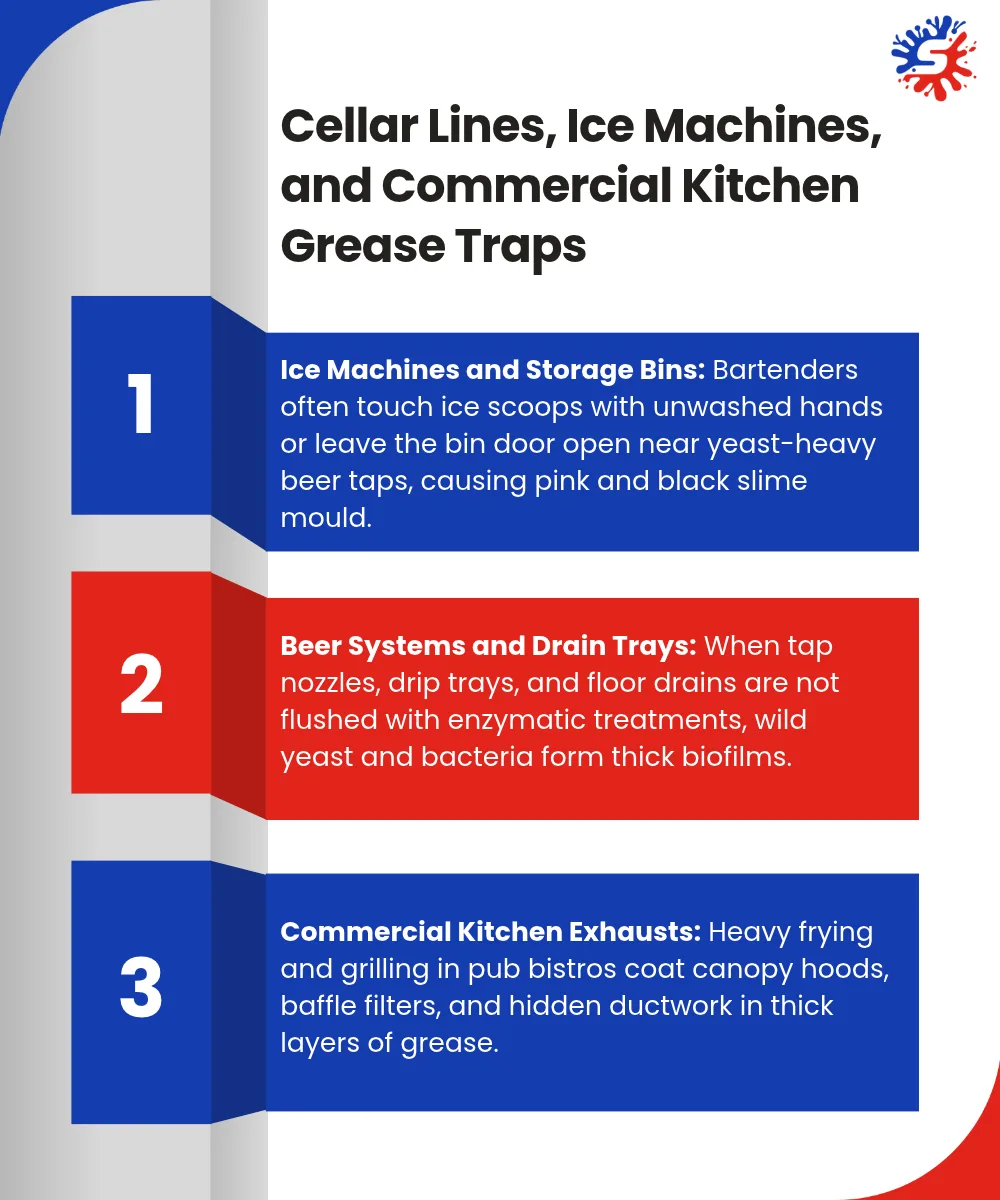
While front-of-house grime ruins online reviews, back-of-house neglect triggers both customer complaints and severe legal penalties. Foodborne illness costs the Australian economy approximately $3 billion each year (up from $2.81 billion in 2023). FSANZ data on Australian food safety culture confirms there are around 4.7 million cases of foodborne illness annually, resulting in roughly 47,900 hospitalisations and 38 deaths.
In Sydney pubs, three hidden back-of-house areas are notorious for making patrons sick or ruining the taste of food and drinks:
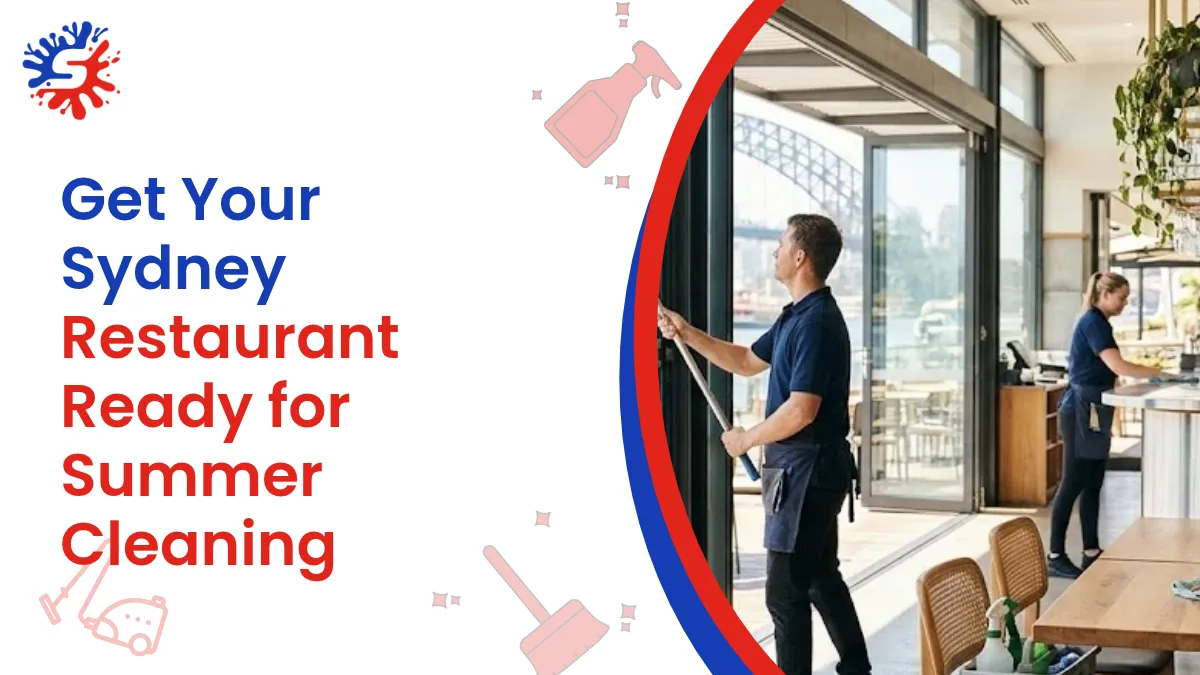
Review our dedicated Sydney restaurant summer cleaning guide aabout heat and humidity accelerate bacterial growth and pest breeding inside drains and grease traps overnight.
Why Relying on Bar and Kitchen Staff for Deep Cleaning Fails
When we speak with Sydney owners whose online ratings have slipped below 4 stars, their first reaction is almost always frustration with their own team: "I pay my staff for an hour after close every night to clean; why is the place still dirty?" The truth is, asking hospitality staff to do commercial deep cleaning sets your team and your venue up to fail.
Staff Turnover, Late-Night Fatigue, and Rushed Close-Downs
Hospitality workers are hired for their speed behind the taps, their culinary skill, and their warmth with customers, not their expertise in commercial sanitation chemistry. Expecting a bartender or kitchen hand who has just worked a grueling 10-hour Friday shift on their feet to scrub grout lines and degrease behind heavy fryers at 1:30 AM is unrealistic.
The numbers prove how stretched hospitality teams already are. The Accommodation and Food Services sector has the highest job mobility and turnover of any Australian industry, at 15.5%. Piling heavy manual scrubbing onto burnt-out bar staff at the end of a late-night shift accelerates staff turnover and guarantees corners are cut. Even worse, because high staff turnover means constant onboarding, basic hygiene rules get lost.
For example, untrained staff routinely use the same damp microfibre cloth to wipe a raw-meat prep bench, the POS terminal, and the front bar top. In our workplace hygiene study, 100% of surfaces tested positive for coliform bacteria after being wiped with a shared dishcloth or sponge. Without strict colour-coding systems for commercial cleaning, in-house staff accidentally spread bacteria across every surface your customers touch.
Commercial Cleaning Equipment vs. The Mop-and-Bucket Myth
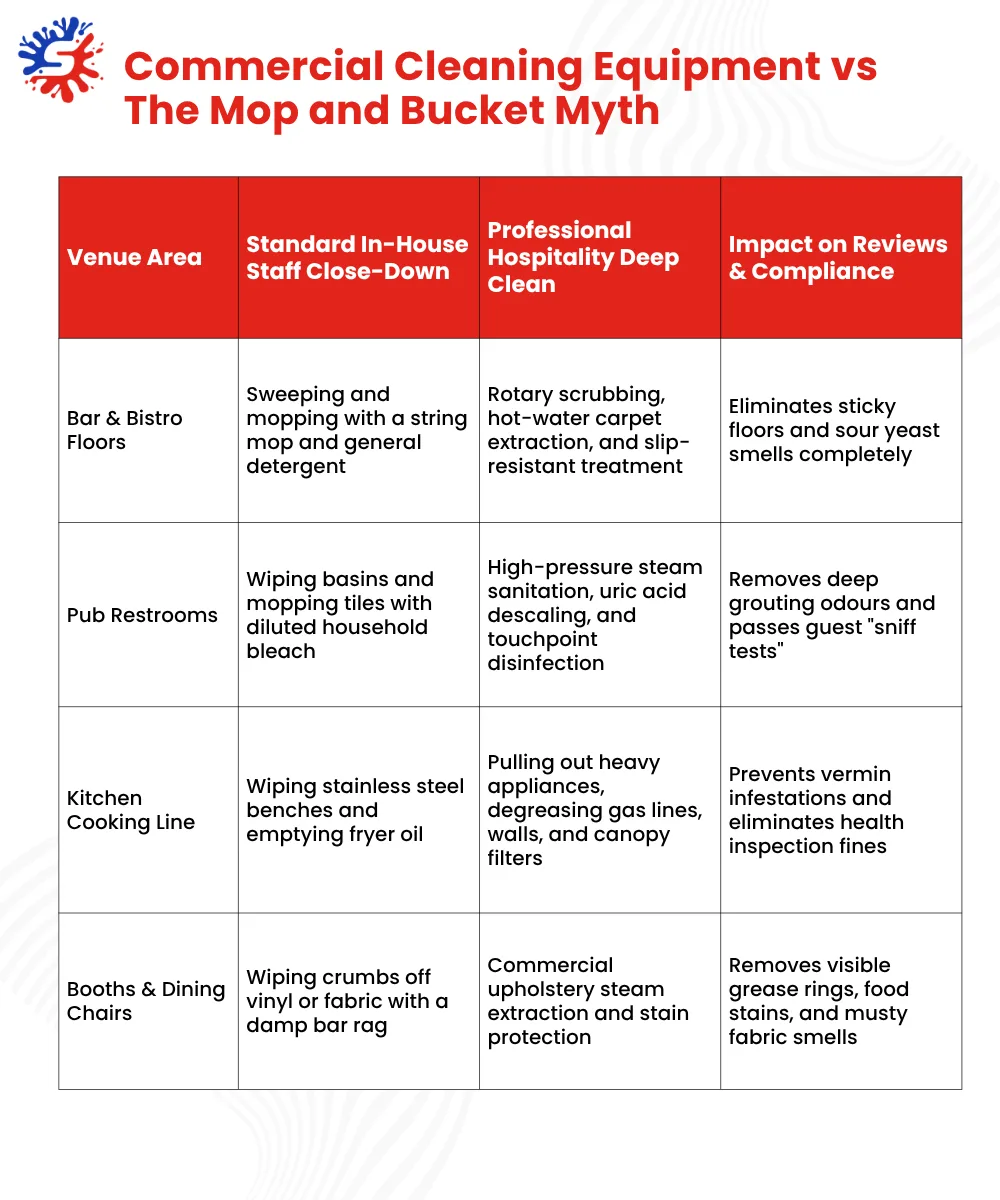
Even with the best intentions, your bar and kitchen staff often lack the right industrial tools. Pushing a traditional string mop and a bucket of warm soapy water across a Quarry-tiled kitchen floor or a sticky bar area doesn't clean the floor; it just mixes grease, spilled beer, and soil into a thin soup and spreads it evenly into the grout lines.
Look at the difference between what a typical in-house pub close-down achieves versus what a professional hospitality cleaning crew delivers:
The Real Risk of the NSW Food Authority "Name and Shame" List
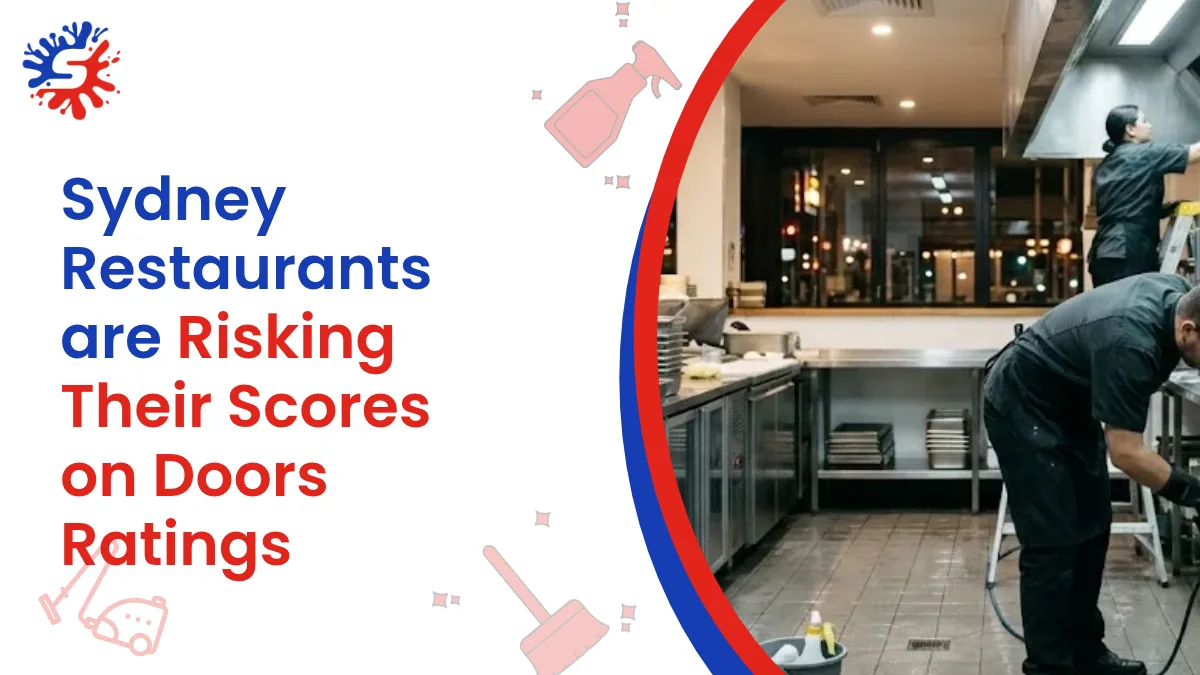
Cutting corners on professional cleaning not only hurts reviews but also puts you in the crosshairs of local council. Under the City of Sydney Scores on Doors hygiene rating program, food businesses are inspected unannounced and awarded between 3 stars (Good), 4 stars (Very Good), and 5 stars (Excellent) based on their compliance with food safety and cleanliness standards.
As of October 2026, the NSW Food Authority Register of Penalty Notices lists 827 active penalty notices on its public Name and Shame register for food safety and hygiene offences. Our analysis of non-compliance issues in inner-Sydney hospitality venues reveals that cleaning and sanitising failures and pest control gaps are the most common triggers for council fines,
How Professional Pub Cleaning Turns Struggling Reviews into 5-Star Loyalty
Turning around a pub with a 3.6-star rating does not require a million-dollar renovation. In fact, fixing the underlying hygiene, smell, and presentation of your existing venue is the fastest, most cost-effective way to spark a wave of glowing new reviews.
Switching from Schedule-Based to Outcome-Based Cleaning
Many pub managers who have hired cheap contract cleaners in the past complain that the cleaners simply empty the bins, run a vacuum down the middle of the room, and leave in 45 minutes. That happens because the pub signed a vague, schedule-based agreement rather than holding the cleaner to measurable hygiene standards.
Switching to an outcome-based commercial cleaning contract changes the entire dynamic. Instead of paying someone merely to mop the bathrooms, an outcome-based model requires your cleaning partner to maintain a minimum 90% hygiene audit score, ensure zero visible debris or sticky residue under inspection lighting, log exact chemical contact times on food-safe surfaces, and provide photo-verified completion reports after every shift.
When we were called in for a rapid overhaul to restore a Millers Point pub kitchen to 100% compliance in 48 hours, the venue faced imminent council enforcement and declining bistro reviews. By deploying a specialized deep-cleaning team, it saw an immediate shift in customer feedback within two weeks.
A Practical Cleaning Schedule for High-Volume Sydney Pubs
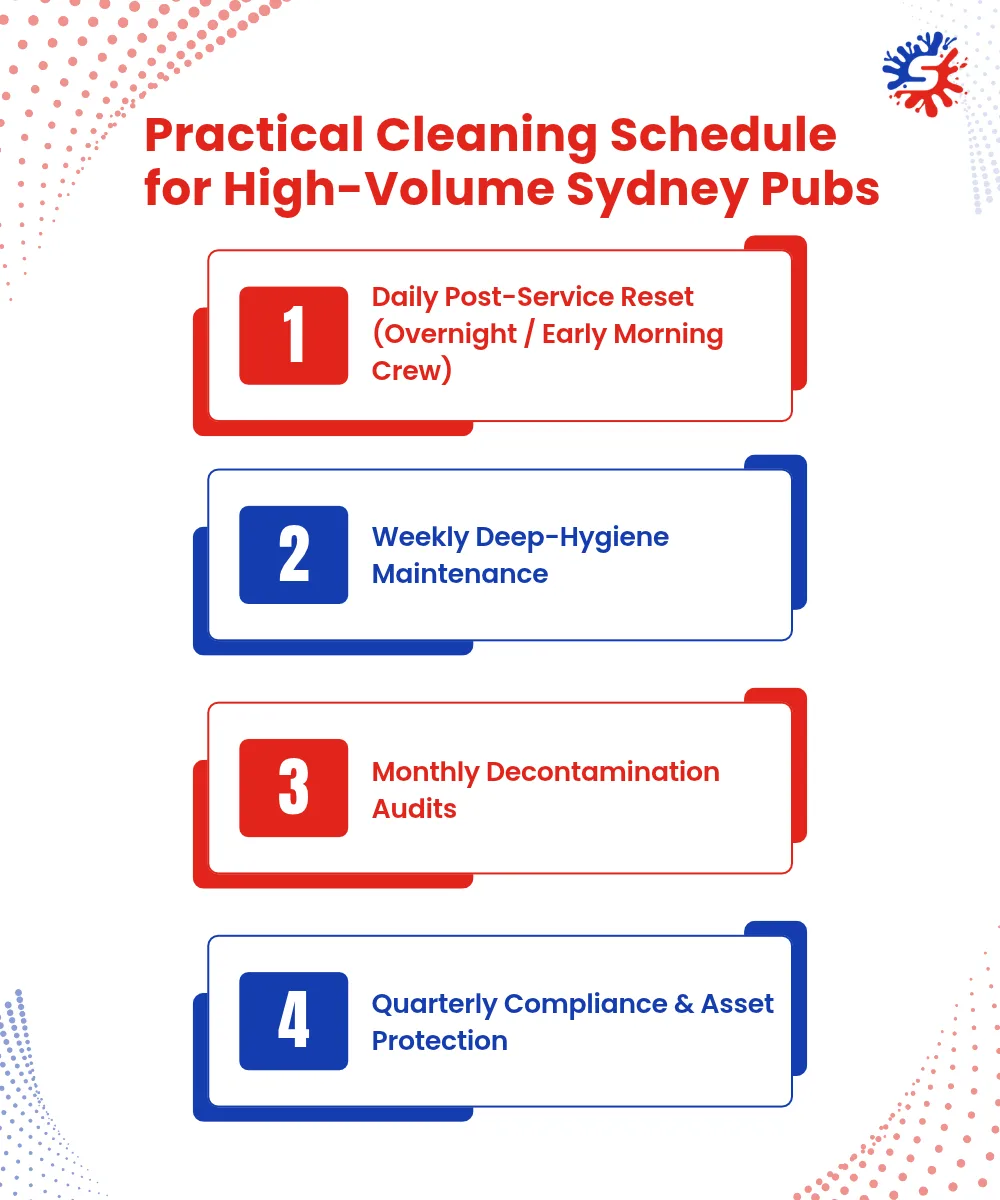
To keep both Environmental Health Officers and tough Google reviewers happy, a pub needs a layered cleaning rhythm that separates light daily bar duties from heavy professional sanitation. Here is how top-rated Sydney pubs structure their hygiene responsibilities:
Turning Hygiene Excellence into Your Strongest Marketing Asset
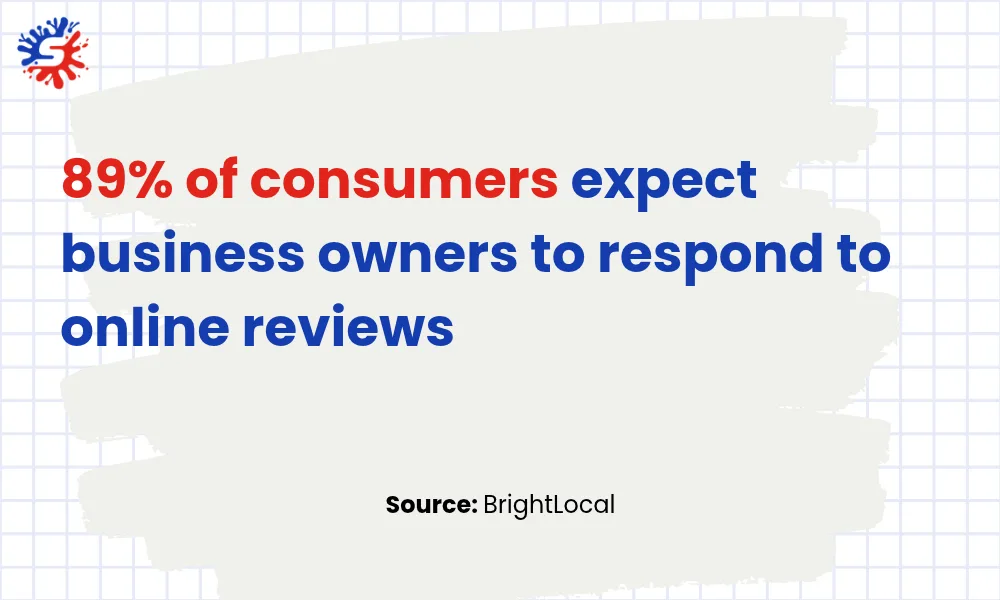
Once you invest in professional pub cleaning, do not keep it a secret. 89% of consumers expect business owners to respond to online reviews, and 80% are more likely to choose a business that actively responds to all feedback; yet 50% are turned off by generic, copy-pasted replies.
If your pub has older one- or two-star reviews complaining about sticky floors, smelly bathrooms, or dusty dining rooms, hiring a professional cleaning service gives you a powerful, authentic story to tell in your public owner responses. Instead of writing a defensive excuse or a robotic "Thanks for your feedback, we will pass this on to management," you can reply with concrete action:
Future customers reading your reviews will see an owner who listens, invests in guest comfort, and takes hygiene seriously. Combine that with a gleaming 5-star Scores on Doors and clean pub, and your new reviews will naturally start reflecting the high standard of your food and drinks.
Conclusion
Don't let subpar cleaning hold your ratings back any longer. Partner with Spark Clean Australia to restore pristine hygiene, pass every health inspection, and turn casual drop-ins into five-star advocates.
Book your professional pub cleaning service today and let our expert team handle the heavy lifting while you focus on pouring great drinks and serving amazing food. If you’re not sure, we will give you a free consultation for your venue.
Frequently Asked Questions
Find quick answers to booking, payments, pet-friendly policies, deep cleaning, and more. Our team is dedicated to making the process effortless and transparent. If you have additional questions, we're here to help ensure a seamless experience.
Get In Touch