
Schedule-Based vs Outcome-Based Commercial Cleaning Contract
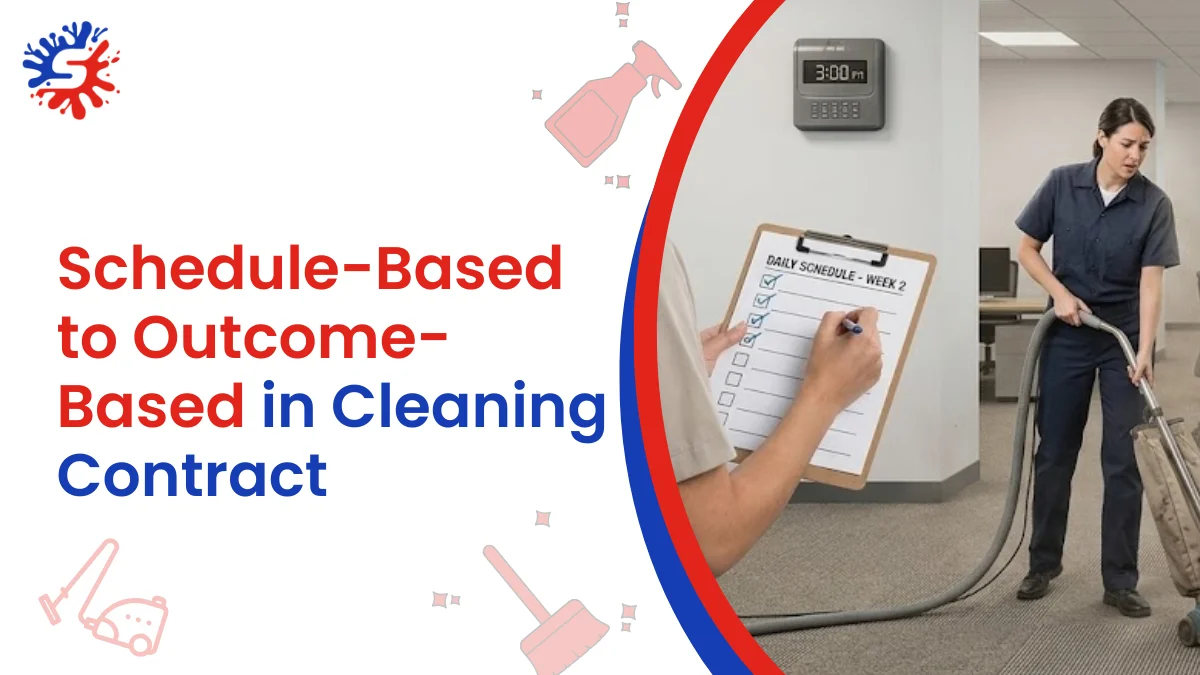
Here is how most office cleaning contracts work. The provider sends a cleaner three nights a week. The cleaner spends 2 hours on-site, and the invoice arrives at the end of the month. The office manager approves it, repeats it for 12 months, then renews it without discussion.
At no point does anyone ask: is the office actually clean? At no point does the contract specify what a clean office looks like, how it is measured, or what happens when it is not achieved. The only thing the contract guarantees is that someone showed up.
That is a schedule-based contract. And for most Sydney businesses, it is where the cleaning budget goes to stop being useful. You are paying for time, not results. The provider's job is to be present, not to perform. The distinction between a cost and an investment is driving a structural shift in the global commercial cleaning industry away from that model.
The contractual cleaning services market is worth $92 billion in 2026 and is projected to reach $155 billion by 2036. The analysts tracking that market are direct about what is driving it: facility management executives must now evaluate cleaning contracts on outcome metrics, cleanliness scores, contamination rates, and occupancy-adjusted efficiency, rather than labour hours deployed.
Key Takeaways
- Shift from paying for hours and tasks (schedule-based) to measurable results and standards (outcome-based) to ensure your cleaning budget is an investment rather than an expense.
- Schedule-based contracts suffer from misaligned incentives, where providers are motivated to "run out the clock" rather than achieve a high level of cleanliness.
- Mitigate financial value leakage by replacing vague tasks with specific, verifiable performance metrics.
- Implement a three-pillar framework consisting of defined quality standards, regular audit mechanisms, and clear rectification/consequence clauses for underperformance.
- Use documented performance data and a 90-day review period to transition your current provider to an accountability-based model without needing to immediately terminate the contract.
- Treat a provider’s refusal to accept performance-based KPIs as a definitive indicator that they lack the professional systems required to deliver consistent quality.
What a Schedule-Based Contract Actually Buys You
A schedule-based contract is built around inputs. It tells the provider how often to come, how long to stay, and which tasks to perform. In some cases, it specifies the exact products and equipment to use. What it almost never specifies is the standard those tasks need to reach.
This is the structural flaw. When a contract is built around tasks rather than outcomes, the provider can satisfy every requirement in the contract and still leave your office in a condition that staff and clients notice and react to negatively.
Consider the difference:
|
Schedule-based contract language |
Outcome-based contract language |
|
Bathrooms to be cleaned every service night |
Bathrooms to achieve a minimum audit score of 90% on the standard checklist at every fortnightly inspection |
|
Floors to be vacuumed three times per week |
Carpeted areas to show no visible debris or embedded particulate under standard inspection lighting |
|
Kitchen surfaces to be wiped nightly |
All kitchen touch points to be disinfected with an EPA-approved sanitiser at correct contact time; completion logged per service |
|
Meeting rooms to be cleaned after hours |
Meeting rooms to be reset to a blank state: surfaces cleared, chairs in, whiteboard clean, no residue from previous session |
|
Two hours of cleaning per service |
All nominated areas to pass inspection; the provider is responsible for adjusting the time to meet the standard |
The schedule-based version describes effort. The outcome-based version describes results. Only one of those can be held accountable.
The difference between what looks clean and what is verifiably clean is precisely what schedule-based contracts are structured to ignore, because the task can be marked complete regardless of the standard achieved.
The Problem the Hourly Rate Model Was Never Designed to Solve
The hourly rate model has one clear advantage: it is simple to price, invoice, and compare across providers. That simplicity is also its core limitation.
When you pay by the hour, you create an incentive structure that is misaligned with your actual goal. You want a clean office. The contract rewards time on site. Those two things are not the same, and in practice they diverge in ways that cost Sydney CBD businesses real money.
Where the Hourly Rate Model Leaks Value
When you pay for someone's time rather than the result they deliver, your interests and the service provider’s interests often misalign. Here is why this model frequently breaks down:
1. Parkinson’s Law: Work Expands to Fill Time
When a contract mandates a two-hour block, that is exactly what you get—two hours of labor, not necessarily two hours of results.
-
Reality: Once the critical high-impact zones (like kitchens and bathrooms) are finished, the provider will often fill the remaining time with low-value tasks to "run out the clock."
-
Impact: You pay for a full shift, but your facility’s most important surfaces may still fall short of the standard.
2. The Incentive Paradox: Why Mediocrity is "Safe"
Hourly contracts offer no financial reward for excellence, nor do they impose a penalty for mediocrity.
-
Reality: Whether a cleaner hits an audit score of 60% or 95%, their paycheck remains the same.
-
Impact: Without a contract that defines what "great" looks like or ties payment to audit scores, there is zero business incentive for the provider to improve their processes.
3. The Path of Least Resistance: Silent Scope Drift
Without clear, outcome-based metrics, the natural tendency is to prioritize ease over effectiveness.
-
Reality: It is easier to vacuum an open carpet than to deep-clean a coffee machine or sanitize complex touchpoints. Over time, the service drifts toward these "easy" tasks.
-
Impact: The decline in quality is often gradual and hard to pinpoint. Because you lack hard data, you’re left with a nagging feeling that things aren't right, but no concrete way to hold the provider accountable.
What is Outcome-Based in a Commercial Cleaning Context
Outcome-based is not a vague aspiration toward better cleaning. It is a specific contractual architecture that replaces effort-based language with result-based language throughout the agreement.
Performance-based contracts are based on outcomes. Rather than paying for effort, a customer is paying for an outcome. Standard contracts describe exactly what the cleaning staff must do to perform the work. Performance-based contracts describe the outcome the client expects to receive.
The outcome-based model shifts responsibility from the client to the provider. In a schedule-based contract, the client is responsible for noticing when the standard is not met and raising a complaint. In an outcome-based contract, the provider is responsible for meeting the standard, and the contract specifies what happens when they do not.
Redefining Cleaning Standards: Outcome-Based Contract Examples
To shift from managing staffing inputs to achieving actual cleanliness, service agreements should focus on defined, measurable results. The following examples demonstrate how to replace rigid schedules with outcome-based language:
|
Area |
Schedule-Based Input |
Outcome-Based Standard |
|
Floors |
Carpeted areas vacuumed three nights per week. |
All visible carpeted areas must show no embedded debris, matting, or soiling under standard inspection; the provider must adjust frequency based on occupancy and seasonal needs. |
|
Restrooms |
Restrooms cleaned every service night. |
Surfaces must achieve a minimum 90% score at every fortnightly audit; scores below 80% require re-servicing within 24 hours at no cost; three consecutive sub-80% scores trigger a contract review. |
|
High-Touch |
Kitchen and communal areas wiped nightly. |
Nominated high-touch surfaces must be disinfected using approved products at the correct contact time; completion must be logged per surface, and missed areas must be self-reported by the provider. |
The Cost of Staying with the Schedule-Based Model
The financial case for moving to outcome-based is not speculative. It is documented across contract management research from some of the most credible sources in commercial procurement.
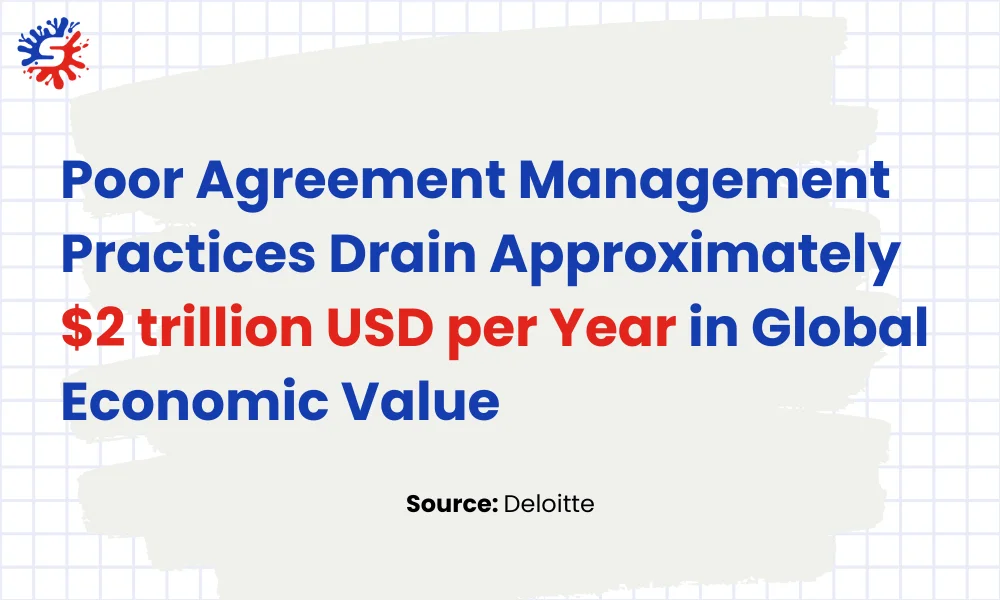
A study by Deloitte found that poor agreement management practices drain approximately $2 trillion USD per year in global economic value due to delayed deals, duplicated effort, and missed terms. Also, the average cost of poor contract management at 9.2% of annual contract value. Best-performing organisations limit that leakage to 3%. Underperforming organisations lose 15 to 20%.
For an office spending $30,000 per year on cleaning, the gap between a well-managed outcome-based contract and a poorly managed schedule-based one represents $2,700 to $6,000 in value that disappears annually due to untracked underperformance. That is before accounting for the downstream costs of sick days, reduced productivity, and client impression failures that a poorly performing cleaning contract drives.
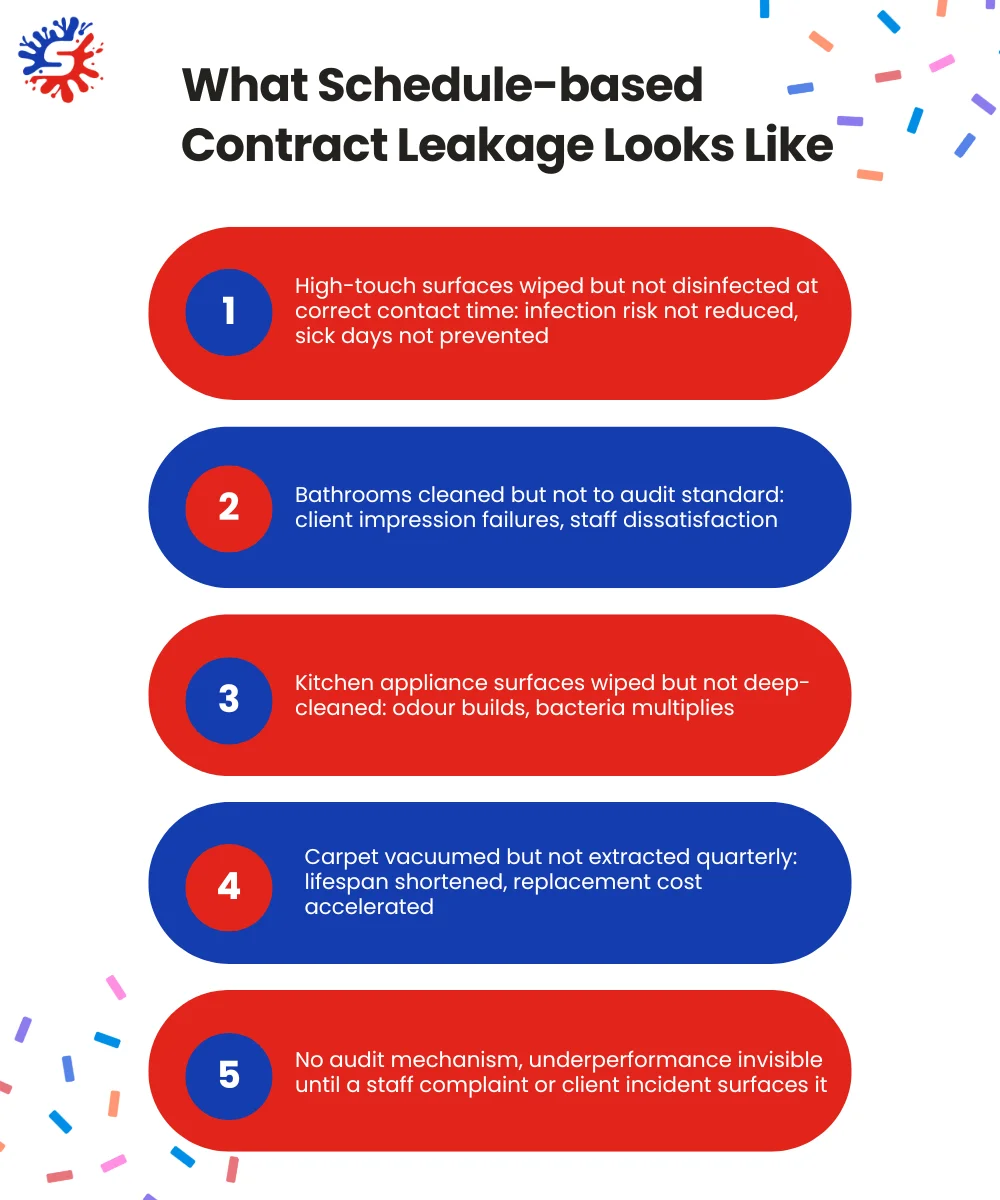
The full financial picture of what professional cleaning returns when structured properly is detailed in our analysis of commercial cleaning returns for Sydney businesses.
The Three Contract Shifts That Make the Difference
Moving from schedule-based to outcome-based does not require rewriting the entire contract from scratch. It requires three specific changes to the way performance is defined, measured, and enforced.
Shift 1: Replace Task Language with Standard Language
Go through every task in your current contract and ask: what does success look like? For every task, there is a measurable standard that constitutes completion to the required level. Write that standard into the contract.
The task is not 'vacuum the carpet.' The standard is 'carpeted areas to show no embedded debris or visible soiling under standard inspection.' The task is how the provider delivers against the standard. The standard is what you are paying for.
A cleaning specification defines each area, the tasks required, and the expected standards. Without a defined standard, the specification is incomplete and unenforceable.
Shift 2: Add an Audit Mechanism
An outcome cannot be verified without a measurement process. Your contract needs an audit schedule that specifies how often performance is assessed, who conducts the assessment, what scoring system is used, and what score constitutes passing.
The audit schedule should operate at two levels:
-
Fortnightly client-led inspections using a standard checklist that covers all nominated areas. Simple pass-or-fail scoring per item, with an overall percentage score. Completed by the office manager or facilities lead, not the cleaning provider.
-
Quarterly independent or joint inspections that cover deep clean compliance, asset condition assessment, and a review of complaint logs and completion records against the contract schedule.
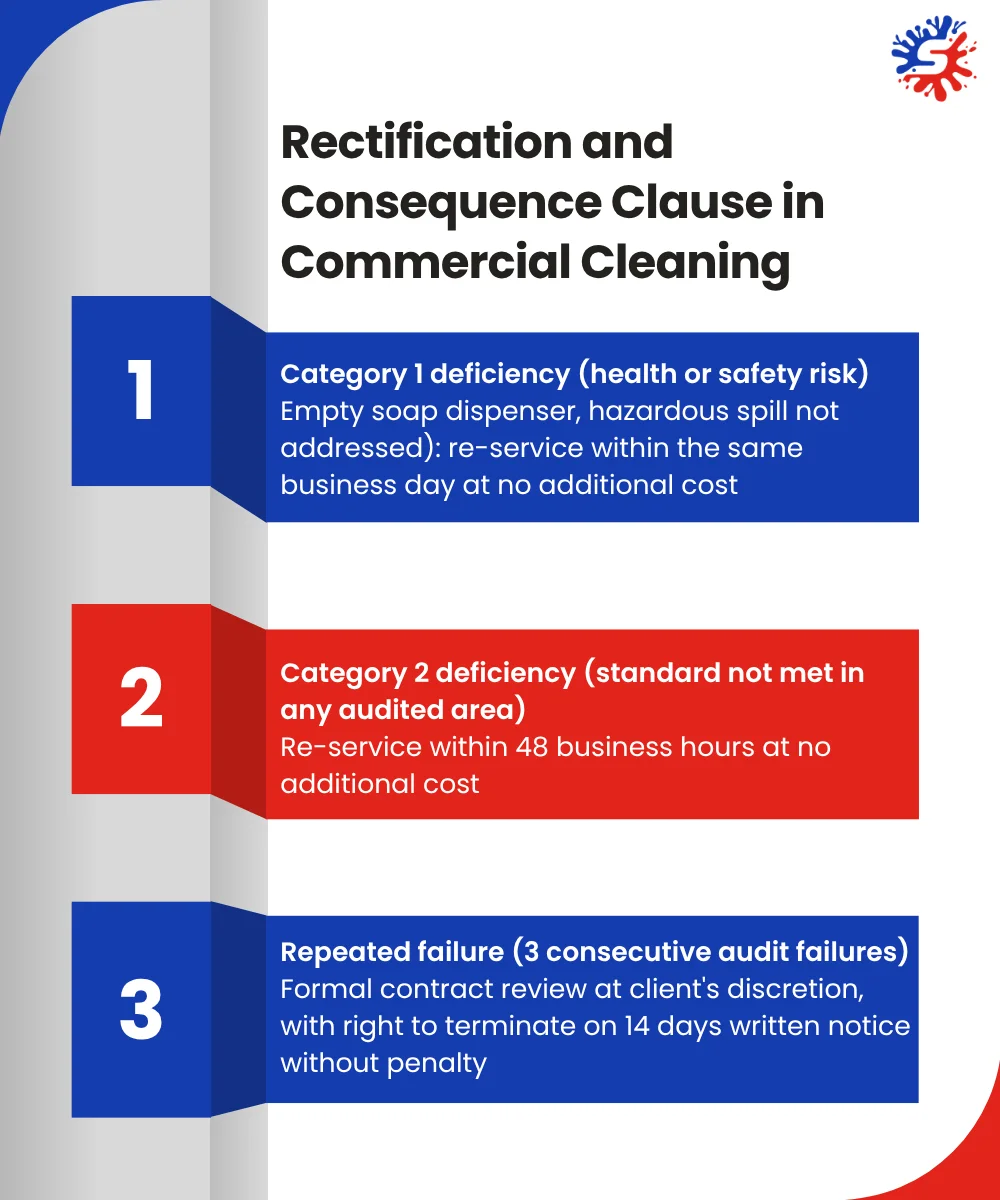
Shift 3: Add a Rectification and Consequence Clause
The audit has no teeth without a consequence clause. For every KPI in the contract, there should be a defined rectification process and a defined consequence for repeated failure:
If you want to see exactly what a cleaning audit looks like in practice before introducing one to your contract, our commercial cleaning services audit guide walks through the checklist format, scoring methodology, and how to interpret results against industry benchmarks.
What a Fully Structured Outcome-Based Contract Contains
For reference, here is the anatomy of a contract that is built around outcomes rather than schedules. This is the framework that we use for office cleaning contracts.
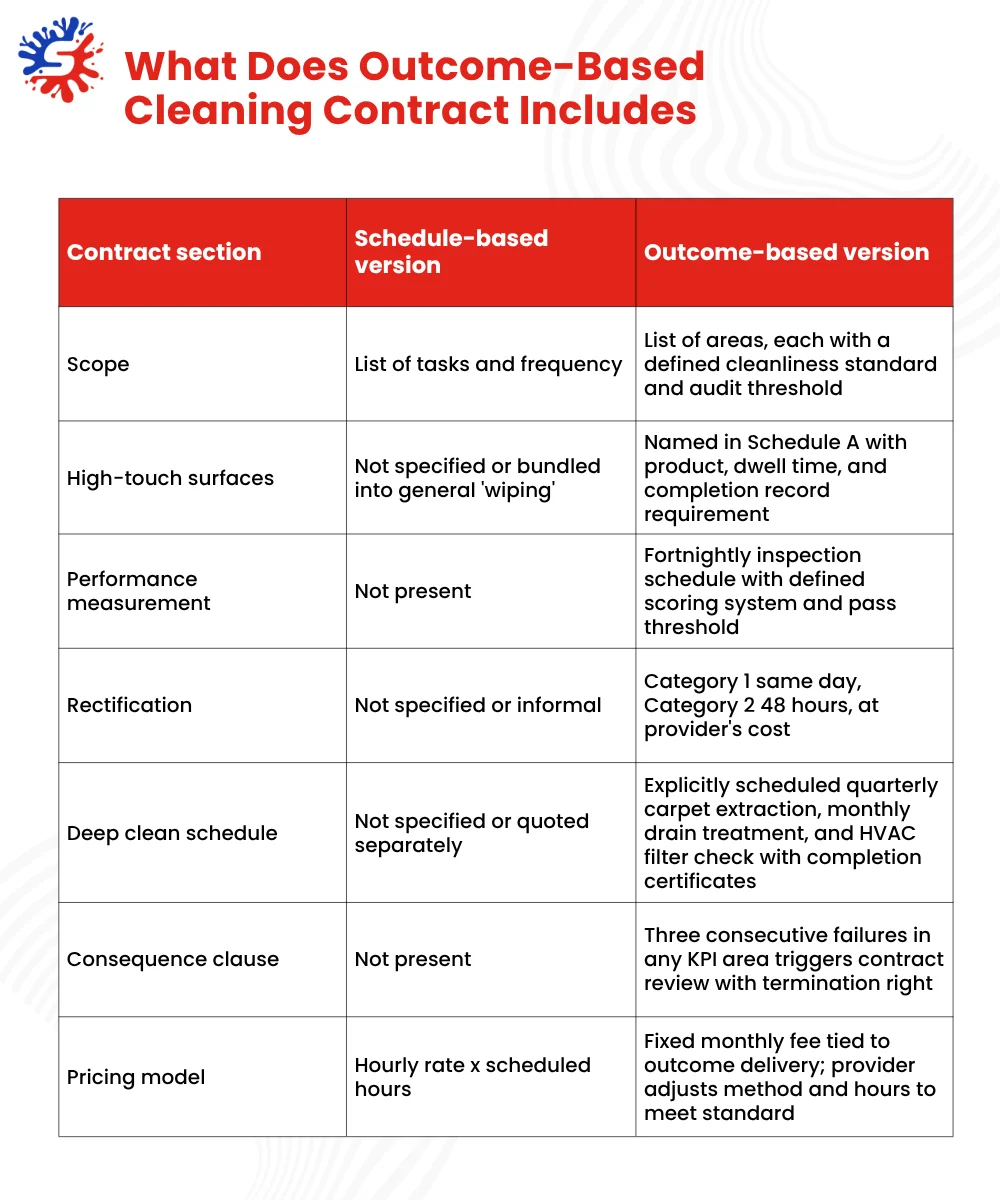
The detailed standards that sit behind each row of this table, specifically what each area of a Sydney CBD office should look like when the cleaning contract is performing, are covered in our commercial cleaning best practices guide.
How to Have the Conversation with Your Current Provider
If you are on a schedule-based contract and want to transition to an outcome-based structure, the most effective approach is to present the proposed changes as additions to the existing agreement rather than as a wholesale renegotiation.
Most providers, when presented with documented performance data and specific KPI language, will accept the amendment rather than risk losing the account. Those who refuse to accept performance accountability in their contract are telling you something worth knowing before the next renewal.
What to Bring to the Conversation
-
Three months of sick day records, a walk-through checklist scored against current conditions, and your staff environment satisfaction score. This is the before picture.
-
Standard definitions for each area, a KPI table, an audit schedule, and a rectification clause. Bring the document, not just the request.
-
Propose that the new KPI framework be assessed at 30, 60, and 90 days, with a joint review at each milestone. This frames the shift as a partnership improvement rather than a punitive change.
-
If your contract is approaching renewal, your strongest leverage is the option to retender. A provider who knows the contract is being competed will engage more seriously with performance accountability language than one who assumes automatic renewal.
The office cleaning strategy that actually pays for itself covers in detail how to structure that 90-day review framework and what data to collect during it.
When the Provider Will Not Move
Some providers will decline to accept KPI language or audit requirements into their contracts. This is useful information.
A provider who cannot commit to a measurable standard either does not believe they can meet one consistently or has not built the internal supervision systems that would allow them to track it. Either way, their refusal to be measured is a better predictor of ongoing performance than any reference they can offer.
The office cleaning data on the real cost of poor hygiene standards when it goes untracked and unaddressed makes a compelling internal business case for anyone who needs to justify the switch to leadership.
Conclusion
The schedule-based contract describes what your cleaning company does. The outcome-based contract describes what you actually need: a clean, safe, well-maintained office that your staff trust, your clients notice, and your assets benefit from.
The offices that get this right spend the same or less on cleaning and get measurably more from it. The offices that do not continue paying for someone to show up and hope for the best.
Contact Spark Clean Australia to review your current contract against the outcome-based framework. We will identify the specific gaps, propose the language changes, and put a performance measurement structure in place from the first service.
Frequently Asked Questions
Find quick answers to booking, payments, pet-friendly policies, deep cleaning, and more. Our team is dedicated to making the process effortless and transparent. If you have additional questions, we're here to help ensure a seamless experience.
Get In Touch