8 Critical Hygiene Failures in Gym That Can Void Public Liability Insurance
Most gym owners think about their public liability insurance when they sign up, when the premium renews, and when something goes wrong. The problem is that the conditions that void that insurance are not written in large print on the policy. They live in the fine print, under terms like 'reasonable care', 'duty of occupier', and 'systemic failure to manage known hazards'.
There are more than 7,700 gyms and fitness centers operating across Australia, and each is legally required to hold public liability insurance before opening. That insurance protects the business when a member is injured.
This blog covers the ten hygiene failures that most commonly cross that line. Each one is specific, documented, and more common in Sydney gyms than most operators realise. Each one has a clear action that prevents it.
Key Takeaways
-
In the eyes of an insurer or a court, a cleaning system that isn't documented does not exist. Without logs and audit trails, you are personally liable for injury claims.
-
Relying on member-accessible wipes is insufficient because they lack the required contact time to kill pathogens like S. aureus and do not guarantee 100% compliance.
-
Using prohibited cleaning chemicals voids manufacturer warranties and can lead to equipment failure, leaving you vulnerable to uninsured liability claims.
-
It is not the presence of water that causes liability, but the absence of a documented, hourly inspection and signage protocol during peak periods.
-
Locker room drains and porous surfaces (like gym mats and foam rollers) are high-risk vectors for MRSA and bacterial infections that require specialized cleaning, not just surface wiping.
How Hygiene Failures Void Public Liability Insurance in Australia
Public liability insurance for a gym is based on specific legal principles. The insurer agrees to cover claims against the gym provided the gym has met its duty of care to members and visitors.
When an insurer investigates a claim, the first thing it looks for is documentation. A gym that cannot produce documented evidence of a reasonable system of inspection and cleaning is, in the eyes of both the court and the insurer, a gym that had no system. And a claim arising from a failure of that non-existent system falls on the owner, not the policy.
Failure 1:Wet Floors Without a Documented Inspection System
Gym floors get wet, and that is not a hygiene failure. Water comes from showers, members' water bottles, sweat, cleaning equipment, and Sydney weather tracked in through the entry. None of these can be fully prevented.
What creates liability is not the wet floor, but the absence of a documented process to identify and address wet floors within a reasonable time. The difference between a covered claim and a gap in coverage is the logbook showing that floor inspections were conducted every hour during peak periods.
The range of personal injury compensation payouts for slip-and-fall accidents in Australia is $10,000 to $500,000+. A gym with no documented inspection or cleaning schedule is personally liable for the full amount if the insurer finds systemic hygiene negligence.

What a documented wet floor management system requires:
-
Scheduled floor inspection log at minimum hourly intervals during peak periods, with staff sign-off at each check
-
Wet floor signage protocol; signs deployed within 60 seconds of any wet surface identified, never removed until surface is dry
-
Non-slip matting at every entry point, in the changeroom, and at any transition from wet to dry surface
-
All gym floor surfaces to meet the relevant wet slip resistance standard under AS 4586
-
Incident records: any slip or near-miss recorded with time, location, condition of floor, and actions taken
Failure 2:Using the Wrong Cleaning Products on Equipment
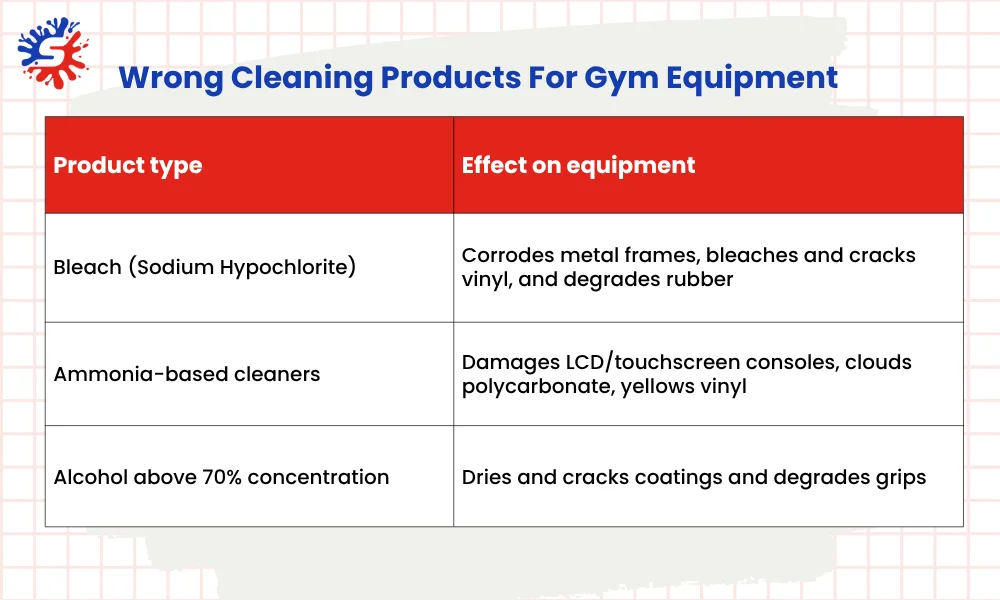
This failure has two simultaneous consequences. It voids the manufacturer's warranty on equipment worth tens of thousands of dollars. And it leaves a contamination problem because the wrong product was used at the wrong concentration for the wrong contact time.
The major commercial fitness equipment manufacturers explicitly prohibit specific products in their maintenance documentation. Using prohibited products voids the warranty and, if the equipment subsequently fails and causes injury, can expose the gym to an uninsured liability claim on the grounds that the equipment was not maintained.
Bleach, ammonia, and undiluted alcohol can easily damage gym equipment. These chemicals are prohibited by most major manufacturers and immediately void equipment warranties.
What most gym cleaning staff use instead is whatever spray is available at the time. This is the structural gap that the distinction between wiping a surface and actually sanitising it is built around. Looking clean and being disinfected are not the same outcome, and the difference matters to both the equipment manufacturer and the insurer.
Failure 3: No Disinfection Protocol Between Members on the Equipment
The gym industry operates on a fundamental assumption: members will wipe down equipment after use. The research shows that the assumption consistently fails, and the resulting equipment surfaces carry pathogen loads that create both infection risk and liability exposure.
73.81% of fitness equipment swab samples in a peer-reviewed study of gymnasiums tested positive for Staphylococcus aureus, a leading cause of cutaneous bacterial infection. The most contaminated surfaces were weight balls, cable curl bars, and CrossFit boxes.
S. aureus and MRSA contamination on 38.2% of surfaces across 16 commercial fitness facilities. The most frequently colonised surfaces were free weights, cable machines, and CrossFit equipment. Community gyms showed the highest contamination rates.
A gym with no staff-led disinfection protocol for high-use equipment, where a member contracts a skin infection and can demonstrate the gym had no documented system for equipment sanitation, is facing an unprotected liability claim.
-
Free weight handles: Disinfected with professional-grade product at correct dwell time after each scheduled interval, not just end of day
-
Cardio machine handles and touchscreens: Wiped with approved product between peak periods, with staff sign-off
-
Resistance machine handles, pads, and headrests: Disinfected at scheduled intervals regardless of visible use
-
Completion records: Equipment disinfection schedule logged and available for inspection
Failure 4: Locker Room and Shower Drain Neglect
Locker room drains are among the most overlooked surfaces in any gym cleaning program and among the highest-risk vectors for serious bacterial infection. The conditions inside a commercial shower drain are ideal for the establishment of bacterial biofilm: warm, moist, continuously replenished with organic matter, and rarely disturbed by cleaning.
CBS News testing at four major gym chains found "astronomical total bacteria counts in the many millions" on gym surfaces. The highest E. coli counts were found on mats and in showers. Pseudomonas, which can cause serious rashes, was found in showers at every location.
A member who contracts a serious skin infection, MRSA, athlete's foot, or ringworm, and can connect it to inadequate locker room hygiene in a gym with no documented drain cleaning schedule, has the basis for a public liability claim. The claim is strengthened significantly if no treatment records exist.
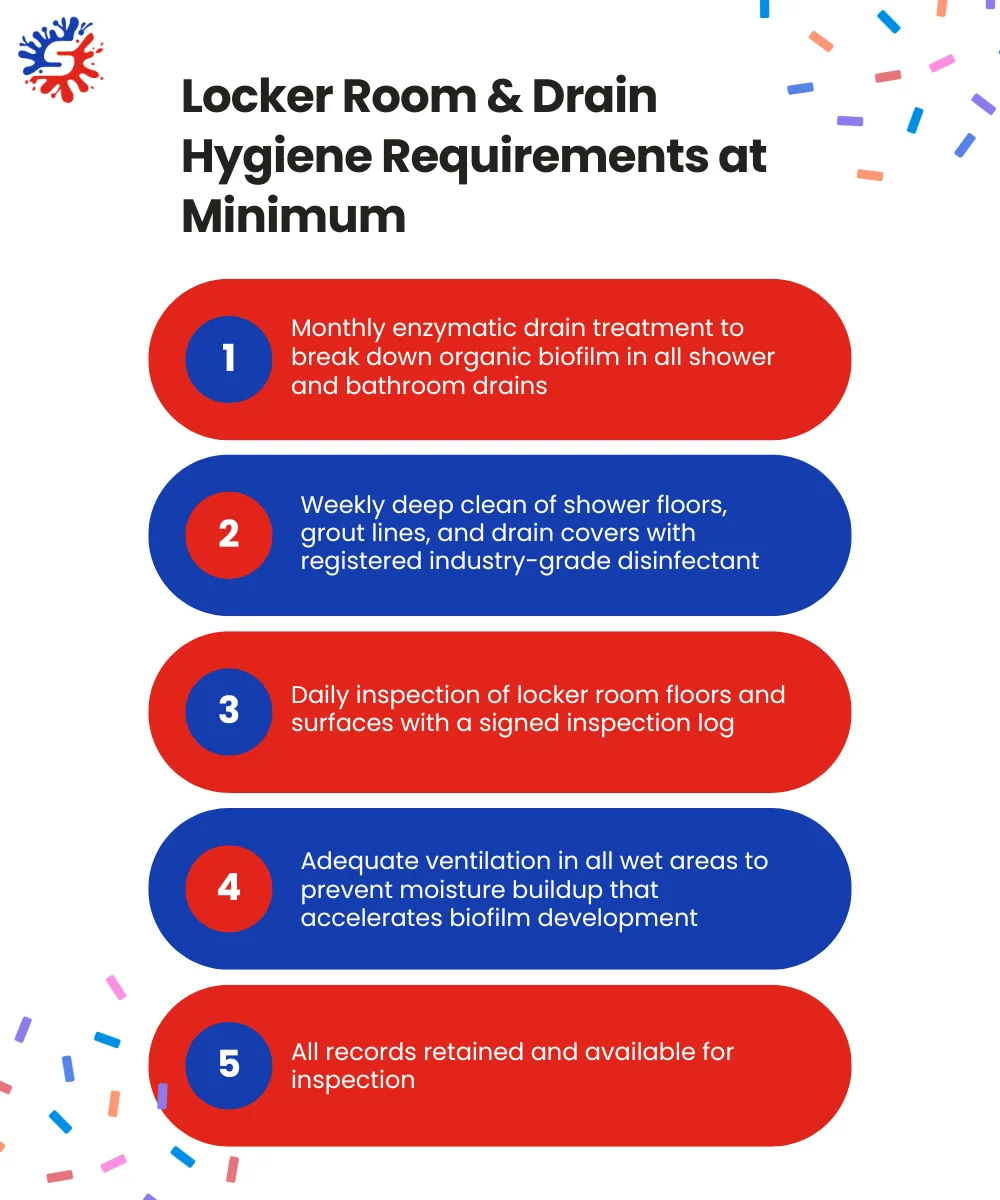
What locker room and drain hygiene requires at a minimum:
The hygiene data on what accumulates in shared wet facilities over time is detailed in our bathroom hygiene statistics resource, which covers contamination patterns in commercial wet areas.
Failure 5: No Documented Cleaning Schedule or Completion Records
This is the failure that converts every other hygiene problem on this list from a manageable issue into an uninsured liability. A gym with a genuine cleaning routine but no records of it is legally indistinguishable from a gym with no cleaning routine at all.
A cleaning contract that lacks a KPI structure, completion records, and an audit mechanism does not provide this documentation. A cleaning provider who delivers completion records after every service, maintains a signed inspection log, and produces an audit report quarterly does.
Failure 6: Inadequate Wet Area and Changeroom Sanitation
Beyond the drain, the entire wet-area ecosystem in a commercial gym poses a sustained pathogen risk that requires a cleaning standard above what most operators maintain. Tinea pedis (athlete's foot), ringworm, plantar warts, and MRSA skin infections are all associated with gym changerooms and showers.
The overall prevalence of S. aureus on environmental surfaces across 16 commercial fitness facilities was 38.2%, with MRSA identified across multiple facility types. The incidence of MRSA in athletes is almost triple that observed in the general population.
Failure 7: Rubber Flooring and Gym Mat Sanitisation Failure
Rubber and foam surfaces in gyms, including free-weight area flooring, stretching mats, yoga mats, and CrossFit platforms, are among the most contaminated surfaces in any fitness facility. Their porosity allows bacteria to persist below the surface level, where a simple wipe cannot reach.
62.5% of weight balls and CrossFit boxes tested positive for S. aureus in a 2023 multi-facility study. Treadmill handles showed a 50% prevalence of contamination. These are contact surfaces where members' skin abrasions during exercise create a direct pathway for the transmission of infection.
The combination of skin abrasions from exercise and contaminated surfaces is the specific transmission mechanism that makes gym equipment a higher-risk source of infection than most other commercial environments. A member who sustains a visible skin abrasion during a workout and then contacts a surface contaminated with S. aureus has a direct route to infection.
Failure 8: Consumer Wipes as the Primary Disinfection Method
Every gym in Australia has a dispenser of member-accessible wipes near the equipment. This is a good habit to encourage in members. It is a catastrophically insufficient hygiene strategy on its own, and a gym that relies on member wipes as its primary disinfection method has a public liability exposure it may not be aware of.
The problem with consumer wipes at a standard gym is threefold:
-
A typical wipe-down by a member takes 5 to 10 seconds. Most disinfectants require 30 to 60 seconds of contact time on the surface to inactivate MRSA and other target pathogens.
-
Even with clearly positioned dispensers, a significant proportion of members skip the wipe-down after use. No gym can document 100% member compliance, and a court will not accept member responsibility as a substitute for an operator hygiene system.
-
Consumer wipes are not regarded as disinfectants. Many are primarily designed to remove visible soil, not to achieve microbial reduction to the level required for gym equipment.
The principles that differentiate a surface wipe from actual commercial disinfection are directly applicable here. Member-available wipes are a hygiene supplement, not a hygiene system.
What a Gym Cleaning Program That Protects Your Insurance Actually Looks Like
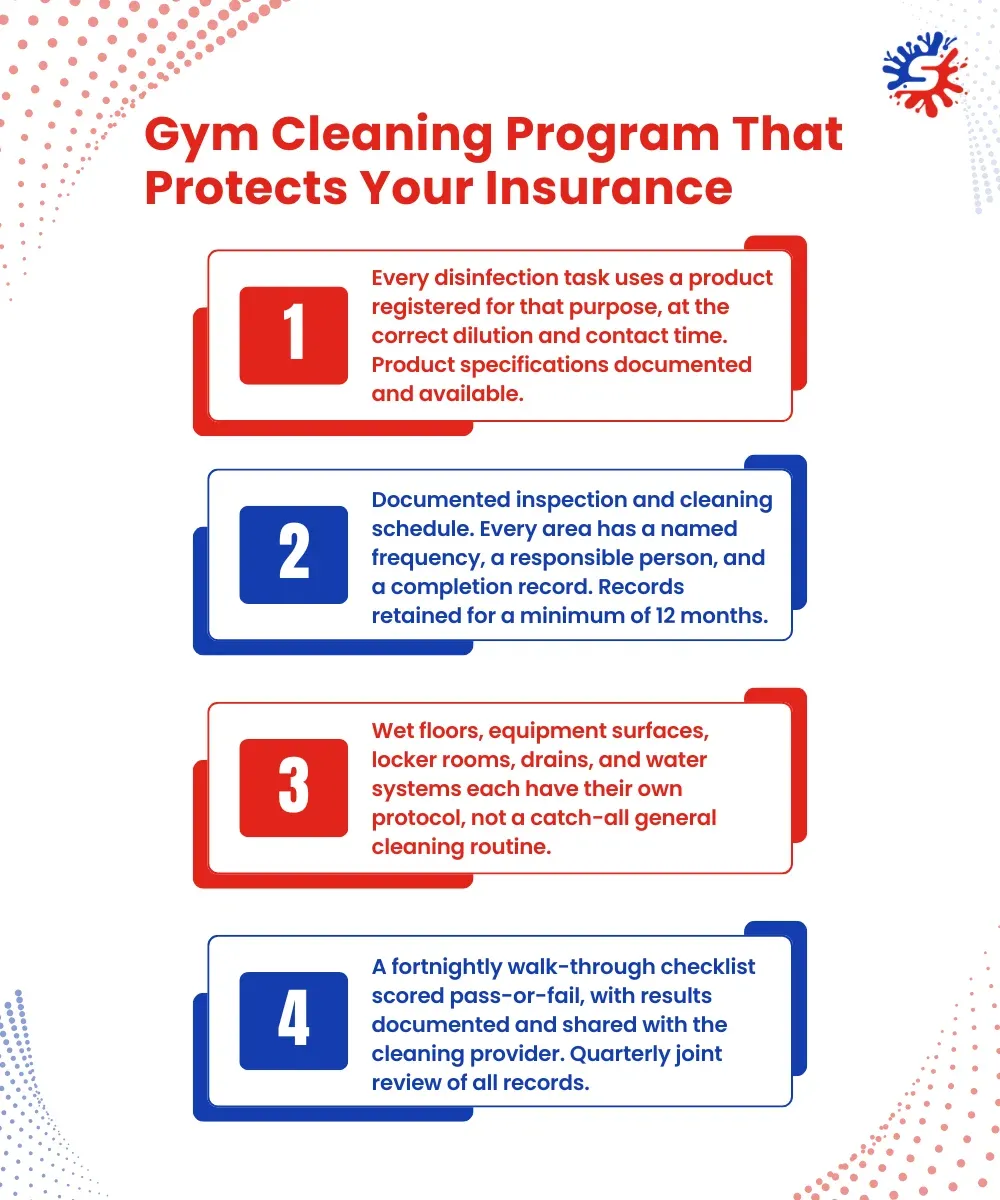
A hygiene program that holds up to both a public liability insurer and an Australian court has four specific components. All four need to be present. The absence of any one of them creates an exposure.
Your Insurance is Only as Good as Your Hygiene System
A gym that can produce a signed inspection log, a completed equipment disinfection schedule, drain treatment records, and a quarterly audit report has taken reasonable care. A gym that cannot produce any of those things is a gym that did not take reasonable care.
If you want to understand whether your current gym cleaning program would hold up to an insurer's investigation or a NSW court's standard of reasonable care, contact Spark Clean Australia for a consultation.
Frequently Asked Questions
Find quick answers to booking, payments, pet-friendly policies, deep cleaning, and more. Our team is dedicated to making the process effortless and transparent. If you have additional questions, we're here to help ensure a seamless experience.
Get In Touch