Lessons We Learned From 6 Years of Commercial Cleaning in Sydney
Six years ago, we started Spark Clean Australia with one core belief: that proper cleaning changes how a business performs. We had the theory; what we did not yet have was 200-plus office spaces, hundreds of post-service surveys, and one very consistent pattern of findings that took us three years to fully articulate.
Australia's commercial cleaning industry is now worth $20 billion in annual revenue, supported by more than 44,000 businesses and over 209,000 employees nationwide. In an industry that large and that crowded, the difference between providers who actually move the needle for their clients and providers who simply show up is not equipment or product. It is understanding.
If you manage a Sydney office, pub, strata building, or any commercial space, some of this will be uncomfortable to read. However, we think that is a sign it is worth reading.
Key Takeaways
- Poorly defined cleaning contracts typically waste 9% of their annual value due to lack of measurable performance standards
- Facility satisfaction correlates most strongly with bathroom maintenance, making it the most critical room to audit.
- Cleaning with a "reset" focus, rather than maintenance, increases employee well-being scores by 12% on Monday mornings
- Persistent odors indicate long-term pollution buildup, as indoor air can be 2–5 times more contaminated than outdoor air
- Meticulous documentation is essential, especially given a 25.8% year-on-year increase in NSW food safety penalty notices
- Low-priced quotes mask hidden expenses such as high absenteeism and asset decay, with 72% of workers reporting productivity losses in dirty spaces
- Since only 1 in 26 unhappy clients complain, proactive surveys are required to prevent silent contract churn
What the First Year Actually Taught Us
When we started, we believed what most people in this industry believe at the beginning: that a good clean is visible. You can see a mopped floor, empty bins, and wiped glass. These are the signals a client registers during a walk-through, and we focused on them.
What we did not yet understand was that the things clients consciously register are not the ones that drive their actual satisfaction or dissatisfaction with the service. They are the bacterial load on the coffee machine handle. The draft beer line has not been properly flushed. The carpet bacteria that produce a smell clients notice, and employees no longer perceive. The drain that needs treatment, not mopping.
The first year taught us that visible cleanliness and actual cleanliness are different outcomes. Getting both right simultaneously is the professional standard. Getting only the visible version right is what most of our competitors charge for.
This distinction is the foundation of everything else we figured out, and it is the subject of our detailed breakdown of what surface cleaning versus commercial sanitisation actually produces.
Ten Things We Figured Out the Hard Way
Lesson 1: Most Clients Do Not Know What Their Contract Is Paying For
This is the lesson that took the longest to say out loud, because it implies something uncomfortable about an industry we are part of.
When we audit a new client's existing cleaning arrangement, as part of our standard onboarding process, the most common finding is not that the previous provider was dishonest. It is that the contract was written in a way that made honest measurement of performance impossible.
Most commercial cleaning contracts in Sydney are built around inputs: how many hours, how many visits, which tasks to perform. They do not specify what standard those tasks must meet, how that standard will be measured, or what happens when it is not met. World Commerce and Contracting research found that poor contract management costs organisations an average of 9% of annual contract value. For a cleaning contract, that leakage is invisible precisely because there is nothing to measure it against.
When we switched our contracts to outcome-based language, defining the standard each area needs to reach and specifying a fortnightly audit process to verify it, two things changed. Our clients could see what they were paying for. And we could not hide behind effort when the standard was not met.
Lesson 2: The Surfaces That Matter Most Are Almost Never on the Checklist
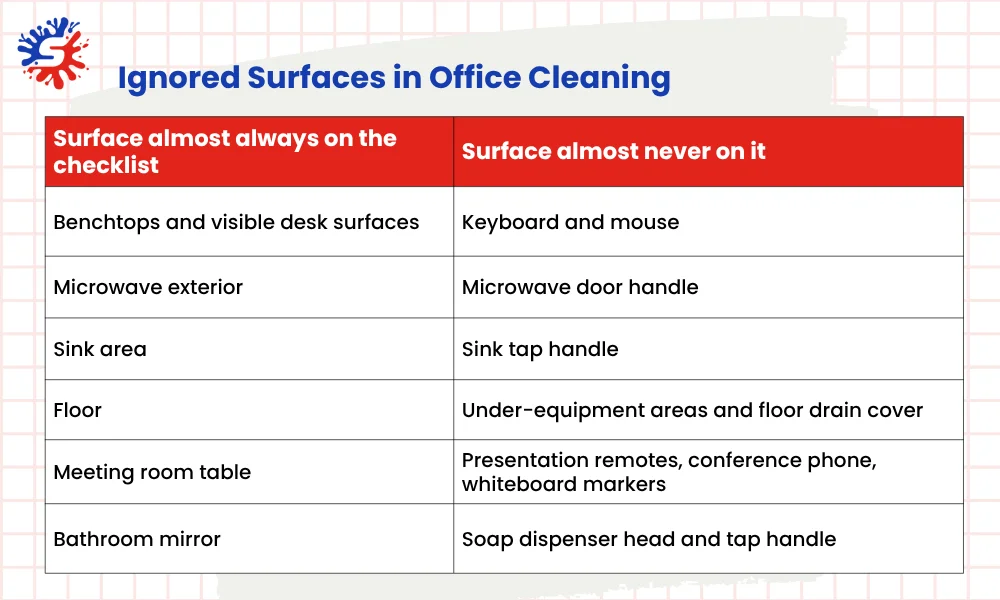
Ask any cleaning provider what they clean in an office kitchen, and you will get a list: benchtops, appliance exteriors, sink, and floor. That list is accurate and incomplete in the ways that matter most.
A study, one of the most detailed workplace germ studies published, found that the microwave door handle and the sink tap handle, not the visible surfaces we all wipe, are the highest-contamination surfaces in an office kitchen.
These surfaces are almost never on a standard cleaning checklist. Not because the providers do not know about them. Because writing them into a checklist with a specific disinfection protocol and a verification requirement takes effort and creates accountability, most contracts avoid both.
The full picture of what accumulates on high-touch surfaces in a Sydney CBD office across a working day is more than most office managers have seen before. It is also more than most cleaning contracts address.
Lesson 3: The Bathroom Tells the Whole Story
We have seen this pattern enough times to state it as a rule: show us the bathroom and we will tell you what the client thinks of the cleaning contract.
Clients and staff do not consciously inspect the bathroom as a diagnostic tool. But they experience it as one. A bathroom with functioning soap dispensers, a drain that does not smell, clean grout lines, and a bin that has been emptied communicates that the space is being genuinely maintained.
A bathroom with empty dispensers, a faint drain odour, and a full bin communicates the opposite, regardless of what the rest of the office looks like. After 200-plus offices, we stopped treating the bathroom as one item on a checklist. We started treating it as the single most important room in any commercial space because it has the strongest correlation with overall satisfaction in every survey we have ever run.
The bathroom hygiene statistics that drive this are consistent across residential and commercial settings. What this changed in practice: our bathroom standard now has its own checklist, audit threshold, and rectification trigger.
Lesson 4: Monday Morning is the Most Important Clean of the Week
We stumbled onto this one through our post-service survey data, and it surprised us when we first saw it.
The single question on our survey that correlates most strongly with overall client satisfaction is not about cleanliness scores or task completion. It is: 'When you arrived at the office Monday morning, did the space feel ready for the week?'
Those two things feel different, even when they look similar. The difference is intentional:
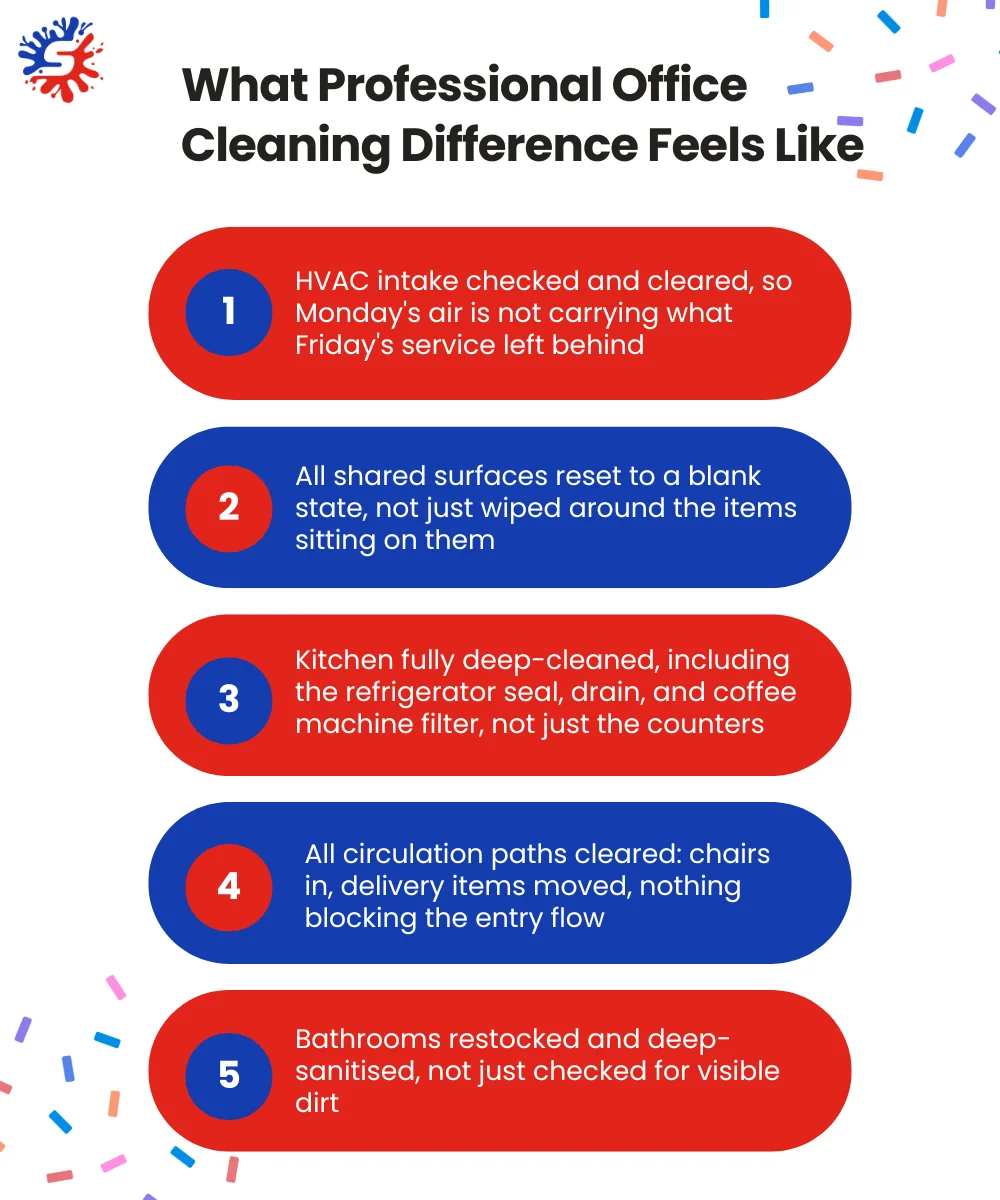
Our post-service data shows a 12% higher reported sense of well-being on Monday mornings in offices where the Friday or weekend clean is specifically structured as a reset rather than a maintenance service. This aligns with research on how indoor CO2 levels and air quality at the start of the week directly affect cognitive performance during the first hours of work.
Lesson 5: The Smell Was Always Telling Us Something
A smell in a commercial space is not just unpleasant. It is diagnostic. Every time we have arrived at a new client's space and detected a background odour, the source of that odour has turned out to be a real hygiene problem.
The EPA reports that indoor air can be 2 to 5 times more polluted than outdoor air. In a poorly maintained office or hospitality venue, the smell is the first sign that the air quality problem has become visible, or rather audible to the nose, but the underlying accumulation has been building for weeks or months.
We learned to treat a smell as a referral for an investigation, not as something to neutralise with an air freshener. The investigation almost always found something the standard cleaning routine had been missing.
Lesson 6: Staff Notice Three Things and Not What You Think
Five years of post-service surveys have produced a pattern that now underpins how we design every cleaning program.
We would ask staff to describe what they noticed after a service. The responses were not evenly distributed across all cleaning tasks completed. They concentrated in three areas, consistently, across office types, industries, and building sizes:
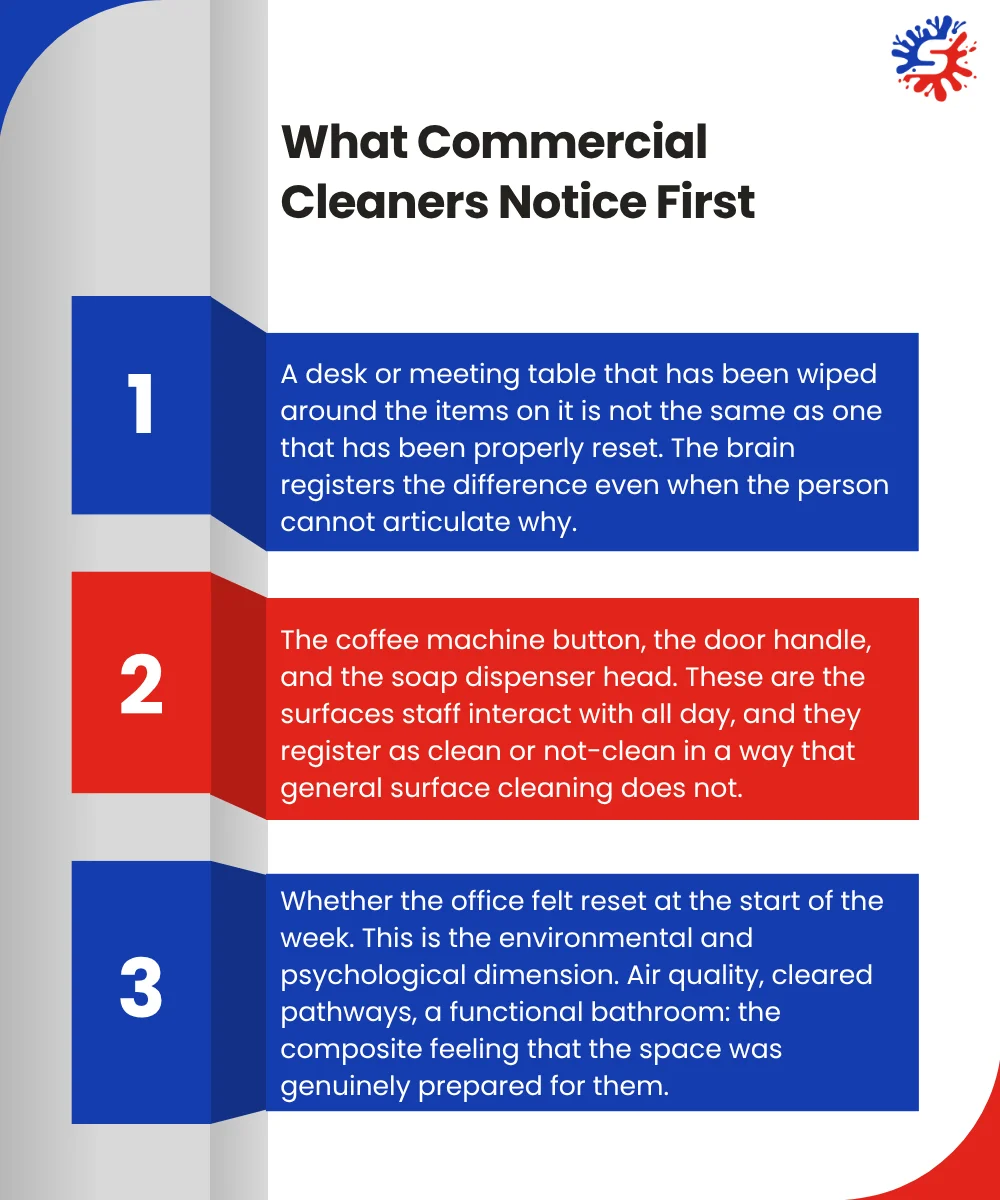
Visual clutter on surfaces directly competes for neural representation in the brain's visual cortex, reducing focus and increasing cognitive load. This is why a cleared shared desk produces a real, measurable change in how staff experience their productivity, not just a cosmetic improvement.
Lesson 7: The Cheapest Quote Is Almost Always the Most Expensive Contract
It is a recurring reality in the industry: the lowest price is almost always the most expensive contract. When a Sydney CBD office chooses a cleaning contract based solely on price, they rarely save money in the long run. Instead, they typically incur costs that far exceed the initial "savings" through three primary avenues:
-
Increased Sick Days: Neglected high-touch surfaces lead to poor hygiene, driving up employee illness and absenteeism.
-
Asset Depreciation: Skipping scheduled carpet or floor extractions accelerates wear and tear, leading to premature, costly replacements.
-
Emergency Expenses: Failed inspections or client complaints necessitate reactive, emergency-rate cleaning services.
Beyond direct maintenance costs, a dirty workspace has a quantifiable impact on your bottom line. Research highlights the correlation between office hygiene and employee behavior:
-
Productivity: 72% of office workers report that working in dirty surroundings decreases their overall productivity.
-
Engagement: 46% of employees admit to taking longer lunch breaks simply to escape a messy office environment.
Almost always, the price gap reveals a compromise in the most critical areas of service:
-
Frequency of deep-cleaning cycles
-
Protocols for disinfecting high-touch surfaces
-
Documented quality audit schedules
-
Formal rectification clauses
For a deeper look at how professional cleaning affects your overheads, you can review our full analysis of the true returns of a properly structured commercial cleaning contract for Sydney businesses.
Lesson 8: Documentation is What Separates Compliance From Crisis
This lesson came from our hospitality clients. Specifically, from watching what happened when an environmental health officer arrived without notice.
We have worked with venues that were genuinely clean, by any reasonable standard, and still received an enforcement notice because they could not produce a temperature log, a beer line cleaning record, or an exhaust system service certificate. The cleaning had been done. But without a record, the officer had no evidence of it.
We have also watched venues with visible hygiene issues avoid the worst outcomes because their documentation was meticulous. The officer could see what had been done, when, and by whom. The violations they found were treated as isolated gaps in an otherwise disciplined system, not as evidence of systemic neglect.
As of December 2025, 412 Sydney food businesses appeared on the NSW Food Authority's active penalty notices register, a 25.8% year-on-year increase. Many of those businesses were not the dirtiest venues in their postcode. They were the ones without documentation.
We now build documentation delivery into every hospitality and commercial contract we hold. After every service, the client receives a completion record. Deep cleans produce certificates. Beer line cleans are logged. Ice machine decontaminations are dated and signed. The paper trail is not overhead. It is protection.
Lesson 9: The Feedback Loop Is Where the Relationship Lives
Early in the business, we treated client feedback as something that happened when something went wrong. A complaint would come in; we would respond, fix it, and continue.
What we learned, slowly and through some uncomfortable contract losses, is that the absence of complaints is not the same as satisfaction. In the cleaning industry, most clients do not complain when something is not right. They tolerate it, slightly lower their expectations, and start paying attention when it is time to renew.
Research found that only 1 in 26 unhappy customers will tell the business about their bad experience. The other 25 say nothing and make a different decision at renewal.
Our response to this was structured feedback: a brief post-service survey after every clean, a quarterly joint walk-through audit with the client's facilities contact, and a six-monthly contract performance review where we present our own audit data alongside the client's feedback scores.
The commercial cleaning services audit framework we use for these quarterly reviews is available to any Sydney business that wants to assess their current provider's performance against a documented standard.
Lesson 10: Cleaning is Not a Facility Cost, But a Signal.
This is the lesson that changed everything for us, and it came from listening to staff rather than managers. Managers talk about cleaning in terms of cost per square metre and service frequency. Staff talk about it in terms of how the office makes them feel.
A study found that 86% of office employees emphasise cleanliness as important to their work environment. What all of this research and all of our survey data consistently point to is the same thing: when an employee walks into a clean, well-maintained office, they do not think about cleaning.
Employees think about work, they feel capable, and valued. And that feeling is not accidental or incidental. It is a direct communication from the business to its people about how much their daily experience matters.
Cleaning signals in an organisation that runs a space has its priorities in order. When that signal is strong, everything else the business does lands slightly better, from a client pitch to a staff performance review.
This is the principle behind what Sydney's best-performing offices have built into their hygiene investment strategies. It is not about keeping things tidy. It is about what tidiness communicates.
How These Lessons Changed What We Do
Every one of these lessons is now embedded in how we operate. Not as a mission statement on a wall. As specific, documented changes to how we write contracts, how we train our team, how we structure our audits, and what we refuse to compromise on.
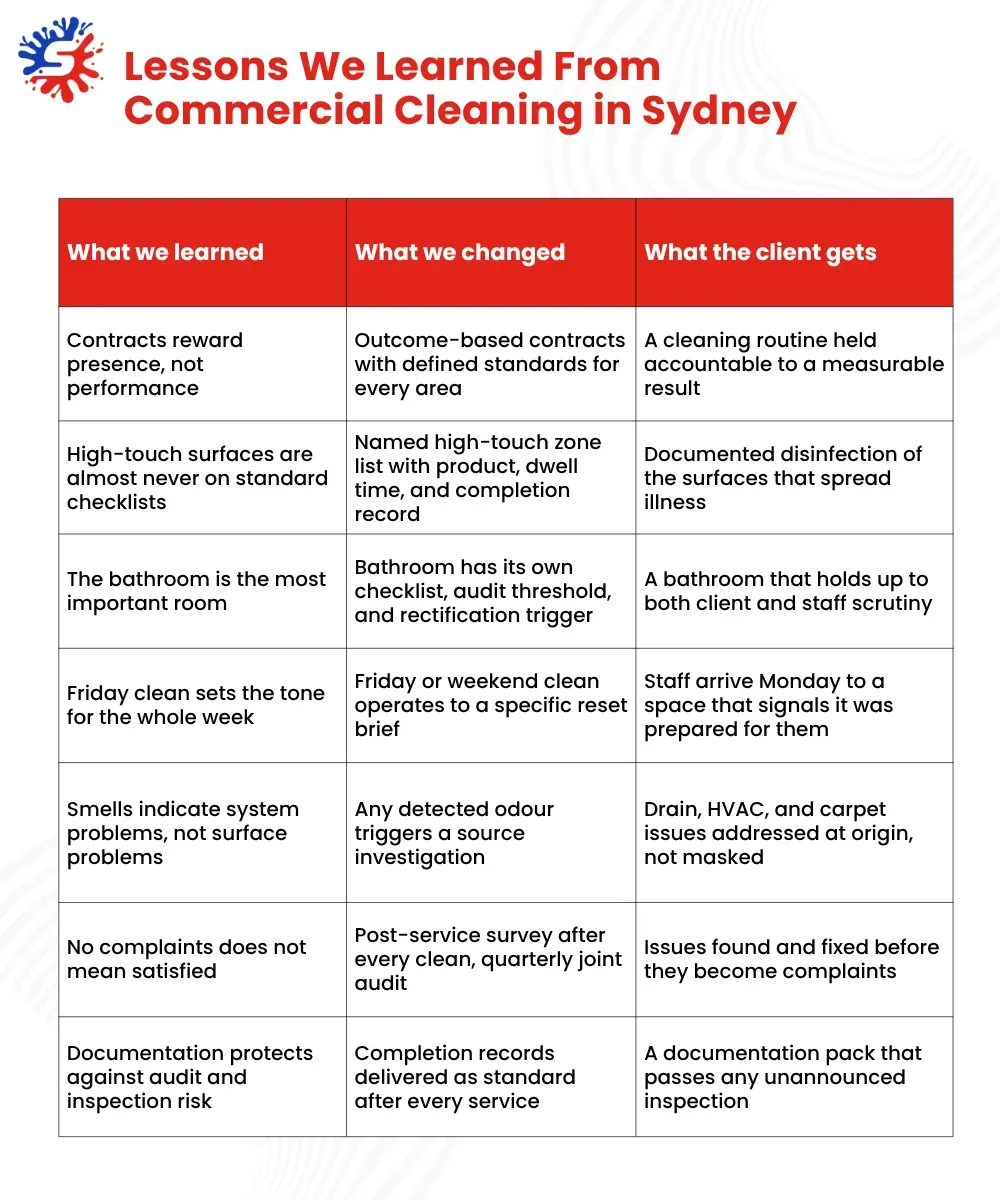
What This Means if You are Managing a Sydney Commercial Space
If you have read this far, you are probably reviewing your current cleaning arrangement in the back of your mind. That is a useful reflex.
We are not suggesting every Sydney business needs to switch providers. We are suggesting every Sydney business should be able to answer five questions about their current one:
-
Does your contract specify the standard each area must meet, or only the tasks to be performed?
-
Does your contract include a fortnightly audit schedule with a defined scoring system, and does it specify what happens when the standard is not met?
-
Is there a documented high-touch zone list with disinfection protocols and completion records?
-
Is your Friday or weekend clean operating to a reset brief, or the same brief as Tuesday?
-
When was the last time you walked through your space with the question 'what would a client notice in the first 60 seconds?' rather than 'is it tidy?'
If any of those five questions produces an uncertain answer, that uncertainty is where the value is being lost. Our office cleaning strategy for Sydney CBD businesses walks through how to answer each of those questions against a specific, documented standard.
And if you want to look at your current provider's performance across the things we have found matter, actually, our free commercial cleaning services audit checklist gives you the framework for that walk-through in about 30 minutes.
Six Years, One Conclusion
After six years of cleaning Sydney offices, pubs, strata buildings, medical suites, and hospitality venues, we have one conclusion that holds across the board: Cleaning is not something that happens to a space. It is something that happens to the people in it.
When it is done with that intent, the measurable outcomes follow. Sick days go down, client impressions improve, and staff feel more valued. We know which kind of cleaning company we want to be. We have spent six years building systems to ensure consistency.
If you would like to understand what that looks like for your specific Sydney commercial space, contact Spark Clean Australia for a consultation. We will assess your current setup, identify the gaps, and put together a proposal that reflects everything on this list.
Our commercial office cleaning services in Sydney are built around every lesson in this blog. Outcome-based contracts, documented audit schedules, named high-touch zone protocols, and a Friday reset brief are all standard. All measured. All on the record.
Frequently Asked Questions
Find quick answers to booking, payments, pet-friendly policies, deep cleaning, and more. Our team is dedicated to making the process effortless and transparent. If you have additional questions, we're here to help ensure a seamless experience.
Get In Touch