Sydney Offices are Losing 15% of Monthly Revenue Due to Dirty Workplace
Most business owners know exactly where their expenses go. Rent, salaries, software, marketing, and more. These are the items that get reviewed, questioned, and negotiated every budget cycle.
What almost no business owner tracks is the money leaving quietly through a dirty office. No invoice arrives for it, and it does not show up in the accounts. It disappears through sick days, through clients who form a bad impression, through staff who start looking elsewhere because the place they work in does not feel cared for.
Together, these losses routinely account for between 10 and 15 percent of monthly revenue for Sydney CBD businesses, and they stay invisible because nobody connects them back to hygiene.
Key Takeaways
- Absenteeism costs Australian employers $33 billion per year
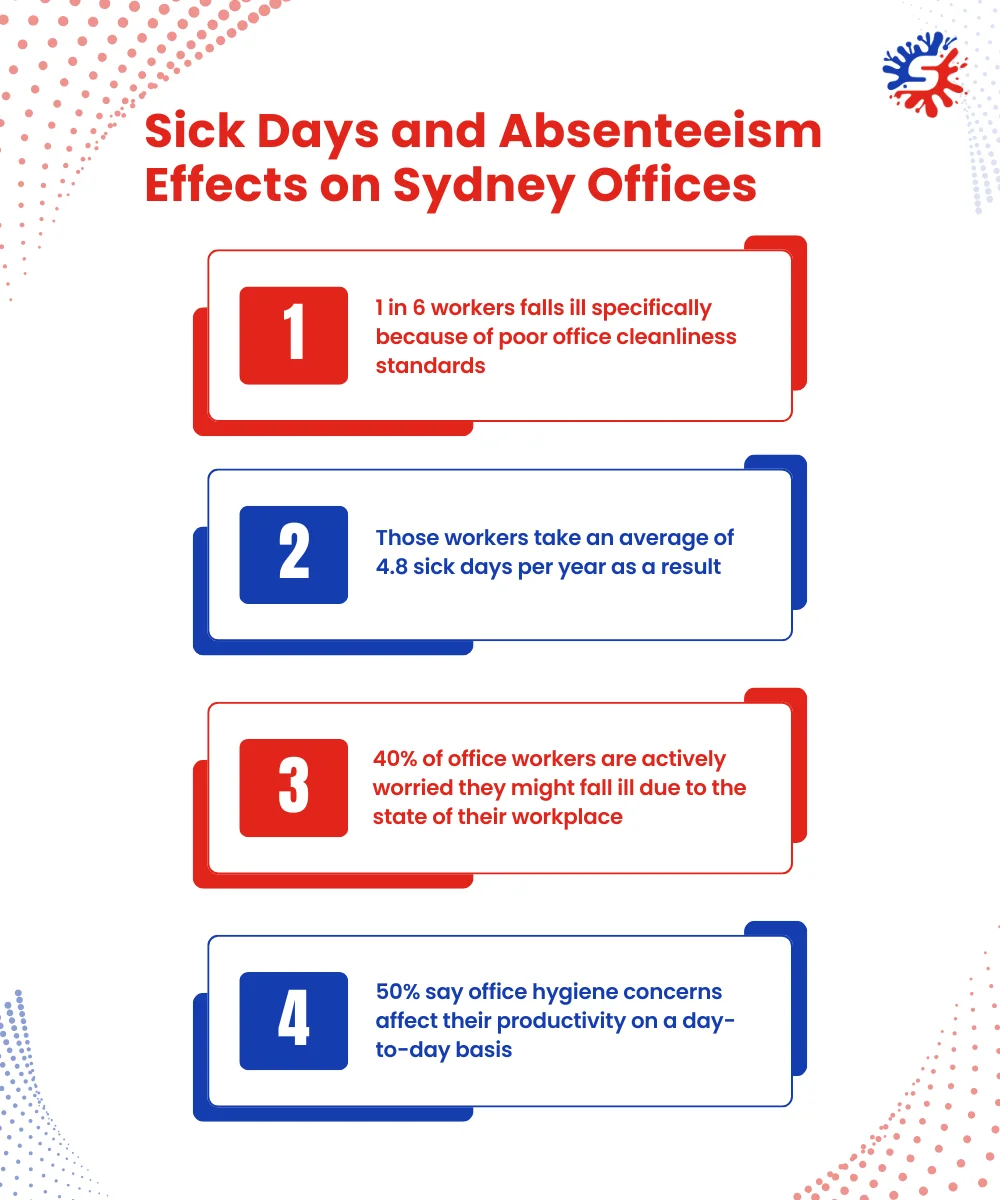
- 1 in 6 Australian workers falls ill due to poor office cleanliness, taking an average of 4.8 sick days each year as a result
- 50% of Australian office workers say hygiene concerns actively affect their productivity at work
- Workplaces with routine professional cleaning protocols reduces employee sick days
- People form a first impression of your office within 7 seconds of walking in
- A single contaminated shared surface can spread illness to multiple colleagues within days
Where the 15% Actually Goes
The revenue leak happens across three channels. They operate simultaneously, are rarely measured separately, and are almost never traced back to office hygiene. But each one has a clear financial footprint.
Channel 1: Sick Days and Absenteeism
Absenteeism costs Australian employers $33 billion per year in lost productivity. That figure excludes presenteeism, which is the separate, larger problem of staff who show up but are not working at full capacity because they are unwell. Presenteeism costs similarly, bringing the combined total to 65-68 billion annually.
The hygiene connection is direct. A survey by Initial Hygiene found that in Australia:
Channel 2: Reduced Output Even When People Are There
The higher, less visible cost is presenteeism. A worker who comes in sick and operates at 50% capacity costs the business as much as half a day's output without the business recording a single sick day.
Office workers in clean environments have higher productivity than those in poorly maintained spaces. Research from Harvard University reinforced this, showing a 61% improvement in cognitive performance in cleaner, better-ventilated green workspaces.
That gap shows up as work that takes longer, decisions that are made more slowly, and meetings that run over because nobody in the room is efficient.
Channel 3: Business You Lose at the Front Door
People form a first impression of a space within seven seconds of entering. In those moments, before a word is spoken, a client is deciding whether your business is trustworthy, competent, and worth dealing with. A dirty entry area, a smeared glass partition, or dusty surfaces in a meeting room do not just create discomfort.
The revenue that walks out the door after that impression is never counted as a hygiene cost, but it is.
The Germ Problem Your Office Does Not Know It Has
Most people picture a dirty office as one that looks dirty. Visible mess. Overflowing bins. Stained carpets. In reality, the surfaces that spread illness most effectively in a typical Sydney CBD office look completely normal.
What Lives on the Surfaces Your Team Touches All Day
A 13-month study that swabbed 4,800 surfaces across office buildings found that the highest bacterial readings were not in the bathrooms. They were on microwave door handles, keyboard surfaces, tap handles, and fridge doors.
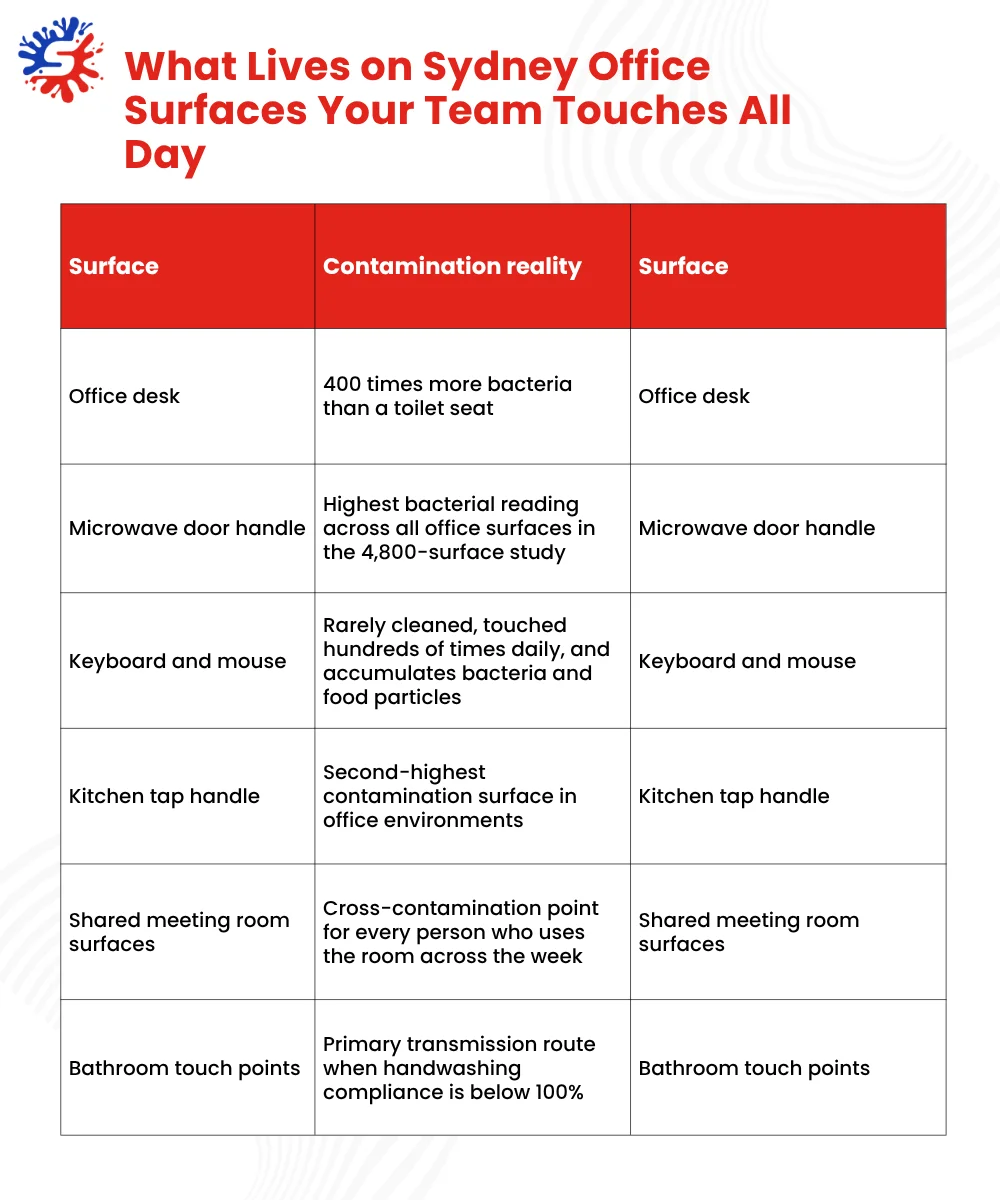
Viruses can survive on hard surfaces like phones and keyboards for hours and, under certain conditions, for months. A single sick staff member who does not stay home spreads the illness to colleagues through every surface they touch. By Wednesday, three people are infected, which started with one.
Why Open-Plan Offices Make This Worse
Open-plan office layouts, which now dominate Sydney workspaces, significantly amplify the problem. Workers in open-plan spaces have a higher incidence of sickness absence than those in private or shared cellular offices.
In an open-plan layout, the same air circulates, surfaces are constantly shared, and there is no physical barrier between a sick employee and the rest of the team. A hygiene routine that was adequate when everyone had a private office is not adequate in a modern open-plan space.
Our detailed look at what office germs look like in Sydney CBD covers exactly which surfaces accumulate the most contamination across a standard working day and why end-of-day cleaning timing matters.
The Client Impression You Cannot Afford to Get Wrong
Every client visit, every in-person pitch, every partner who walks through your door is making a subconscious assessment of your business in the first few seconds.
Cleanliness is one of the strongest signals people use when forming that impression. A clean, well-maintained office communicates reliability, professionalism, and attention to detail. A dirty one communicates the opposite, regardless of what you say in the meeting that follows.
What Clients Are Judging Before You Start Talking
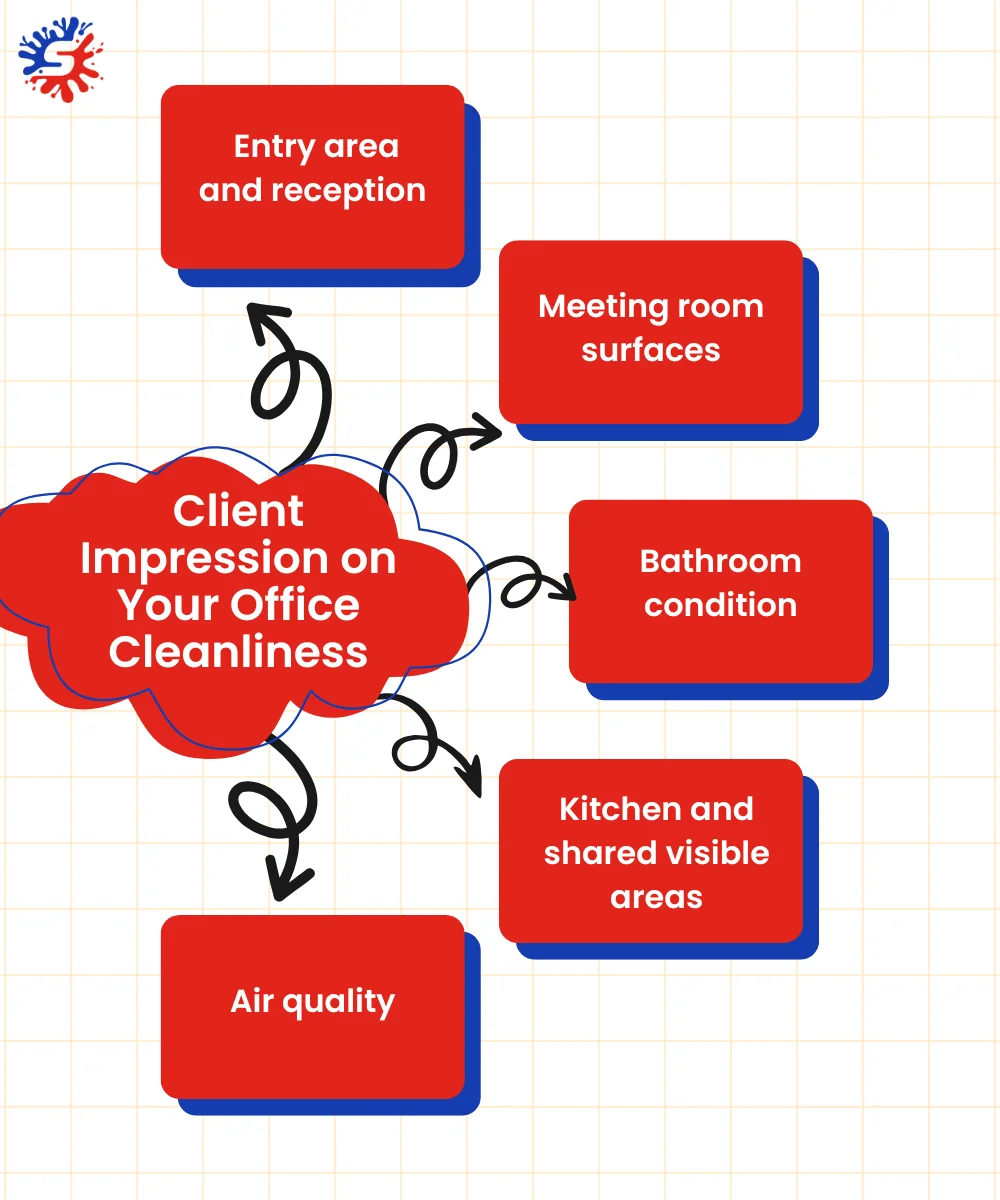
This is closely connected to the principle Sydney CBD businesses have built into their office-cleaning partnerships: the office environment is a direct extension of the brand and is constantly being judged.
The Areas of Your Office That Are Costing You the Most Right Now
Not all areas carry equal risk. Some surfaces in a typical Sydney CBD office account for a disproportionate share of illness transmission, productivity loss, and negative impressions. Here is where the damage concentrates.
The Office Kitchen
The kitchen is where most office hygiene failures originate. The fridge and microwave door handles test consistently as the two most contaminated surfaces in any office environment.
Shared coffee machines, sink areas, and bench tops accumulate bacteria throughout the day and rarely receive anything other than a quick wipe. For the data on exactly what accumulates in shared kitchen environments, our kitchen hygiene statistics are worth reading before your next office inspection.
The Meeting Room
Meeting rooms are cleaned at the end of the day, if at all. During the day, they host back-to-back groups of people who touch chairs, tables, presentation remotes, and markers.
Cross-contamination between groups is continuous. Dust on presentation screens and marks on glass partitions are the first things clients notice when they walk in.
The Bathroom
People will avoid a business in the future after a bad bathroom experience. That figure applies to your office bathroom as much as it applies to a restaurant or pub. Clients use your bathroom during long meetings. Prospective employees use it during interviews. What they find becomes part of how they remember your business.
High-Touch Shared Technology
Keyboards, mice, phones, video conference remotes, and printer touchscreens are constantly shared and almost never cleaned. These are the surfaces most directly linked to the spread of illness among colleagues, and they are almost never on a standard cleaning schedule.
The Entry Area and Floors
The entry area is a first-impression machine. It operates at every visit and shapes the assessment clients make before the first handshake. Dusty surfaces, marks on glass, stained reception chairs, or an entry mat that has absorbed weeks of Sydney weather all contribute to an impression that is difficult to undo once formed.
What a Proper Professional Cleaning Program Actually Covers
The gap between what a standard cleaning contract covers and what a proper professional program addresses is where most revenue leakage occurs.
A standard contract typically covers:
- Vacuuming and mopping floors
- Emptying bins
- Wiping visible surfaces
- Basic bathroom top-up
What that misses entirely:
- High-touch surface disinfection of keyboards, phones, door handles, and shared technology with proper sanitisers and correct contact time
- Kitchen deep cleaning of the fridge, microwave interior, sink drain, coffee machine, and under appliances
- Meeting room sanitisation between back-to-back groups, not just at the end of the day
- Air quality management through filter cleaning and ventilation system maintenance
- Carpet extraction in high-traffic corridors and entry areas where ground-in contamination accumulates over weeks
- Bathroom deep sanitisation of grout, fixtures, and touch points on a schedule that reflects actual usage levels
The distinction between what looks clean and what has been properly sanitised is the foundation of this entire issue. Our guide on the difference between a surface clean and actual commercial sanitisation explains why appearance and hygiene are not the same thing, and why confusing them is where most office cleaning budgets go wrong.
Getting the Strategy Right, Not Just the Frequency
Cleaning more often does not automatically solve the problem. A daily wipe-down of visible surfaces with a general-purpose spray, repeated five times a week, still misses every high-risk surface and will not change your sick day rate.
The strategy that actually stops the revenue leak has three components:
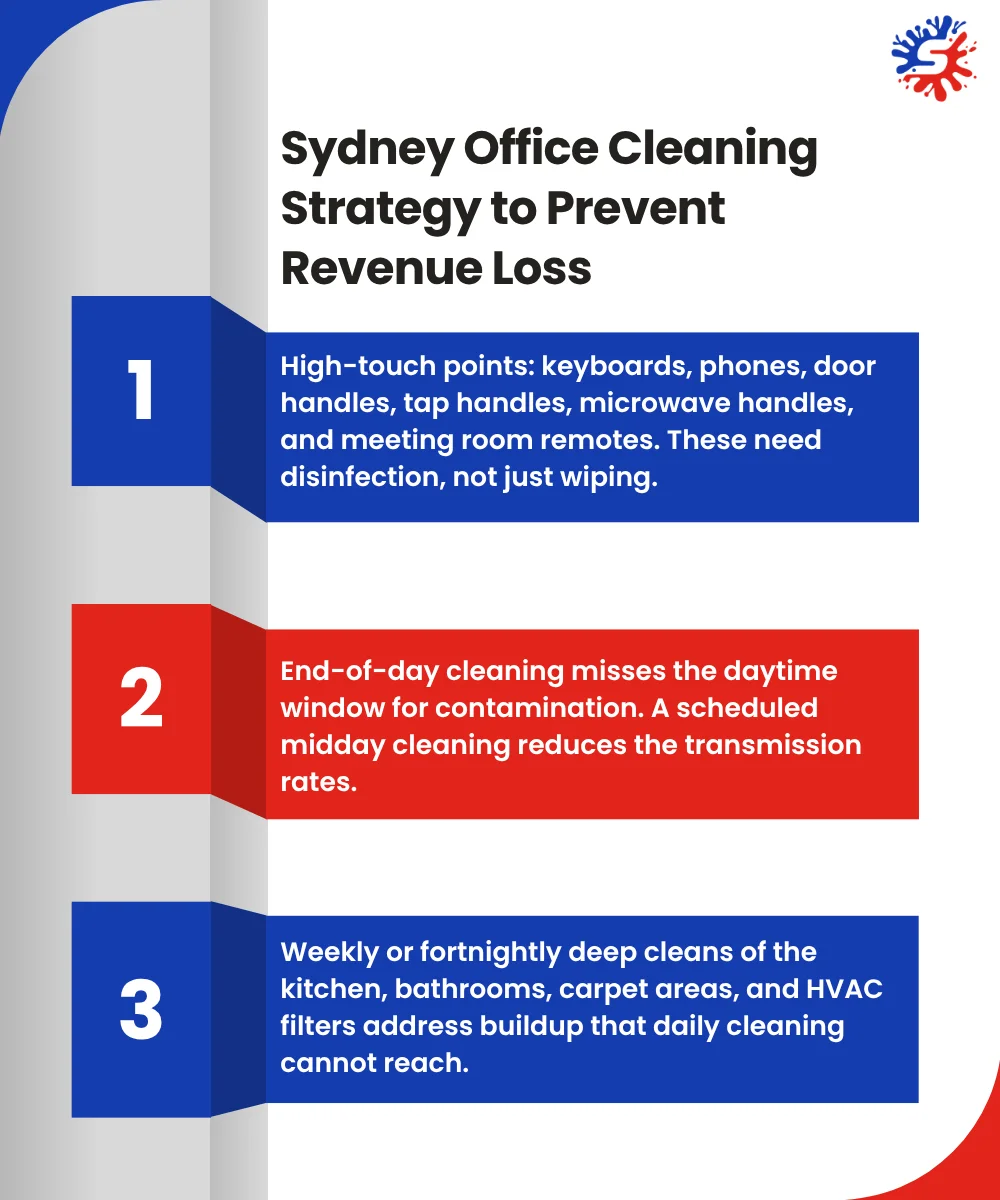
The office cleaning strategy that pays for itself in Sydney breaks down exactly how to structure these three components for a Sydney CBD office, including what to prioritize if your budget requires a phased approach.
Conclusion
The revenue your business loses due to poor office hygiene is not going to a competitor. It is going to sick days that should not happen, to productivity that never quite reaches what it should, to client impressions that land slightly wrong, and to staff who leave for somewhere that feels more professional.
None of these losses appears on a hygiene line in your accounts. But they are there, and the research is consistent in its estimate of their scale: between 10 and 15 percent of monthly revenue is a reasonable estimate for a Sydney CBD business that has not audited and addressed its office hygiene standards.
Contact Spark Clean Australia to book your office cleaning consultation. We will assess your current setup, identify the areas causing the most revenue loss, and implement a program that pays for itself through productivity and retention gains.
You can also explore our full range of office cleaning services in Sydney to see what a proper professional program covers for your business size and office layout.
Frequently Asked Questions
Find quick answers to booking, payments, pet-friendly policies, deep cleaning, and more. Our team is dedicated to making the process effortless and transparent. If you have additional questions, we're here to help ensure a seamless experience.
Get In Touch