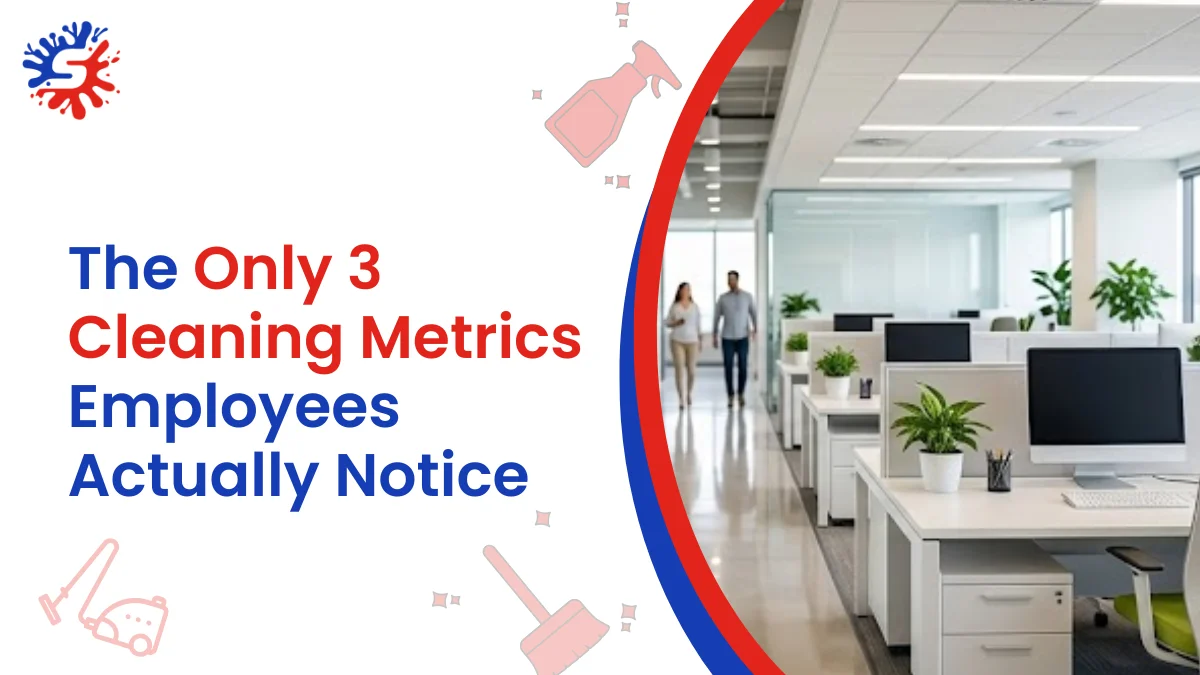
The 3 Office Cleaning Metrics That Actually Impact Employee Productivity
Most office cleaning contracts are built around a long list of tasks. Vacuum the floors, empty the bins, wipe the desks, clean the bathrooms, and whatnot. Every item on that list might be completed to a reasonable standard, and your staff will still arrive on Monday morning and think the office feels grubby.
We know this because we have cleaned more than 200 office spaces across Sydney. We track the feedback, conduct post-service surveys, and ask staff directly what they notice. And the pattern that emerges from that data is clear, consistent, and almost completely at odds with how most cleaning contracts are structured.
Employees do not notice most of what a cleaning contract does. They notice three specific things. The office still feels wrong. Understanding this distinction is the foundation of what Sydney offices are now investing in at scale.
Key Takeaways
-
Standard cleaning contracts focus on tasks, but employees prioritize how an office feels rather than whether a box was ticked.
-
Cluttered shared surfaces act as "visual noise," increasing stress and impairing cognitive performance. A "Surface Reset" protocol is essential for productivity.
-
Employees notice the cleanliness of things they touch (like coffee machines and door handles) far more than the appearance of floors or windows.
-
A specialized end-of-week cleaning brief ensures staff start the week feeling refreshed, not burdened by the previous week's residue.
-
You don't need a new contract; update your existing one by adding a surface reset protocol, a named high-touch zone list, and a differentiated Friday/weekend reset brief.
What 200 Offices Taught Us About What Staff Actually Care About
Over five years of servicing Sydney offices across the CBD, North Sydney, Pyrmont, Surry Hills, and the inner west. Also, we have conducted post-service surveys with staff from businesses ranging from seven-person startups to 300-person corporate tenancies.
We ask the same questions every time: what did you notice? What felt different? What still felt wrong?
The answers cluster into three distinct categories with remarkable consistency across building types, tenancy sizes, and industries. Staff notices clutter on shared surfaces. Staff constantly notice the cleanliness of the things they touch. And staff notice how the office feels at the start of the week, specifically whether the space signals that it was properly reset while they were away.
This finding is consistent with what broader research on workplace hygiene and its direct effect on staff behaviour consistently shows: the psychological relationship between people and their workspace is more nuanced than a cleaning checklist can capture.
Metric 1: Cognitive Load
Of the three metrics, this is the one that most cleaning contracts never touch at all, because it is not technically a cleaning task. It is a surface management task. And it is the one that most directly affects how productive your staff feels the moment they sit down on Monday morning.
The Neuroscience Behind the Clutter Problem
Princeton Neuroscience Institute published a study using MRI scans to examine how visual environments affect cognitive processing.
In plain language: every item on a desk or shared surface that is not the thing you are trying to focus on is actively competing for brain space. The brain has to work to suppress those competing signals. That effort is real, it is measurable on a scan, and it depletes the cognitive resources available for the actual task at hand.
Visual overload also increases cortisol levels (the primary stress hormone), impairs working memory, and slows recovery from mental fatigue. Your staff is carrying this cognitive cost every minute they sit at a cluttered shared desk or conduct a meeting at a table covered in leftover materials from the previous group.
What This Means for Your Cleaning Contract
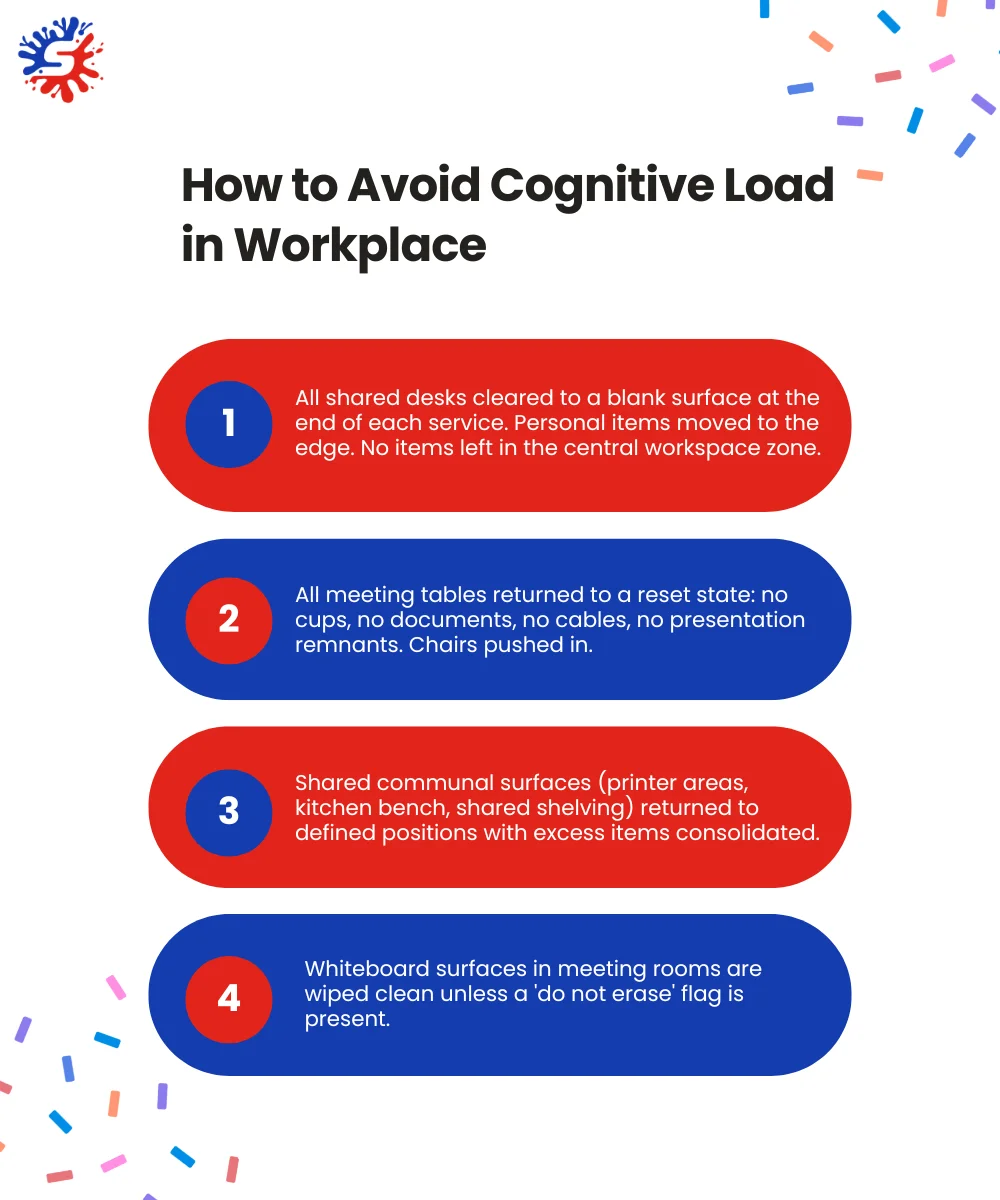
A cleaning routine that addresses cognitive load treats surfaces as active. Shared desks and meeting tables are cleared, reset, and returned to a neutral starting state. Items left behind by the previous occupant are consolidated and placed in a designated location, rather than scattered back across the surface.
The practical steps are simple:
The connection between surface clutter, cognitive load, and the financial cost to a Sydney CBD business is explored in more depth in our analysis of how workplace hygiene directly affects productivity and revenue.
Metric 2: Hygiene Trust
The second metric is the one with the most direct biological stakes. Hygiene trust is whether staff trust that the specific surfaces they touch constantly are actually free of pathogens.
The distinction matters because those two things are not the same. A floor can be spotless, a window can be streak-free, and the coffee machine handle can be carrying bacteria from the hands of forty people that day.
What Lives on the Surfaces Your Team Touches All Day
Sink and microwave door handles in office kitchens are some of the dirtiest surfaces touched by office workers on a daily basis, ahead of bathroom fixtures.
|
High-touch surface |
Contamination level |
|
Office keyboard |
3,000 to 5,000 bacteria per square inch. |
|
Elevator buttons |
More than 40 times the germ count of a public toilet seat. Source: ProEthic |
|
Office coffee cup lids |
20% harbour fecal bacteria in studies. |
|
Microwave door handle |
Consistently among the two or three highest-contamination surfaces in any office building. |
|
Shared conference room phone |
Used by many, rarely cleaned. Harmful bacteria including Streptococcus, MRSA and E. coli detected in studies. |
|
Door handles |
Thousands of colony-forming units including staph and E. coli. Primary cross-contamination pathway between colleagues. |
What Hygiene Trust Requires in Practice
Standard cleaning contracts wipe whatever surfaces are accessible and move on. A hygiene trust-focused routine operates differently. It has a documented list of nominated high-touch surfaces, a defined disinfection protocol for each, a specified dwell time for the sanitising product, and a completion record.
The specific surfaces that need to be on that list in any Sydney office:
-
Coffee machine buttons, handles, and drip tray exterior
-
Microwave door handle and interior touch points
-
Refrigerator door handles
-
All door handles
-
Elevator buttons
-
Photocopier and printer touch panels
-
Meeting room remote controls, conference system touchpads
-
Kitchen tap handles
-
Light switches
The reason most of these surfaces are missed by standard cleaning is covered in detail in our breakdown of why surface appearance and actual sanitisation are two different things. A surface that has been wiped and a surface that has been disinfected to the required contact time are not the same outcome.
Metric 3: Environmental Reset
The third metric is the most psychological of the three, and in some ways the most powerful. It is also the most difficult to write into a cleaning checklist because it addresses a feeling more than a task.
We call it the Monday morning effect. It is the experience of arriving at the office on Monday after two days away and immediately sensing whether the space is ready for you. Whether it has been genuinely reset or still carries the residue of last Friday's rushed afternoon.
This matters because the transition from home to work is a cognitive and psychological shift that happens every single Monday morning for every member of your team. That transition either gets support from the environment or friction from it.
What the Air Actually Does to Monday Morning Performance
People spend approximately 90% of their time indoors, where pollutant levels are typically 2 to 5 times higher than those in the outdoor air immediately outside the same building. An office that has been closed over the weekend with no air circulation has accumulated CO2, dust, VOCs from furnishings and equipment, and any residual particulate matter that settled on surfaces during the week.
When staff arrive on Monday morning, and the HVAC begins its warm-up cycle, it distributes whatever the system has accumulated through every room it serves. A Harvard study involving more than 300 office workers across six countries found that increased indoor CO2 and PM2.5 concentrations were directly associated with slower response times and reduced accuracy on cognitive tests.
What the Monday Morning Reset Looks Like
In our post-service surveys, the question that captures the Environmental Reset metric is this: 'When you arrived at the office Monday morning, did the space feel ready for the week?'
The correlation between a positive answer to that question and three specific cleaning actions is consistent across our entire 200-office dataset:
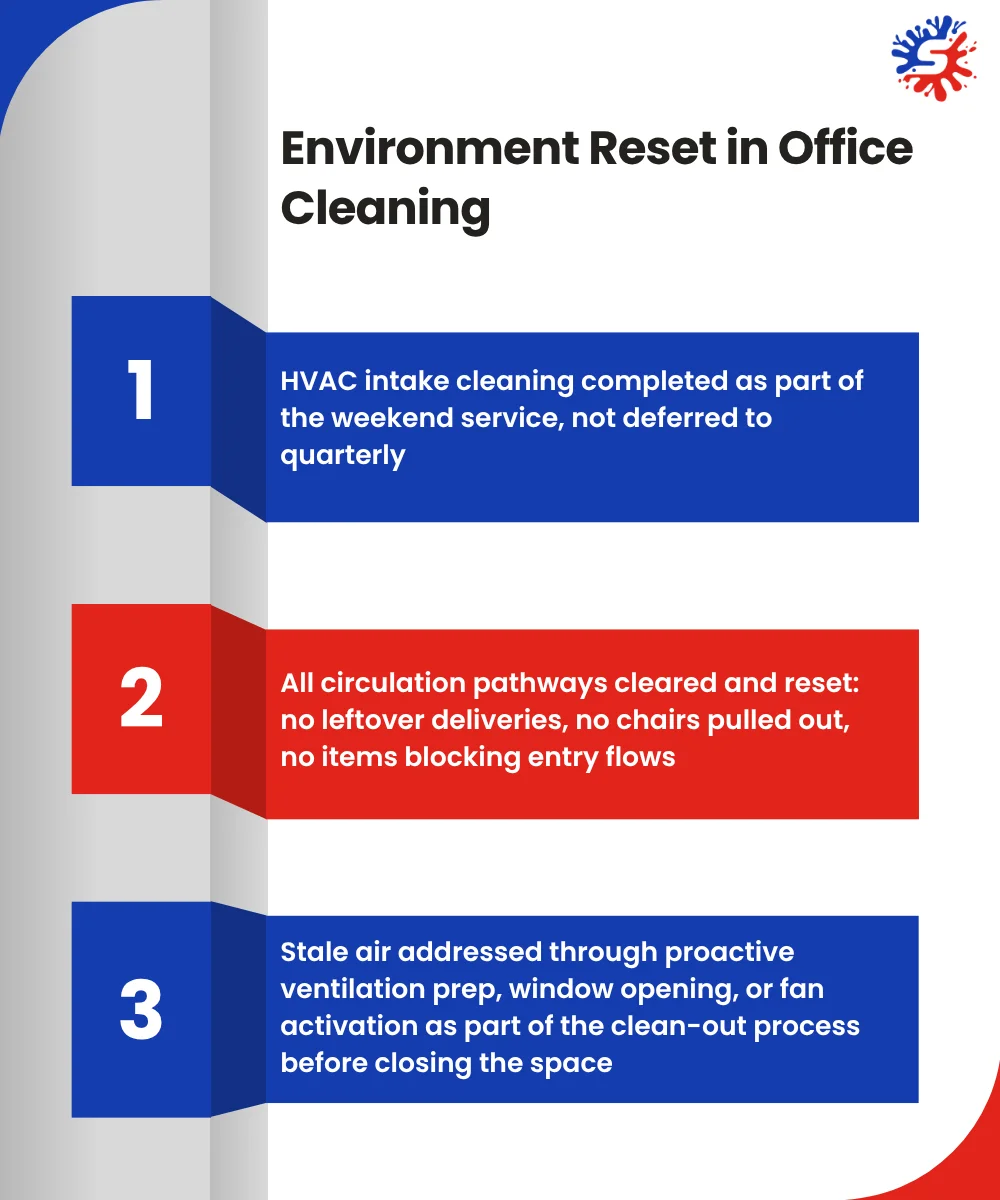
When all three of these actions are completed as part of the Friday or weekend clean, the result in staff experience is measurable:
Why the Monday Morning Reset is Different From a Regular Clean
A Tuesday evening clean and a Friday or weekend clean serve different purposes. The Tuesday clean maintains, and the Friday and weekend clean resets. The specific objectives are different, and the task list should reflect that.
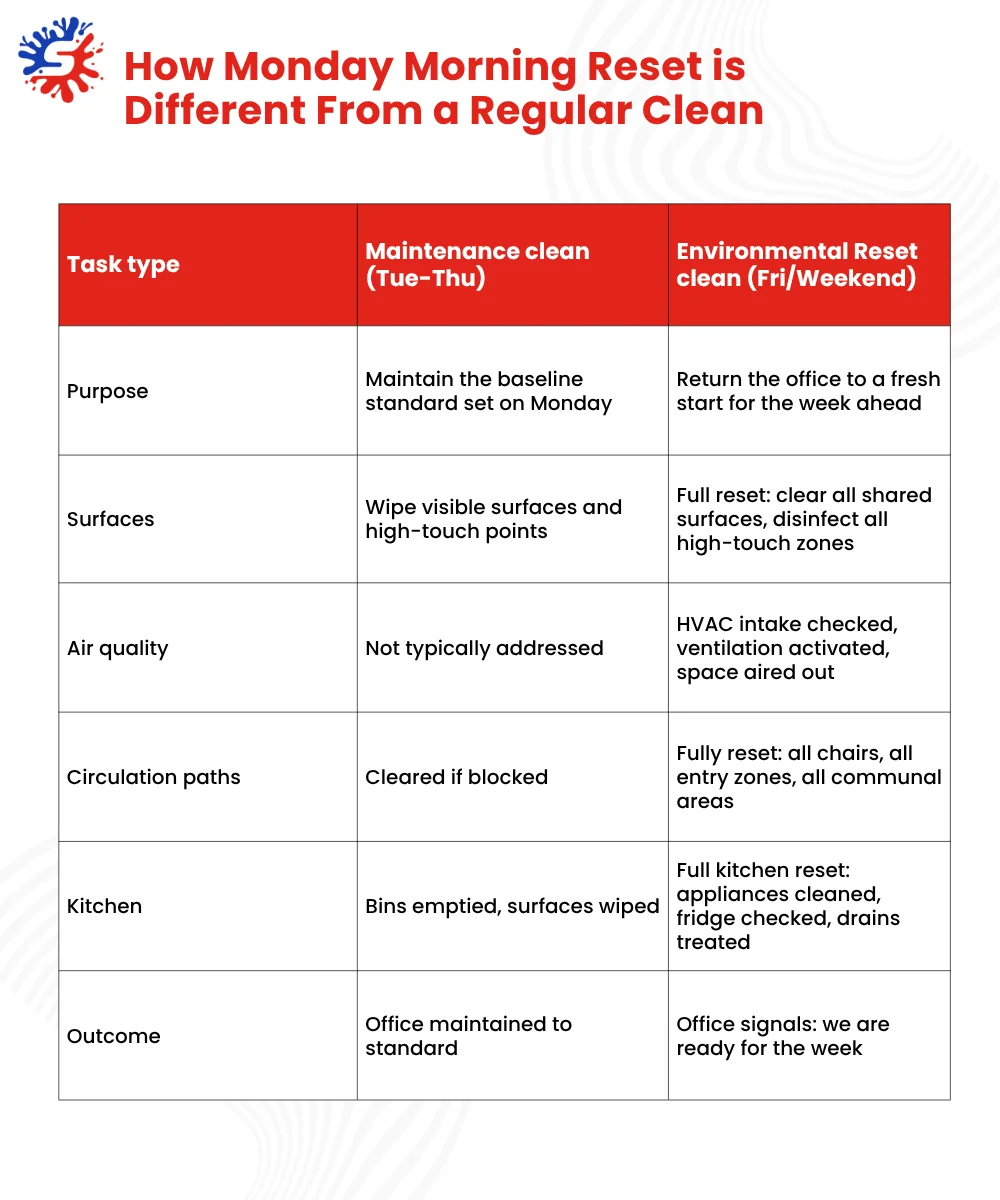
The kitchen element of this reset deserves specific attention. The data on what accumulates in an office kitchen across a working week explains why a proper Friday kitchen deep clean has an outsized effect on Monday air quality and overall space feel, particularly in open-plan offices where the kitchen is never fully separated from the working environment.
How to Apply the Three Metrics to Your Current Cleaning Contract
You do not need to rewrite your entire cleaning contract to start getting better results from these three metrics. You need to introduce three specific additions or amendments.
Amendment 1: Add a Surface Reset Protocol
Ask your provider to add a defined surface reset protocol to your service. This is a documented list of shared surfaces (meeting tables, shared desks, communal bench areas) that will be cleared and reset to a blank state during every clean. It requires a small amount of additional time and produces a disproportionately large impact on perceived cleanliness.
The protocol should specify: which surfaces are in scope, what 'reset' means for each (cleared, wiped, chairs pushed in), and where consolidated items are placed.
Amendment 2: Add a Named High-Touch Zone List
Ask your provider to supply and maintain a documented list of nominated high-touch surfaces in your office, updated when new equipment is added. The list should specify the disinfectant to be used, the required dwell time, and the treatment frequency. Completion should be recorded at each service.
If you are unsure what is currently being done about these surfaces in your existing contract, our 30-second commercial cleaning audit is the fastest way to find out.
Amendment 3: Define the Friday Clean Differently
Ask your provider to operate your Friday or weekend clean to a different brief than your midweek cleans. The brief should explicitly include HVAC intake inspection and clearance, kitchen deep reset, full pathway and circulation zone clearance, and a ventilation step before closing the space.
This is not significantly more time. It is a different focus for the same time. The Monday morning experience of your staff is the outcome you are managing.
The detailed framework for what each amendment should include and how to hold your provider accountable for delivering them is covered in the commercial cleaning best practices guide.
The Three Things Your Team Will Notice Tomorrow
After servicing 200 offices and tracking the pattern of what staff actually notice, the conclusion is simple enough to fit on a Post-it note.
Your team notices whether shared surfaces are clear. They notice whether the things they touch constantly are actually clean or just visibly wiped. And they notice whether the office felt reset when they arrived Monday morning, or whether it still carried the weight of last week.
Everything else is background. Necessary background, but background. When the three metrics are right, your staff describes the office as clean without being able to say exactly why. When the three metrics are wrong, the office feels off, regardless of how many items were ticked on the task list.
If you want to understand whether your current cleaning contract is delivering on these three metrics, contact Spark Clean Australia for a review of your existing service structure. We will assess your current provider's approach against the three metrics, identify the specific changes that would have the greatest impact on your staff's experience, and propose a service structure that delivers outcomes your team actually feels.
Our professional office cleaning service for Sydney businesses is built around these three metrics as standard.
Frequently Asked Questions
Find quick answers to booking, payments, pet-friendly policies, deep cleaning, and more. Our team is dedicated to making the process effortless and transparent. If you have additional questions, we're here to help ensure a seamless experience.
Get In Touch