Restoring a Millers Point Pub Kitchen to 100% Compliance in 48 Hours
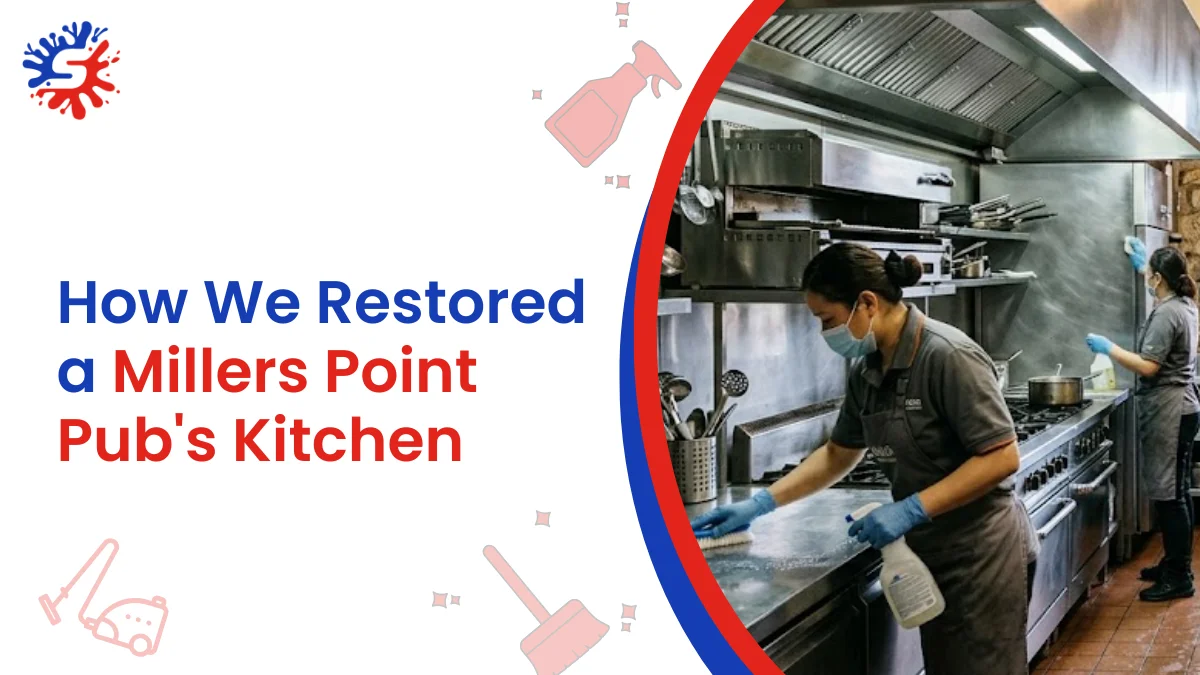
A pub just received a compliance notice following an unannounced NSW Food Authority inspection. The inspector had found grease above the 50-micron limit, drains were blocked, temperature logs were missing, and a rear wall near the fryer had a layer of grease that the report described as presenting an active fire risk.
The re-inspection was booked for Friday morning, which gave us 48 hours.
This is an account of exactly what happened across those 48 hours: what we found, what we did, in what order, and what the Friday morning inspection recorded. We are sharing it because the situation this Millers Point pub found itself in is not rare.
Key Takeaways
- Commercial kitchen compliance failures are often the visible symptom of long-term grease and maintenance neglect.
- A strict cleaning sequence is essential to prevent recontamination of clean surfaces.
- Heavy grease accumulation behind fryers poses a severe, active fire risk because grease ignites at temperatures below routine cooking levels.
- Blocked or gas-producing floor drains act as primary food sources and breeding environments for severe pest infestations.
- Missing temperature logs are viewed by inspectors as a systemic failure to monitor food safety rather than a simple paperwork gap.
- Proactive, scheduled monthly deep cleaning is significantly cheaper than the emergency costs and lost revenue of a forced kitchen closure.
What We Found When We Arrived
Walking into the kitchen on Wednesday afternoon, we knew we had no time to waste. But before picking up a mop or a spray bottle, we had to see exactly what we were dealing with.
The Initial Walk-Through
We arrived at 5 pm on Wednesday. The pub was between service periods, so the kitchen was empty. Our first step was a full walk-through with our site lead and the pub's manager. We were not cleaning anything yet. We were documenting everything.
The inspection report gave us the outline, and the walk-through gave us the details. Every compliance failure is the visible tip of an accumulation that has been building for longer than the report can see.
What the walk-through found:
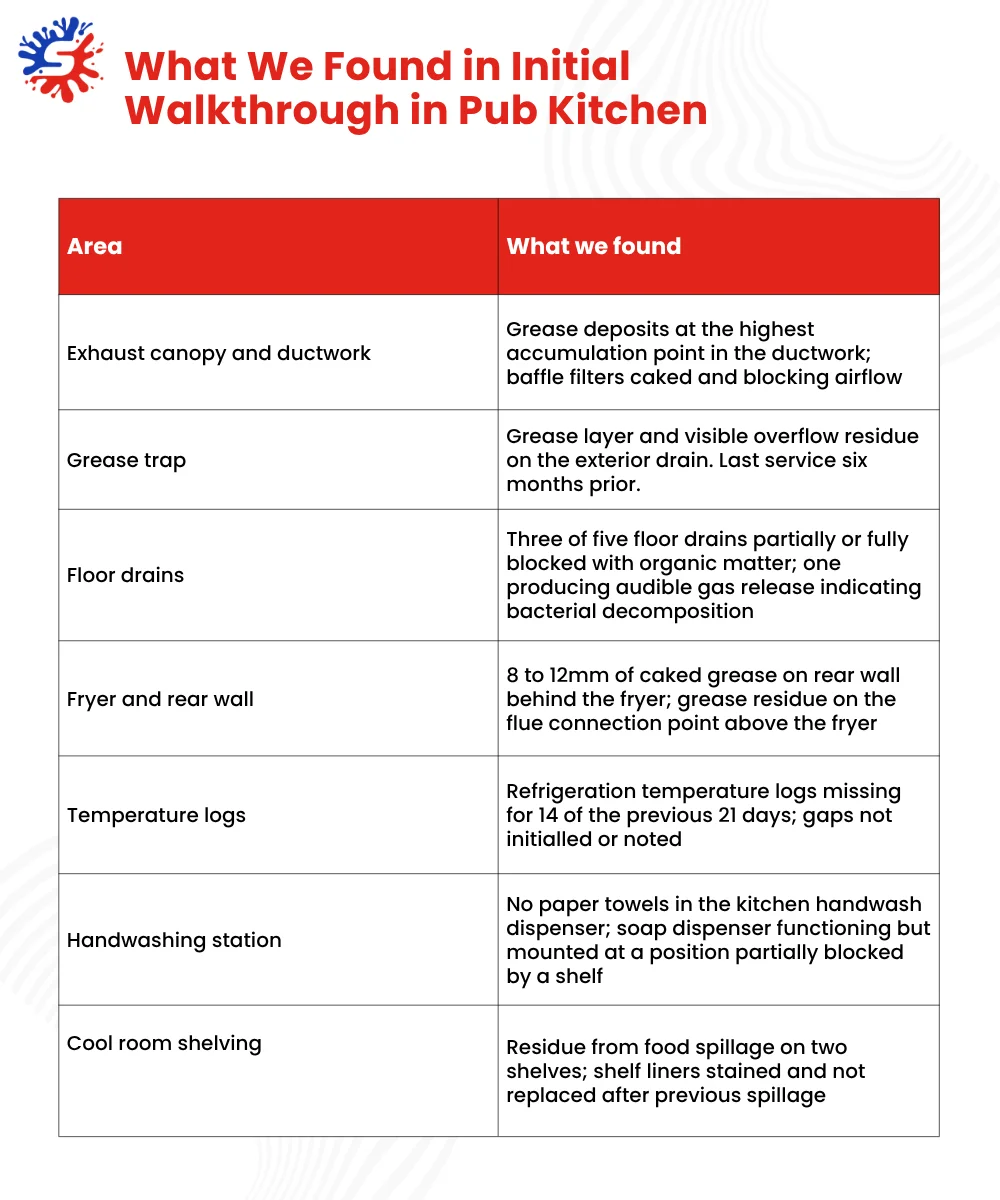
The Assessment That Matters Before the Cleaning Starts
Some failures were straightforward to fix, and two required specialist equipment and significant time. One required a licensed trade waste contractor who needed to be booked immediately.
The assessment is about understanding the order. In a 48-hour compliance restoration, the sequencing determines whether you finish on time. You do not start cleaning the fryer walls before the exhaust system is clear, because cleaning the fryer releases grease aerosol that re-contaminates any surface that has already been wiped.
The same sequencing principle that governs a 48-hour emergency clean governs every professional kitchen clean. It is the practical application of commercial cleaning best practices when applied correctly.
The 48-Hour Restoration Plan
By 6 pm Wednesday, we had the plan. Five phases, structured by dependency and compliance priority. The grease trap contractor was booked for 9 am on Thursday. The ductwork team was arriving at 10 pm on Wednesday for overnight work while the kitchen was closed.
Phase 1: Documentation Audit, Compliance Setup, and Preparation
Site assessment and photo documentation of all failure areas. Compliance matrix created mapping each failure to the applicable standard and the corrective action required. Grease trap contractor booked for next morning. Ductwork team confirmed for 10 pm start. Cool room emptied and temperature probe calibrated for re-logging.
Phase 2: Kitchen Exhaust Deep Clean and AS 1851 Compliance
Baffle filters removed, soaked in alkaline degreaser, hand-scrubbed, rinsed, and reinstalled. Plenum chamber, vertical and horizontal ductwork sections cleaned with rotary brush system and hot pressure wash.
Fan housing cleaned and inspected, and rear wall and flue connection point degreased using commercial-grade alkaline degreaser at correct concentration. Compliance certificate photographs taken at pre-clean and post-clean measurement points. Written certificate prepared for Friday.
Phase 3: Grease Trap Service, Drain Clearing, and Kitchen Equipment Deep Clean
Licensed trade waste contractor arrived at 9 am and pumped and cleaned the grease trap. Service docket produced with date, volume removed, and contractor licence number. Floor drains hydrojetted to remove organic blockage.
Enzymatic drain treatment was applied to all five drains and left to dwell. Fryers, ranges, and cooking equipment are deep-cleaned with appropriate commercial degreasers. Cool room shelving removed, washed, sanitised, and reinstalled.
Handwashing station repositioned with shelf moved 30 cm to clear access. New paper towel dispenser installed and stocked.
Phase 4: Full Kitchen Sanitisation and Floor Deep Clean
All food preparation surfaces, benchtops, splashbacks, and tile walls sanitised with disinfectant at the correct dwell time. Floor drains confirmed clear. Floors scrubbed with commercial degreaser, pressure-washed, and sanitised.
Floor drain covers removed, cleaned, and replaced. All touch points including tap handles, drawer handles, and light switches disinfected. Kitchen equipment wiped down with manufacturer-approved product after degreasing to ensure no chemical residue.
Phase 5: Documentation assembly, final verification, and pre-inspection check
Full documentation pack assembled: AS 1851 exhaust compliance certificate, grease trap service docket with contractor licence number, floor drain treatment records, cleaning completion records for all failure areas, temperature log re-established with probe calibration record, photo evidence set. Final walk-through at 7 am against the original inspection report. All failure areas checked and signed off. Clean, complete.
What Each Phase Actually Involved
Making a plan is one thing, but getting down and dirty to fix heavy grease and blocked pipes is another. Each step of our timeline required specific tools, heavy-duty cleaning products, and proper paperwork to prove the job was done right. Let's look closely at how we tackled each major problem area one by one.
The Exhaust System: The Highest-Risk Item on the List
The exhaust ductwork failure was the most serious item. Blocked ductwork is an active fire risk that no other cleaning can offset. You cannot make a kitchen clean while the exhaust system is a fire hazard.
The canopy, baffle filters, plenum chamber, vertical and horizontal ductwork, fan housing, and rooftop discharge point must all be assessed for grease accumulation. The overnight clean took nine hours. The rotary brush system works through the ductwork mechanically while hot pressure washing removes the softened deposits.
Each section is measured before and after using a calibrated grease thickness gauge. The post-clean certificate includes photographic evidence at each measurement point and the actual micron readings before and after.
Floor Drains: The Most Overlooked Surface in Any Kitchen
Of the five floor drains in this kitchen, three were partially blocked, and one was producing gas, a direct indicator of bacterial decomposition inside the pipe. This is a routine finding in kitchens without a drain maintenance schedule.
The organic material that builds up in commercial kitchen floor drains is exactly the kind of food source and breeding environment that pest control reports flag as a precondition for infestation.
Enzymatic treatment applied after clearing prevents re-accumulation. The enzyme-based product contains bacteria that digest fats, oils, and grease at a biological level, rather than just pushing them further down the pipe. This is the approach that creates a drain that stays clear between cleans rather than one that blocks again within weeks.
The Fryer Wall and Active Fire Risk
The 8 to 12mm of caked grease on the rear wall behind the fryer is not unusual in a kitchen that has been operating without a scheduled deep clean of the cooking zone. It builds slowly across service periods. Each time the fryer is used at high heat, grease aerosol rises and deposits on the wall. Over weeks and months, that deposit becomes a substantial layer.
At 8mm, this is not cosmetically unpleasant. It is a fire hazard. Grease ignites at temperatures well below what a commercial fryer routinely reaches during service. A single oil splash or flare-up in a kitchen with this level of wall buildup creates a fire that spreads before any suppression system has time to activate.
Documentation: The Failure That Costs the Most
Of all compliance failures, the missing temperature logs are the ones that cost the most to fix, not in cleaning time, but in the conversation they require with the pub's management. Missing logs are not a cleaning problem. They are a systems problem.
A food business must have a food safety program that includes documented records of monitoring activities. Refrigeration temperature logs are one of the standard monitoring requirements. Two weeks of missing logs is not just an administrative gap. It is evidence, in the inspector's framing, that the monitoring activity did not happen.
The fix is straightforward but requires commitment: calibrate the temperature probe, establish a new logging sheet with clear daily entry fields, train staff on when and how to fill it, and brief the manager on what 'available for inspection' means in practice. The log must be accessible without having to search for it. It must cover every day, including weekends.
What the Friday Morning Inspection Found
After 48 hours of nonstop work, Friday morning finally arrived, bringing the ultimate test. The government inspector walked back into the kitchen at 9:00 AM sharp to re-examine all the problem spots.
The 9 am Re-Inspection
The NSW Food Authority inspector arrived at 9 am on Friday as scheduled. The kitchen had been out of service since the previous Wednesday. We had completed the final walk-through at 7 am and confirmed every item against the original non-compliance list.
Re-Inspection Result: All Compliance Failures Cleared
-
All five drains confirmed clear and flowing freely; enzymatic treatment logged.
-
Grease removed to bare surface; no residue detectable at inspection.
-
New temperature log in place with calibration record; seven days of entries completed.
-
Soap and paper towels stocked, access cleared at the hand-wash station.
-
Sanitised, liner replaced, no food residue in the cold room.
Outcome: 5-star Scores on Doors rating confirmed. Kitchen cleared to reopen for Friday lunch service.
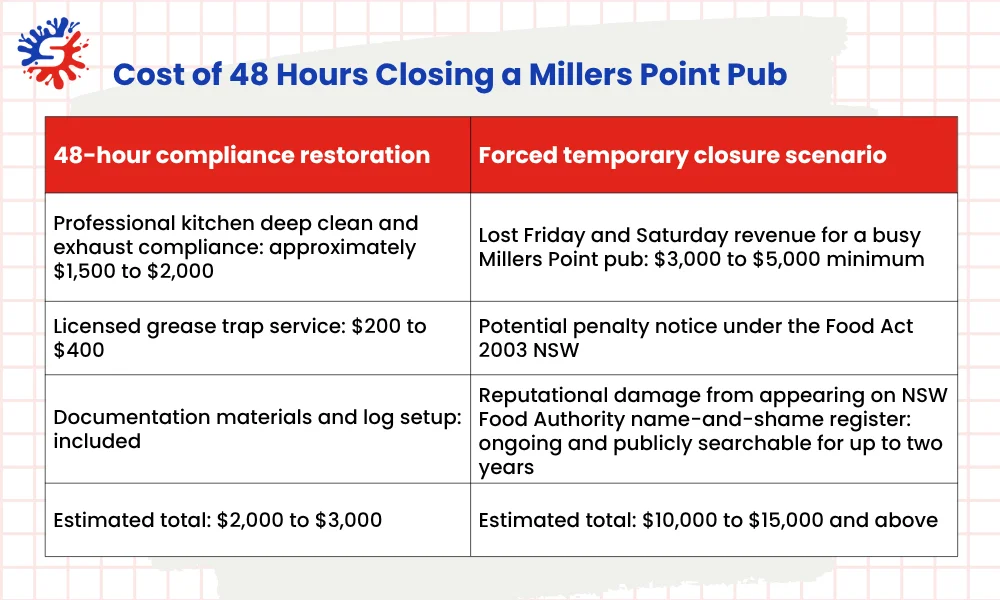
What the 48 Hours Cost vs What Staying Closed Would Have Cost
This is a comparison the pub's manager made when we handed over the final documentation folder on Friday morning.
Conclusion
The pub reopened on Friday and has been on a scheduled monthly deep-clean program since then. The exhaust compliance certificate is current. The grease trap docket is in the folder, and the temperature log has not had a gap since April.
If your Sydney pub kitchen has compliance gaps you know about or suspect, contact Spark Clean Australia for an assessment. We work across Millers Point, The Rocks, Barangaroo, and the wider inner-Sydney precinct, and we can tell you within an hour of walking through your kitchen exactly where the gaps are and what it takes to close them.
Our hospitality cleaning services cover all compliance-critical areas as standard: AS 1851 exhaust cleaning with certificates, licensed grease trap coordination, enzymatic drain maintenance, temperature log setup, and a documented audit folder delivered with every deep clean.
Frequently Asked Questions
Find quick answers to booking, payments, pet-friendly policies, deep cleaning, and more. Our team is dedicated to making the process effortless and transparent. If you have additional questions, we're here to help ensure a seamless experience.
Get In Touch