The $150K Blunder Caused a Top Sydney CBD Law Firm Lose a Whale Client
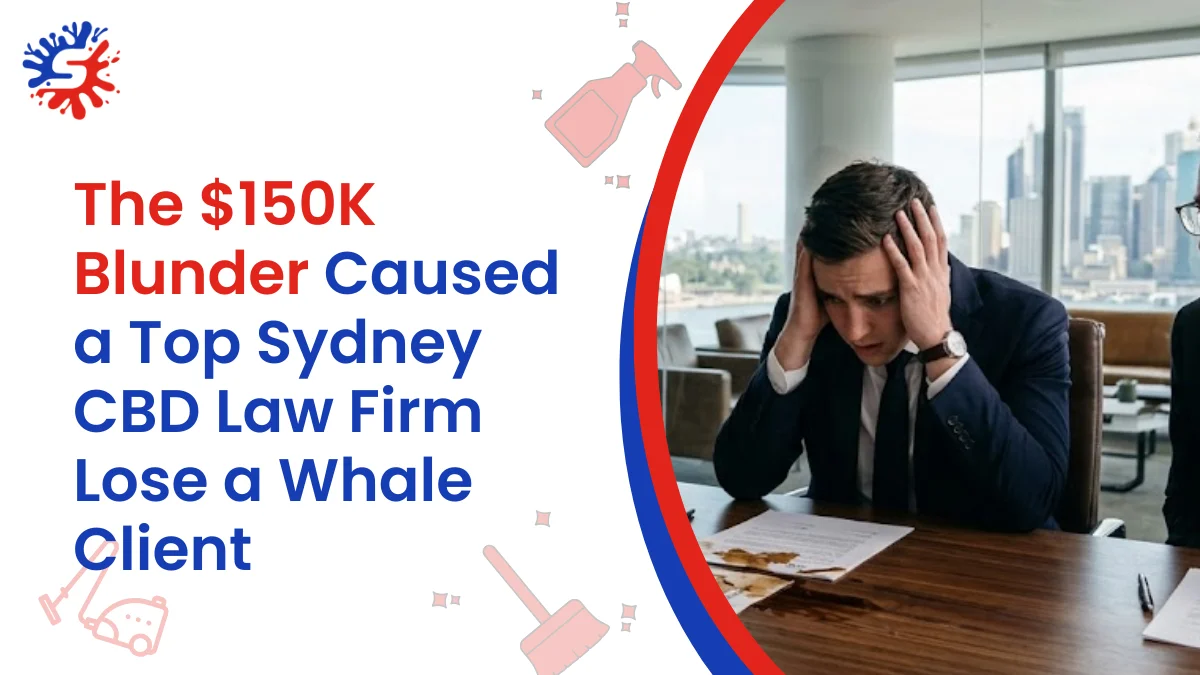
There is a type of client loss that leaves no trail. No complaint letter, no conversation, or no negative review filed that evening. A senior general counsel or procurement director walks into a Sydney CBD law firm, sits through a pitch that goes well on paper, shakes hands at the door, and never reaches back.
The partners debrief and revisit the proposal. They question the price point, the team structure, and the pitch deck. Nobody questions the room.
This is the mistake that costs Sydney law firms far more than they realise. And the cause, in more cases than any managing partner wants to acknowledge, is a boardroom that was not ready for the meeting it was being used to host.
Key Takeaways
- Clients form an opinion about a business based on the cleanliness of its facilities before any substantive interaction begins
- Only 1 in 26 dissatisfied clients will actually tell the business about a bad experience; the other 25 leave without saying a word
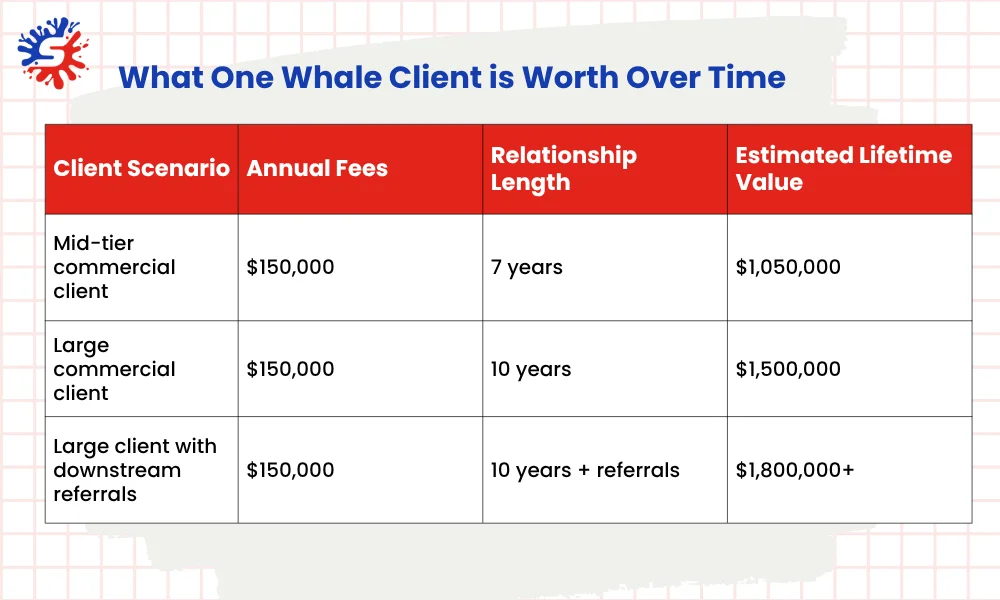
- A client generating $150,000 annually can represent over $1 million in lifetime value across a typical 7 to 10-year legal relationship
- The boardroom is the most commercially critical room in any law firm, and in most firms, the least specifically maintained
- A professional pre-meeting boardroom clean costs a fraction of one month's fees from a single retained client
The Legal Market That Cannot Afford These Mistakes
Sydney's CBD hosts the densest concentration of top-tier and mid-tier law firms in Australia. They are competing in a market valued at $35.5 billion in 2025, which is growing year on year.
A whale client, broadly defined as a commercial account generating $150,000 or more annually in legal fees. It is a relationship with referral power, reputation weight, and compounding value that extends across years. For many boutique CBD firms, a single major client can account for 20% or more of total annual billings.
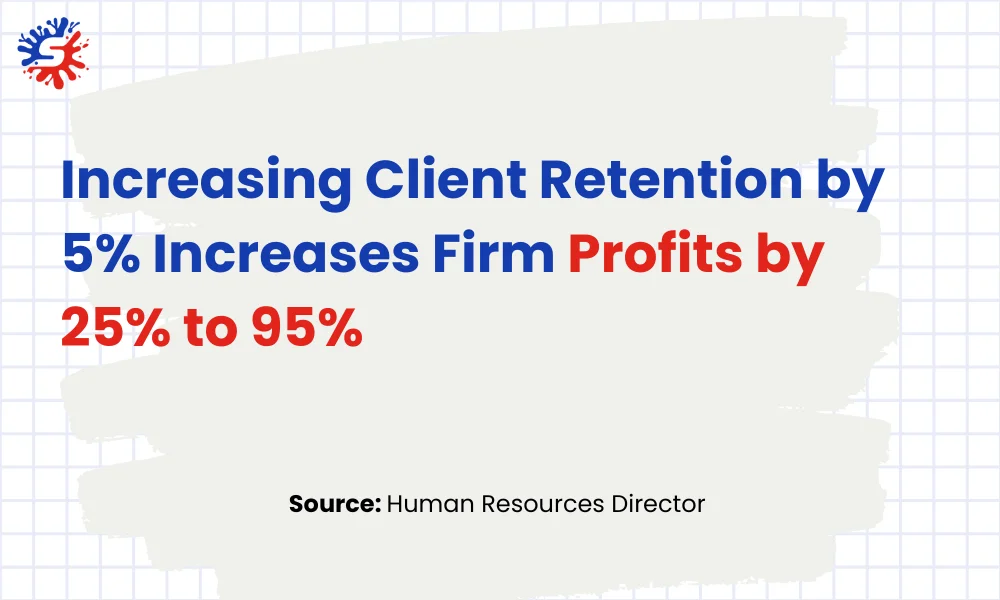
Research has found that increasing client retention by just 5% can increase firm profits by 25% to 95%. The reverse calculus is just as precise. Losing a whale client, including one the firm never identifies, produces a compounding loss that outlasts the relationship itself.
That is the financial context for a smudged boardroom table.
What the Room Tells a Client Before Anyone Speaks
A general counsel arriving at a law firm for an initial scoping meeting is not walking in blind. They have spent years evaluating service providers. They carry professional pattern recognition that operates faster than conscious thought.
In business environments, people judge your firm in as little as a tenth of a second. By the time the lead partner extends a hand, the client's mental file on the firm is already partly written. The room is writing it.
What Gets Assessed in the First 90 Seconds
These are not things a client is consciously auditing. They are signals the brain processes automatically and associates with competence, reliability, and care.
-
The table surface. Rings from yesterday's coffee cups, smearing from a previous presenter's arm, or a film left by a damp cloth used without the right product. Each one reads as: this team did not prepare for me.
-
The glass panels and windows. Fingerprints on glass are among the most commonly cited sources of negative impressions in the office. They communicate that the space is used heavily but not maintained between sessions.
-
The chair arrangement. A boardroom where chairs are in a post-meeting scatter, slightly pulled out, uneven, tells a visitor the last meeting ended, and nobody reset the space.
-
The AV equipment. Tangled cables, a remote with no batteries tested in advance, or a screen still showing the previous session. Each one signals a failure of preparation.
-
The smell of the room. Air carrying the residue of a previous meeting, whether food, coffee, or simply the accumulation of a full day of occupation, tells a client the space has not been freshened between uses.
The Halo Effect Working Against the Firm
When a clean, well-prepared room signals professionalism, the halo effect generates positive associations across every subsequent element of the meeting. The partners seem more capable. The pitch materials seem more considered. The team seems more reliable.
When the room is not ready, the halo works the other way.
A single negative physical impression triggers a chain of associated negative assumptions. A client who notices the table has not been cleaned begins to wonder what else the firm has not prepared for. That is the specific damage a smudged table does in a $150,000 pitch meeting.
|
What the Client Sees |
What the Client Concludes |
|
Smudged conference table |
"They don't check the small things." |
|
Fingerprints on glass panels |
"If this slips past them, what else does?" |
|
Stale smell in the room |
"This space hasn't been properly cared for." |
|
Cluttered or untested AV equipment |
"They aren't fully prepared for this meeting." |
|
Water rings on the table surface |
"The last meeting finished and no one cleaned up." |
The Surfaces That Actually Carry Contamination in a CBD Boardroom
Most firms think of boardroom cleaning in visual terms. The real issue runs deeper than appearance.
A Kimberly-Clark study tested office surfaces across multiple environments and found high contamination on conference room fixtures, table surfaces, door handles, and shared equipment. Gerba's research tracked how a single virus placed on one office surface spread to 60% of common surfaces within four hours of the workday.
The boardroom is used by multiple teams across multiple sessions every day. The contamination it accumulates between professional cleans is invisible to the eye. The impression it creates when a client touches a surface, picks up a remote, or leans on a chair arm is not invisible at all.
The Conference Table
The primary meeting surface in any boardroom experiences direct hand contact, arm contact, and food and drink residue throughout the day. A wipe-down with a damp cloth, does not clean the table. It smears the contamination across a larger surface area and leaves a visible film when the surface dries.
Proper table cleaning requires a surface-appropriate product, the correct contact time, and a clean microfibre application. The difference in result between an in-house wipe and a professional clean is visible under direct boardroom lighting. It is immediately obvious to a client sitting on the other side.
The AV Remote, Shared Equipment, and High-Touch Points
The AV remote control is among the most contaminated objects in any professional office. It is touched by every participant in every meeting, never individually cleaned, and rarely included in any standard office cleaning checklist.
Shared conference-room equipment has some of the highest bacterial levels in any office environment. A client who picks up a remote to advance a presentation slide is in direct contact with that load. Chair armrests, light switches, door handles, and shared pens carry the same accumulated contamination from every meeting preceding the one that matters most.
The Silent Client Exit and the Revenue Behind It
Here is the specific commercial problem with a boardroom that makes a poor impression on a prospective client.
The client does not say anything. Research from CXM World puts a precise number on this pattern: only 1 in 26 dissatisfied clients will actually tell a business about a bad experience. The other 25 leave without a word, no debrief, no feedback email, and no opportunity for the firm to identify what went wrong and fix it.
The managing partner puts the pitch loss down to price, fit, or timing. The proposal is refined for the next opportunity. The boardroom is left exactly as it was.
What One Whale Client is Worth Over Time
The lifetime value of a major commercial client at a Sydney CBD law firm extends well beyond the first year's fees.
The true cost of losing a client includes not just the direct revenue, but the referral network that the retained client would have activated. A whale client that leaves before the relationship properly begins takes that entire downstream value with them.
The Three Zones a Prospective Client Judges on Every CBD Law Firm Visit
A commercial client walking into a Sydney CBD law firm for a significant meeting moves through three distinct zones. Each one builds or erodes confidence before the pitch even opens.
Zone 1: Reception and Lobby
This is the first physical contact with the firm's environment. The reception counter, lobby seating, floor surface, and entry glass all form the initial impression before a single word is exchanged.
TechBullion's analysis of office cleaning and client impressions identifies the reception area, conference rooms, and restrooms as the highest-impact areas during any client visit. These spaces determine perception before substantive conversation begins. They are doing the firm's first impression work, with or without anyone's attention.
Zone 2: The Walk to the Boardroom
The route from reception to the meeting room is not a neutral space. It is an extended first impression. Clients observe the condition of the working office, corridors, shared glass walls, and the overall environment they are being led through.
A dirty office reflects poor management. Also, employees would not recommend a business with poor office hygiene. This means the firm's own people are noticing the same signals that visiting clients notice.
Zone 3: The Boardroom
This is where the deal is confirmed or quietly closed off before the pitch starts. The conference room is potentially the most important room in any law firm. It is where the firm's identity is most directly communicated to prospective clients, through every surface, every object, and every sensory detail the room contains.
A professional cleaning program that does not specifically address conference room preparation before client meetings is missing the most commercially critical space in the building.
What Client-Ready Actually Means for a Sydney CBD Boardroom
There is a gap between what looks acceptable to the people who use the room every day and what a client-ready boardroom actually requires. Our piece on the difference between looking clean and being sanitised covers this distinction in full.
For a Sydney CBD law firm, client-ready means meeting a consistent standard across three separate dimensions before every significant visit.
Surface Standards
-
Tabletop cleaned with an appropriate product that leaves no streak, film, or visible residue under direct light
-
Chair backs, armrests, and bases free of fingerprints, marks, and skin-contact residue
-
Glass panels, partitions, and windows are streak-free on both sides
-
AV remote, shared equipment, and cables cleaned and neatly arranged
-
Presentation screens free of dust and smearing
Sensory Standards
-
Air in the room is fresh, with no residue from the previous meeting's food, coffee, or occupation
-
No material from prior sessions left on the table or chairs
-
Waste bins are emptied and relined before the meeting begins
Pre-Meeting Reset
This is the step most firms skip entirely. A professional reset of the boardroom immediately before a high-value meeting takes fewer than 15 minutes. TechBullion's office cleaning and first impressions analysis found that a pre-client checklist completed before each visit makes a measurable difference in how clients experience a space from the moment they arrive.
The ROI on Boardroom Cleaning Is Not a Cleaning Metric
Firms that think of boardroom maintenance as an operational cost are solving the wrong problem. It is a business development investment with documented financial returns.
|
What Improves |
The Measured Return |
Source |
|
One-star improvement in cleanliness perception |
One-star lift in overall firm or business rating |
|
|
One-star overall rating improvement |
5% to 9% direct revenue increase |
|
|
5% improvement in client retention |
25% to 95% profit increase |
|
|
Eliminating the silent rejection trigger |
Retained lifetime client value of $1M+ |
Internal analysis, Spark Clean Australia |
The cost of a commercial cleaning service for a Sydney CBD office, including regular boardroom maintenance and pre-meeting resets, is a fraction of one month's fees from a single retained client. The cost of losing that client to a competitor whose room was ready is measured in years of compounding revenue.
You can read the detailed breakdown of how every dollar spent on professional cleaning yields a higher return for Sydney commercial businesses in our dedicated analysis.
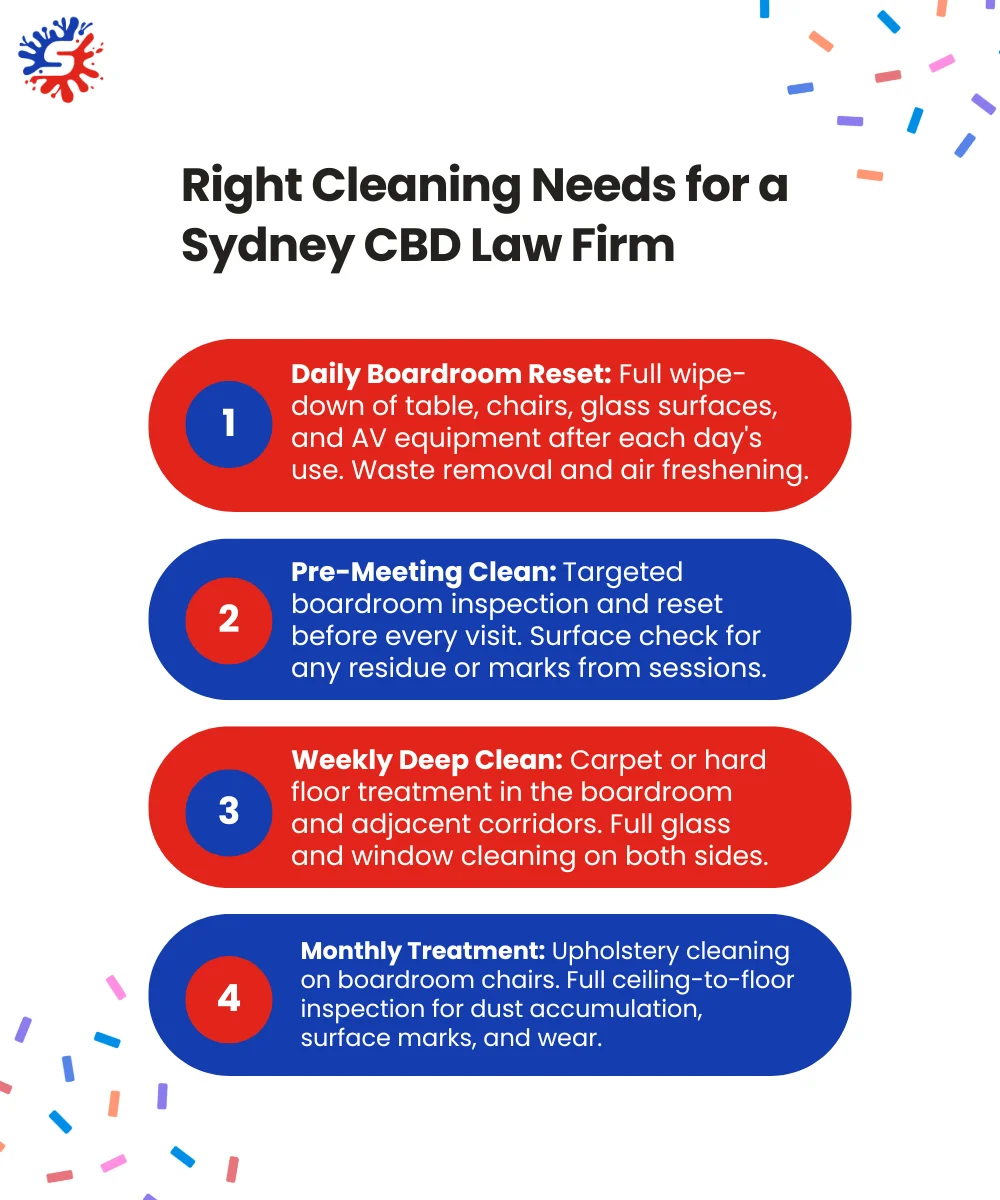
What the Right Cleaning Schedule Looks Like for a CBD Law Firm
Most commercial office cleaning contracts are built around general office maintenance. They are not built around client-visit readiness. For a law firm, these are not the same thing. A 30-second audit of your current cleaning standards often reveals exactly where the gap sits.
A cleaning program designed around a CBD law firm's commercial needs should include:
The Competitive Pressure Pushing This Issue Up the Priority List
Client visits to professional offices are accelerating. Workspace management research from Robin found a 147% increase in in-person client visits since early 2024. More clients are attending in-person meetings. The volume of use in conference rooms across Sydney CBD is rising. The cleaning protocols at most firms have not changed to reflect this.
As we cover in our analysis of why Sydney offices are now investing over $20 billion in hygiene standards, the broader commercial sector is already responding to this shift. Law firms are not exempt from the same raised expectations.
The Sydney CBD firms that understand the commercial stakes of their physical environment treat the boardroom as a client-facing asset. The firms that treat it as a facility afterthought are quietly losing business they will never be able to trace back to the room where it happened.
Conclusion
The $150,000 boardroom blunder does not announce itself. The client walks in, forms a judgment, says nothing, and leaves. The firm never learns why the pitch did not land.
The fix is not complicated and not expensive. It is a professional cleaning program that treats the boardroom as the most commercially important room in the building because, for a law firm pitching to whale clients in Sydney's CBD, it is exactly that.
The commercial cleaning services we provide for Sydney CBD professional offices are built around client-visit readiness. We work around your scheduling, cover the pre-meeting reset that most in-house routines miss entirely, and maintain the boardroom standards.
If you want to understand what a client-ready cleaning program looks like for your office, contact Spark Clean Australia for a consultation.
Frequently Asked Questions
Find quick answers to booking, payments, pet-friendly policies, deep cleaning, and more. Our team is dedicated to making the process effortless and transparent. If you have additional questions, we're here to help ensure a seamless experience.
Get In Touch